Ideas & reading guides
Isis Unveiled or The Secret Doctrine: Which Blavatsky Book First?
If you want to read H. P. Blavatsky, the first decision is usually between Isis Unveiled and The Secret Doctrine. Both are long, both come in more than one volume, and both are famous. They are also very different books, written eleven years apart for different purposes. This guide explains what each one is and suggests a sensible order, including the shorter book many readers overlook.
Blavatsky's claims about ancient wisdom, hidden Masters and the history of humanity are presented here as her teaching. They are not established history or science, and the books are best read with that distinction in mind.
The short answer
For most readers, the order that works best is:
- The Key to Theosophy (1889), Blavatsky's own question-and-answer introduction.
- Isis Unveiled (1877), her first major work, polemical and wide-ranging.
- The Secret Doctrine (1888), her systematic cosmology and account of human origins.
If you already know you want her mature system, you can go straight from The Key to The Secret Doctrine and return to Isis later.
Isis Unveiled (1877): the argument against materialism
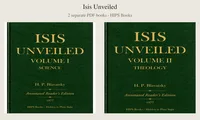
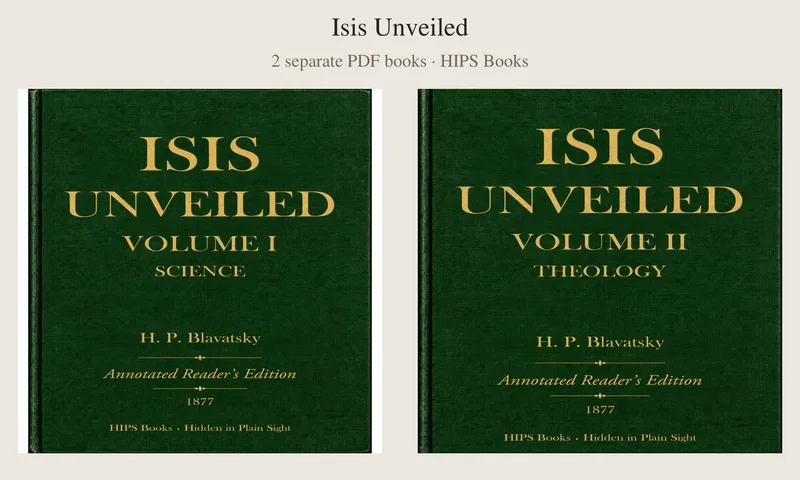
Isis Unveiled was Blavatsky's first large book, published in New York in 1877, two years after the Theosophical Society was founded. It has two volumes with revealing subtitles:
- Volume I: Science challenges the materialist science of her day. It ranges across classical philosophy, mesmerism, Spiritualist testimony and reported phenomena, and argues for what she calls an ancient Wisdom-Religion.
- Volume II: Theology turns to religion, especially Christianity, comparing symbols and doctrines across traditions to argue for shared hidden origins.
It reads as an argument with her contemporaries: crowded with quotations, digressions and controversy. That makes it lively but uneven. It is not yet the organised system of her later work, and a similarity between two symbols, which she often treats as evidence of shared origin, is not proof of borrowing.
The Secret Doctrine (1888): the system
The Secret Doctrine appeared in London in 1888, also in two volumes:
- Volume I: Cosmogenesis builds a cosmology around the "Stanzas of Dzyan" with Blavatsky's commentary: cycles of manifestation, the One Reality and the origin of the universe.
- Volume II: Anthropogenesis describes her account of human origins, including root-races and lost continents.
This is the book most later esoteric writers took as their reference, and it is more structured than Isis. It is also harder: dense, technical and full of terms she defines as she goes. Some of its racial hierarchies reflect nineteenth-century assumptions and need to be read critically.
What about Volume III?
A third volume was published in 1897, six years after Blavatsky's death, from her papers as arranged and edited by Annie Besant. It is not a volume Blavatsky published in 1888. Its contents and editing have been debated ever since, so read it as a posthumous collection of related material.
The Key to Theosophy (1889): the overlooked starting point
The Key to Theosophy was written as an introduction. A questioner and a Theosophist talk through what Theosophy is, how it differs from Spiritualism, and what it teaches about karma, reincarnation, the soul and life after death. It is far shorter than either major work, and because Blavatsky wrote it to explain her ideas plainly, it is the best way to learn her vocabulary before tackling the longer books. Our guide to karma and reincarnation in The Key to Theosophy covers its central ideas.
Side by side
| Isis Unveiled | The Secret Doctrine | The Key to Theosophy | |
|---|---|---|---|
| First published | 1877, New York | 1888, London (Vol. III 1897) | 1889 |
| Purpose | Polemic against materialism and dogma | Systematic cosmology and human origins | Introduction in dialogue form |
| Style | Wide-ranging, argumentative | Dense, structured, technical | Plain question and answer |
| Best for | Readers interested in her 19th-century debates | Readers who want her full system | Beginners |
Reading them without getting lost
- Use one volume at a time. Each volume of Isis and The Secret Doctrine can be read on its own, so don't try to finish a whole set before starting.
- Keep a vocabulary list. Terms such as Manvantara, Pralaya, Akasha and root-race return constantly. HIPS editions put a vocabulary page before each section for this reason.
- Read claims as claims. Blavatsky presents her sources and Masters as authoritative. A reader can follow the argument while keeping the question of evidence open.
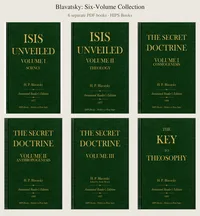
If you plan to read all of them, the six-volume collection contains Isis Unveiled I–II, The Secret Doctrine I–III and The Key to Theosophy as separate PDFs.
Sources and edition notes
- Primary texts: H. P. Blavatsky, Isis Unveiled (1877), The Secret Doctrine (1888; Volume III 1897, ed. Annie Besant) and The Key to Theosophy (1889), as prepared in the HIPS reader's editions linked above.
- For background on Blavatsky's life and the disputes around her claims, see our article Helena Blavatsky: Her Life, Books and Lasting Influence, and on the three volumes, The Secret Doctrine Explained.