About the book
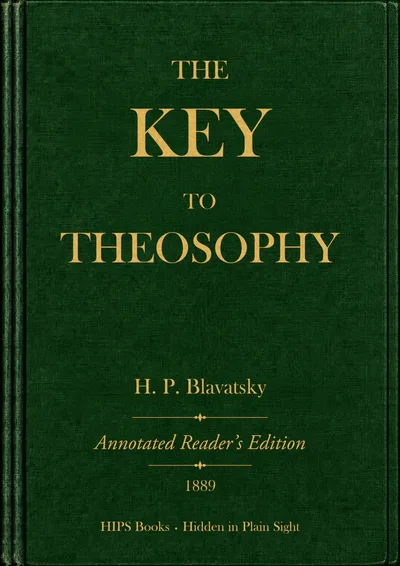
What does Theosophy mean, and how does it explain karma, the soul and life after death? The Key to Theosophy approaches those questions as a conversation. An Enquirer challenges a Theosophist, who answers objections, explains unfamiliar terms and argues for the movement’s view of human life. First published in 1889, it offers a more direct route into H. P. Blavatsky’s ideas than the much larger Secret Doctrine.
The opening sections distinguish Theosophy from membership in the Theosophical Society. Blavatsky discusses the Society’s objects, its relationship to religion, and the differences she sees between Theosophy, occultism and spiritualism. The dialogue then turns to God and prayer, nature and humanity, and the sevenfold account of the human being. Her distinction between personality and individuality is central to the later discussion of rebirth.
Questions about memory, reincarnation and post-mortem consciousness lead into explanations of Kama-Loka and Devachan. These are terms within the book’s religious philosophy, not descriptions established by modern science. Karma is considered alongside responsibility, rather than simply as a promise that good fortune will follow good behaviour. The later sections ask how belief should affect ordinary life: duty, charity, self-improvement and the practical conduct of a Theosophist.
For readers who have encountered Blavatsky through a quotation or a modern introduction, the dialogue makes it possible to follow her own reasoning and its limits. The objections matter as much as the answers. This is an argument from within nineteenth-century Theosophy, not a neutral account of every religion or a modern textbook on psychology. Dated religious, racial and scientific claims remain part of the historical text and are not endorsed by this edition.
HIPS Books keeps the Victorian wording rather than paraphrasing it into modern English. Short vocabularies before the sections help you approach difficult terms; clearly marked guides after them offer summaries, key ideas and questions for reflection. Read the historical dialogue first, then use the guide to revisit an argument or compare it with your own understanding. The editorial additions do not replace Blavatsky’s answers.
What this edition includes
One searchable English-language A4 PDF, 198 pages. Includes the dedication, preface, fourteen sections, Conclusion, original Appendix and 57 linked historical notes. The later glossary added in 1890 is not included in this 1889-based edition.
Clickable contents, PDF bookmarks, section vocabularies and reader guides support screen reading and personal printing. The original title-page facsimile is included. This is a fixed-page PDF, not a reflowable EPUB; small screens may require zooming. No physical book is shipped. AI-assisted preparation and the new cover are distinguished from the historical text.
Inside the book: selected contents
A reading overview, not the complete text.
- Theosophy and the Theosophical Society: the dialogue explains the name and the movement’s stated aims.
- Exoteric and Esoteric Theosophy: Blavatsky distinguishes public teaching, inner study, occultism and spiritualism.
- Human nature and life after death: later exchanges develop her distinction between the changing personality and the continuing individuality.
- Karma and reincarnation: the question-and-answer format addresses moral consequence and rebirth within her system.
- Practical conduct: the book also discusses duty and the behaviour expected of a Theosophist.
This is an introduction to Blavatsky’s position, not an impartial statement of what every religion or Theosophist believes.
Key concepts for reading
HIPS editorial explanations of the historical text.
- Karma: moral causation as Blavatsky explains it, not a scientifically demonstrated accounting of events.
- Reincarnation: the return of a continuing spiritual individuality through successive lives in her teaching.
- Personality: the particular person associated with one life.
- Individuality: the enduring spiritual identity she contrasts with personality.
- Exoteric and esoteric: outward or publicly available teaching, contrasted with inner or restricted interpretation.
Before you buy
How is this different from an archive scan?
An archive scan preserves photographed pages. This is a prepared reading edition: reset text and modern reading support, with the historical author’s words kept distinct. The edition details and preview pages above show what is included in this particular book.
What will I receive, and where do I buy it?
This is a digital PDF edition, not a printed book. The Etsy listing is the place to check the current PDF price and delivery details, and to complete your purchase. Payment and digital delivery are handled by Etsy.
Can I read or print the PDF?
You can read a PDF in a compatible viewer on a computer or tablet. Check the Etsy listing and the edition’s terms for printing permissions and paper size before buying. PDF support and navigation vary by device; this is not an EPUB or a physical copy.