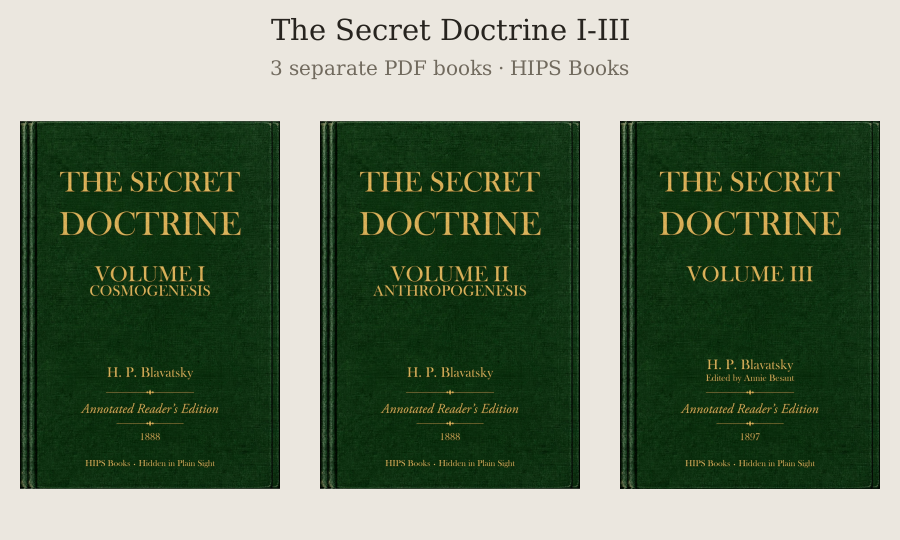
About the book
The Secret Doctrine, Volume I: Cosmogenesis is H. P. Blavatsky’s attempt to explain the origin and order of the universe through an esoteric reading of religion, symbolism and the science of her time. Published in 1888, it is the first of the two volumes she issued during her lifetime. Its subject is the cosmos; Volume II turns more directly to humanity.
The book begins by setting out a framework for everything that follows. In the Proem, Blavatsky proposes an ultimate ground beyond ordinary description, a universe that moves through cycles of manifestation and rest, and a spiritual relationship between all beings. These propositions help explain why the later chapters keep returning to questions of unity, recurrence and consciousness. They are propositions within her philosophy, not conclusions of modern physics.
The seven Stanzas of Dzyan provide the outline for the central commentary. From the stillness before a world appears, Blavatsky traces a symbolic sequence of awakening, differentiation and the formation of cosmic order. Her discussion moves between terms such as Fohat, number symbolism, spirit and matter, planetary cycles and the place of the human being in that larger picture. Religious comparisons and lengthy notes are part of the argument, rather than optional decoration around it.
Later sections explore the symbolism of different traditions and challenge scientific assumptions current in the nineteenth century. Readers interested in the history of Theosophy, comparative esotericism or the relationship between religion and science can follow how Blavatsky assembles those materials. The comparisons should be examined critically: a similarity between symbols does not by itself prove that all traditions teach the same doctrine.
This is a demanding book, with recurring specialist vocabulary and frequent changes of scale. HIPS Books adds vocabulary help and reader guides to make the structure easier to follow without rewriting Blavatsky’s prose. One useful starting point is the Proem, followed by the seven stanzas before their longer commentaries. Returning to that outline can help you see which part of the cosmological argument a section is developing.
The historical occult, religious and scientific claims are retained for study. They are not presented as established modern science, medicine or history. This edition is an invitation to read the original argument with context, not a promise that its account of the universe has been verified.
What this edition includes
One searchable 521-page A4 PDF in English, containing Volume I only. Includes vocabulary, section summaries, key ideas and reflection questions, with the HIPS Books material visibly separate from the historical text.
Historical diagrams and symbols accompany their passages. Clickable contents, PDF bookmarks and linked historical notes support navigation. The wording of the 1888 text is retained; this is not a modern-language paraphrase. Read in a PDF reader or print a personal copy. Small screens may require zooming. The matching series cover and modern editorial material were prepared with AI assistance under human direction.
Inside the book: selected contents
A reading overview, not the complete text.
- Preface and introduction: Blavatsky sets out the scope of her claimed synthesis.
- Proem: three fundamental propositions frame the discussion of reality, cosmic cycles and the soul.
- Seven Stanzas of Dzyan and commentaries: the narrative moves from cosmic rest to awakening and the formation of worlds.
- Symbolism and comparisons with science: later discussions connect the cosmological argument with religious symbols and nineteenth-century scientific debates.
The purported ancient source and cosmology are Blavatsky’s claims. They are not established accounts of the origins of the universe.
Key concepts for reading
HIPS editorial explanations of the historical text.
- Cosmogenesis: the origin and development of the cosmos.
- Pralaya: a period of cosmic rest or dissolution in Blavatsky’s account.
- Manvantara: a period of manifestation or activity.
- Fohat: the force she invokes to connect cosmic ideas with the formation of worlds.
- Stanzas of Dzyan: verses she presents as an ancient source, whose provenance is disputed.
Before you buy
How is this different from an archive scan?
An archive scan preserves photographed pages. This is a prepared reading edition: reset text and modern reading support, with the historical author’s words kept distinct. The edition details and preview pages above show what is included in this particular book.
What will I receive, and where do I buy it?
This is a digital PDF edition, not a printed book. The Etsy listing is the place to check the current PDF price and delivery details, and to complete your purchase. Payment and digital delivery are handled by Etsy.
Can I read or print the PDF?
You can read a PDF in a compatible viewer on a computer or tablet. Check the Etsy listing and the edition’s terms for printing permissions and paper size before buying. PDF support and navigation vary by device; this is not an EPUB or a physical copy.