About the book
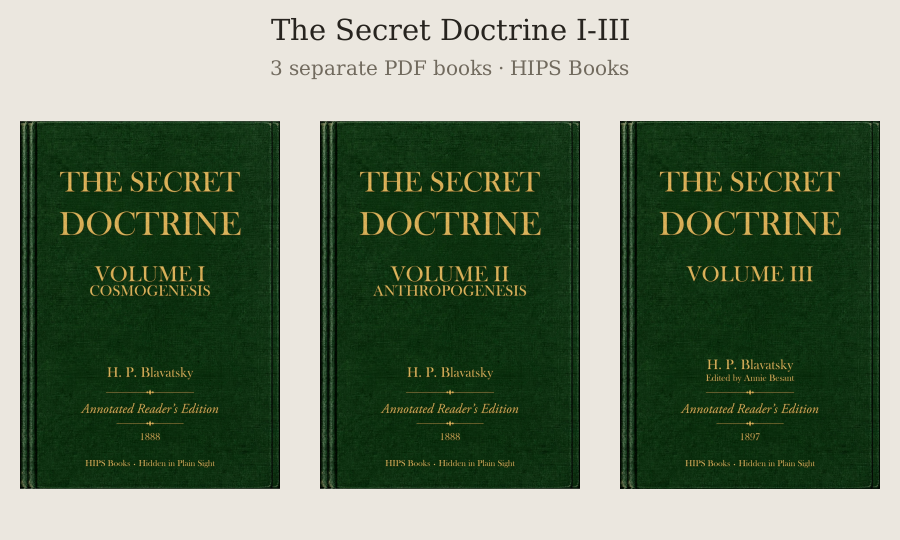
The Secret Doctrine, Volume III has a different publication history from the two volumes of 1888. H. P. Blavatsky did not issue this third volume during her lifetime. Annie Besant arranged and edited surviving papers for publication in 1897, after Blavatsky’s death. That distinction matters when reading the work or choosing a three-volume set.
Rather than simply continuing the cosmological sequence of the first two volumes, the posthumous collection moves across initiation, ancient religious traditions, sacred symbolism and occult philosophy. Sections consider the origin of magic, the secrecy of initiates, Hermetic and Kabalistic doctrines, alphabets and numbers, and competing interpretations of religious texts. These are arguments within the authors’ historical esoteric setting, not settled accounts of ancient history.
Readers will encounter discussions of Enoch, Hebrew allegories, the Zohar, early Christian figures and stories of adepts. The collection asks how an outward religious narrative might be given an inward or symbolic meaning. Comparing these sections with the earlier volumes can show how Blavatsky applies related ideas in different contexts, without assuming that every paper forms part of a single finished argument.
The later material appears under Some Papers on the Bearing of Occult Philosophy on Life. It includes the esoteric papers, an appendix and notes on oral teachings, turning toward Theosophical accounts of human principles and consciousness. The HIPS Books edition follows that historical sequence. It does not assemble a new selection or present the 1897 publication as a modern completion of Blavatsky’s plans.
Besant’s preface is an essential part of the reading experience. It explains her arrangement of the papers and identifies editorial additions. Her historical square brackets are retained and should not be confused with HIPS Books’ separately labelled vocabulary and reader guides. Besant also cautioned that some passages in The Mystery of Buddha were unfinished or erroneous, another reason to approach the material as a posthumously edited historical collection.
This edition supports a careful reading of the surviving text rather than smoothing away its publication history. Vocabulary gives you a way into unfamiliar terms; summaries and reflection questions help you follow the individual sections. Religious, cultural, scientific and occult claims remain claims of their period. Restoring the text for modern readers does not mean endorsing those claims or describing the volume as independently verified scholarship.
What this edition includes
One English-language A4 PDF, 434 pages, containing the 1897 Volume III only. Includes Besant’s preface, the introduction, Sections I–LI, the later papers, appendix and notes on oral teachings in their historical sequence.
Searchable typesetting, clickable contents and linked historical notes accompany historical diagrams, tables and verse. Modern vocabulary, reader guides and reflection questions are clearly marked. The matching series cover and new editorial material used AI-assisted preparation under human direction. Read on screen or print for personal study; this is a fixed-page PDF and no physical book is shipped.
Inside the book: selected contents
A reading overview, not the complete text.
- Preface and introductory material: approach this volume as a posthumous collection edited by Annie Besant in 1897, not a third volume issued by Blavatsky in 1888.
- Magic and secrecy: early sections discuss initiation, hidden teaching and the dangers the text associates with practical magic.
- Hermetic and Kabalistic doctrines: symbolic interpretation is explored through religious texts, alphabets and numbers.
- Historical religious figures: the collection presents its own arguments about adepts, Christian origins and occult interpretation.
The editorial history matters when comparing this collection with Cosmogenesis and Anthropogenesis.
Key concepts for reading
HIPS editorial explanations of the historical text.
- Posthumous publication: material published after its author’s death, with an editor shaping the collection.
- Initiation: entry into the hidden teaching or spiritual discipline described by the text.
- Adept: a person treated as advanced in occult knowledge.
- Esoteric interpretation: a proposed inner meaning beneath an outward religious story.
- Numerical symbolism: the meanings the text assigns to numbers and arrangements; not proof of historical relationships.
Before you buy
How is this different from an archive scan?
An archive scan preserves photographed pages. This is a prepared reading edition: reset text and modern reading support, with the historical author’s words kept distinct. The edition details and preview pages above show what is included in this particular book.
What will I receive, and where do I buy it?
This is a digital PDF edition, not a printed book. The Etsy listing is the place to check the current PDF price and delivery details, and to complete your purchase. Payment and digital delivery are handled by Etsy.
Can I read or print the PDF?
You can read a PDF in a compatible viewer on a computer or tablet. Check the Etsy listing and the edition’s terms for printing permissions and paper size before buying. PDF support and navigation vary by device; this is not an EPUB or a physical copy.