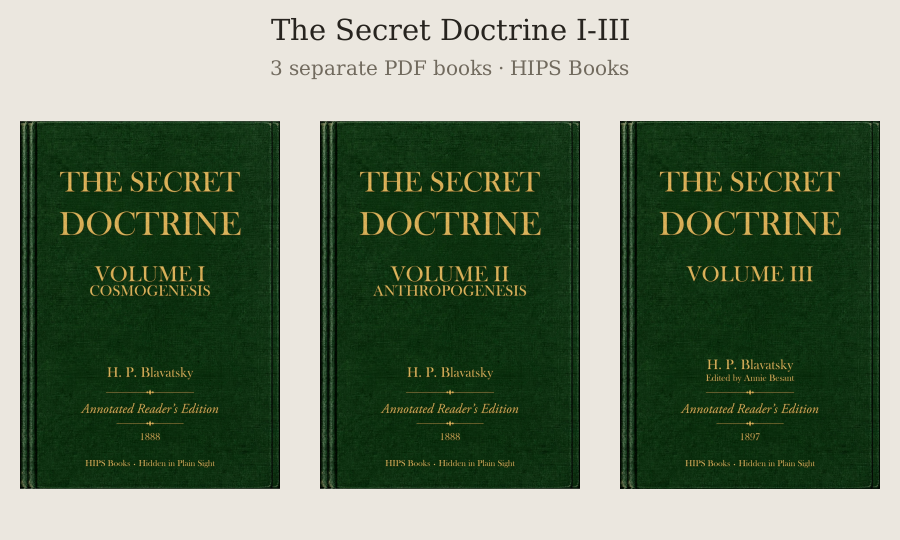
About the book
Where did humanity come from, and what does it mean to become conscious? The Secret Doctrine, Volume II: Anthropogenesis answers through H. P. Blavatsky’s Theosophical system. First published in 1888, this second volume turns from the cosmic origins of Cosmogenesis to her proposed spiritual and physical history of the human being.
The preliminary notes and twelve anthropogenic Stanzas of Dzyan outline the sequence she asks the reader to follow. Her account describes early forms of humanity, gradual embodiment, the awakening of mind, sexual differentiation and successive stages of human development. The commentary expands this outline through religious stories, symbolic correspondences and arguments with the evolutionary theories of her period.
Lemuria and Atlantis play a substantial role in that speculative history. Blavatsky brings together accounts of lost continents, mythic giants, flood traditions and ancient chronologies as material for her argument. These discussions are useful for understanding the imagination and intellectual setting of nineteenth-century Theosophy; they are not evidence establishing the book’s proposed prehistory. Its claims are not modern anthropology, geology or biology.
The later parts range across symbols, mythology and contemporary scientific debate. Mind is particularly important: the book considers not only the appearance of a body, but the emergence of self-consciousness, responsibility and moral life. Readers can follow how metaphysical ideas and historical speculation are woven together, while keeping track of which claims rest on the author’s own interpretive framework.
This volume also requires a clear warning. Blavatsky’s Root-Race scheme includes dated racial theories and descriptions of peoples and cultures that readers may find offensive. The terminology belongs to the historical work and is retained for study, not endorsed or adopted as a way to classify people today. HIPS Books distinguishes those claims from its own explanatory material instead of silently treating them as established facts.
For a first reading, start with the preliminary notes and the stanzas before moving into their commentaries. The new vocabulary and section guides help identify recurring terms and the changing levels of the discussion. The guides summarize the argument, ask critical questions and give you a place to pause; they do not replace the original wording or decide the truth of Blavatsky’s philosophy for you.
What this edition includes
One searchable English-language A4 PDF, 616 pages, containing Volume II only. The 1888 historical text is newly typeset with its period language retained. Historical diagrams and symbols remain alongside their passages.
Includes vocabulary support, clearly labelled reader guides, summaries, key ideas, reflection questions, clickable contents, PDF bookmarks and linked historical notes. Screen reading and personal printing are supported; this is not a reflowable EPUB. No physical book is supplied. The cover and editorial preparation used AI assistance under human direction.
Inside the book: selected contents
A reading overview, not the complete text.
- Preliminary notes: four proposed prehistoric continents introduce the framework.
- Anthropogenic stanzas: Blavatsky presents her narrative of sentient life and human origins.
- Commentaries: lunar ancestors, embodiment and the awakening of mind are developed through her spiritual history.
- Symbolism and scientific debates: myths, traditions and period arguments about humanity are compared.
Her “root-race” scheme and lost-continent narrative are historical occult claims, not accepted anthropology. The text includes racial hierarchies that require critical reading, not endorsement.
Key concepts for reading
HIPS editorial explanations of the historical text.
- Anthropogenesis: an account of the origin and development of humanity.
- Root-races: Blavatsky’s proposed stages of spiritual-human development; the scheme is not a valid scientific classification.
- Lunar ancestors: beings assigned a role in human formation within her cosmology.
- Manas: mind, particularly in the discussion of self-consciousness.
- Sacred chronology: a timeline based on her interpretation of religious and esoteric sources rather than established archaeology.
Before you buy
How is this different from an archive scan?
An archive scan preserves photographed pages. This is a prepared reading edition: reset text and modern reading support, with the historical author’s words kept distinct. The edition details and preview pages above show what is included in this particular book.
What will I receive, and where do I buy it?
This is a digital PDF edition, not a printed book. The Etsy listing is the place to check the current PDF price and delivery details, and to complete your purchase. Payment and digital delivery are handled by Etsy.
Can I read or print the PDF?
You can read a PDF in a compatible viewer on a computer or tablet. Check the Etsy listing and the edition’s terms for printing permissions and paper size before buying. PDF support and navigation vary by device; this is not an EPUB or a physical copy.