Ideas & reading guides
The Key to Theosophy: Karma and Reincarnation Explained
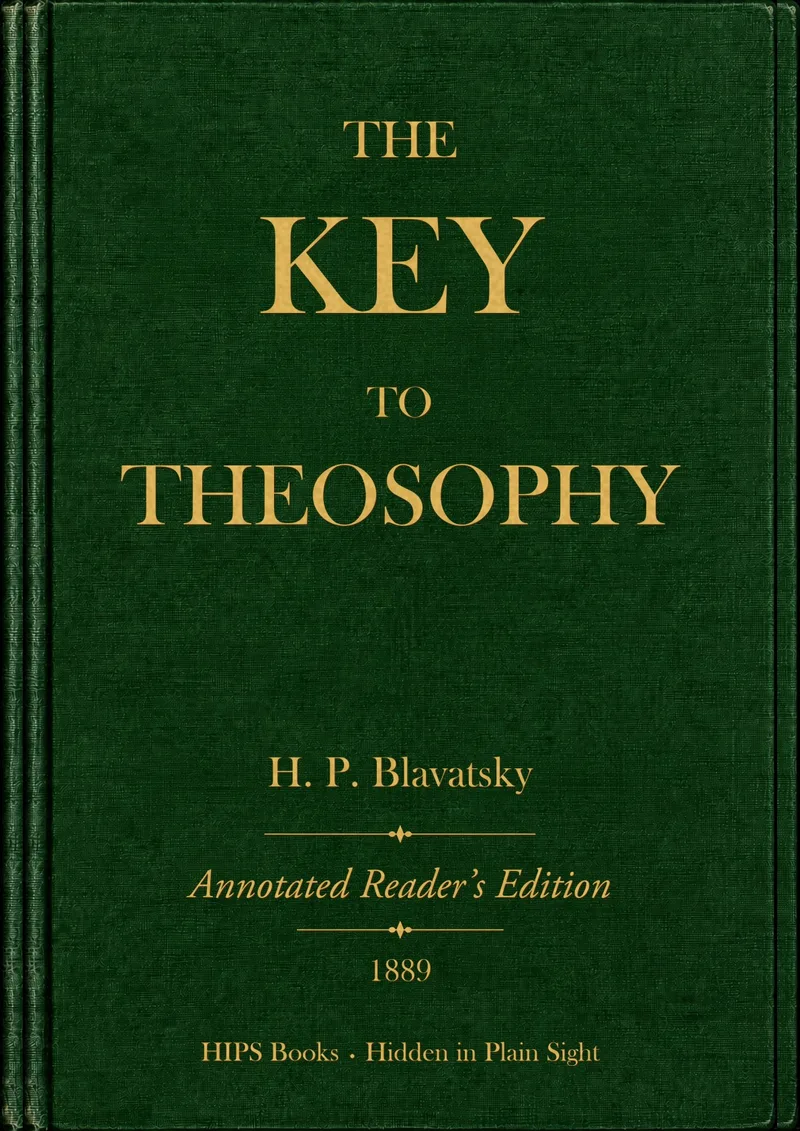
The Key to Theosophy is H. P. Blavatsky's 1889 introduction to her teachings, written as a conversation between an enquirer and a Theosophist. Its ideas of karma and reincarnation depend on a distinction that is easy to miss: the everyday personality is not the same as the enduring individuality that she believes passes through different lives.
Once that distinction becomes clear, much of the dialogue begins to connect. Questions about memory, death, moral responsibility and practical kindness are no longer separate subjects. They are different parts of the author's attempt to explain what a person is and why their actions matter.
This is a guide to that argument, not evidence that previous lives or post-mortem states have been scientifically established. You can follow the reasoning, notice its strengths and difficulties, and decide what you think without treating the teacher's replies as unquestionable answers.
Why The Key to Theosophy works as a conversation
The question-and-answer form makes objections part of the book. The enquirer asks for definitions, challenges contradictions and brings the discussion back to common misunderstandings. Blavatsky uses that exchange to explain the Theosophical Society, distinguish her teachings from other positions, and defend the movement against criticism.
The form is helpful, but it has a limit: Blavatsky writes both voices. The questions are not an independent interviewer testing her claims. The conversation is a carefully arranged way of presenting her own case. A reader can appreciate its clarity while still asking questions that the enquirer does not ask.
For example, when the teacher explains that the self has different aspects, the reader might ask what would count as evidence for those aspects. When she describes reincarnation, the reader might ask whether an analogy explains the claim or proves it. The dialogue often helps with the first task without completing the second.
If you are new to the movement, start with our introduction to Theosophy. This article takes the narrower next step: understanding how the terms fit together inside the 1889 book. Its later discussions of practical duty are as important as the more unusual accounts of life after death.
Personality and individuality: the actor and the role
Blavatsky's central distinction is between the changing details of one life and a deeper self that she believes outlasts them. “Personality” refers to the person with a particular name, memory, habits and circumstances. “Individuality” refers to the enduring spiritual identity in her system.
She explains the difference through an actor playing different roles. The character on one evening is not the character on the next, but the performer remains. In the book's analogy, separate lives are like separate roles. The continuing individuality is like the actor rather than the character's costume or name.
That is a clearer account than imagining the same everyday person simply moved into a new body. It also explains why the absence of ordinary memory does not, for Blavatsky, settle the question of reincarnation. She does not claim that every detail of the earlier role must be remembered by the later one.
However, the analogy leaves a real difficulty. We can observe an actor behind different performances. We cannot establish an enduring spiritual actor merely by inventing a theatrical comparison. The image helps us understand what the author means, but independent evidence would still be needed to establish that it happens.
It also raises a moral question. If the later personality does not remember the earlier one, in what sense is it responsible for the earlier one's acts? Blavatsky answers through a continuing spiritual identity and the working of karma. A reader may find that answer coherent within her system while remaining unconvinced that it solves the problem outside it.
| Term | Meaning in this book | Common confusion |
|---|---|---|
| Personality | The changing person of a particular life | Assuming it is the whole enduring self |
| Individuality | The continuing spiritual identity the author proposes | Treating it as a modern personality trait |
| Ego | A term whose meaning depends on the surrounding discussion | Reading it only as pride or selfishness |
| Reincarnation | Further embodiment of the enduring individuality | Imagining complete everyday memories transferred unchanged |
Read these words as technical terms within the dialogue. Their meanings are not always the ones they carry in casual conversation. Following a word through a few connected passages is more useful than memorizing a definition in isolation.
Karma is more than immediate reward and punishment
Karma in the dialogue is a law of cause and consequence. Blavatsky describes it as restoring balance rather than as a person-like judge handing out prizes and punishments. The teaching links what human beings do with conditions that follow, including consequences extending beyond one lifetime.
This is not simply the familiar observation that careless actions can have bad results. She extends causation into an unseen spiritual order. That larger claim belongs to Theosophy. It should not be presented as though it has the same evidential status as an observable sequence of events.
A simple example helps show the difference. If someone repeatedly breaks promises, other people may stop trusting them. That is a consequence we can investigate. If someone says a particular misfortune was caused by conduct in a previous life, the claim requires knowledge that the first example does not provide. The two statements should not be blended together.
The book also moves beyond isolated individuals. It discusses the way people participate in shared conditions and therefore cannot be understood as sealed-off units. This broader account matters because “karma” is sometimes reduced to a quick verdict on another person. Blavatsky's discussion is larger and more complicated than that casual use.
For a modern reader, there is a firm ethical boundary: an unseen explanation does not justify telling someone that their illness, poverty or abuse is deserved. The claim is not something we can reliably infer from their circumstances. Nor does it remove the need to help. The book's practical sections repeatedly bring the discussion toward responsibility for others.
What does Blavatsky mean by Devachan?
Devachan is the state of post-mortem mental happiness described in the dialogue. Blavatsky compares it to an especially vivid condition of experience rather than a physical place reached by ordinary travel. It is part of her account of what happens between embodied lives.
The name can mislead a reader who expects a geographical heaven with the same surroundings for everyone. In this teaching, the experience is connected to the inner life of the individual. The book uses dream-like comparison to make that idea easier to imagine, while treating it as more significant than an ordinary nightly dream.
The discussion of death also uses Kama-loka, another term for a post-mortem condition in the author's scheme. It is not interchangeable with Devachan. The dialogue distinguishes different aspects of the person and describes them as having different destinies. That is why the personality/individuality distinction has to come first.
None of this supplies a verified map of the afterlife. The reading task is to understand how the claimed stages connect. Ask what survives, what falls away, and what kind of experience the author says continues. Those questions prevent the unfamiliar names from becoming an impressive but empty vocabulary.
The same habit helps with the book's sevenfold accounts of human nature. These are spiritual classifications, not a substitute for anatomy or medical assessment. You can study the structure and its moral meanings without using it to diagnose yourself or another person.
Why practical kindness belongs in a book about reincarnation
The later chapters insist that Theosophy should affect conduct. The section on charity asks whether help means only a donation, or something more direct and personal. Blavatsky emphasizes duty, attention to suffering and work done for others rather than the pursuit of unusual experiences for their own sake.
This changes how the earlier teachings should be read. Karma and reincarnation are not merely a way to speculate about who one might have been. In the dialogue, they support an account of responsibility extending beyond immediate self-interest. The moral question is what a person does now, not whether they possess a dramatic story about the past.
One concrete example is the difference between an abstract declaration of brotherhood and the act of helping someone in need. The book presses the reader to notice that declarations cost little. Practical assistance requires time, judgment and a willingness to be inconvenienced. That makes its ethical argument accessible even to a reader who does not accept the metaphysical system.
Another is its discussion of ambition and self-discipline. Learning special teachings is not presented as a license to evade ordinary obligations. A person still has duties to other people. This is a useful corrective to reading the book as a manual for acquiring a superior spiritual identity.
At the same time, ethical appeal is not proof of the whole philosophy. A teaching can recommend kindness without establishing its claims about previous lives. Keeping those matters separate allows a reader to take the moral discussion seriously while remaining critical about its explanations.
A clear route through the 1889 book
Read in connected units rather than collecting isolated quotations. Start with what the Society is and is not. Then move to the discussion of the self, followed by reincarnation and karma. Finish with the practical sections so that the teaching's ethical aim remains in view.
A useful reading sequence is:
- Note how the teacher separates Theosophy from simple agreement with an organization.
- Follow the actor analogy and write down the distinction between personality and individuality.
- Ask how that distinction is used to explain memory, death and rebirth.
- Read karma as the book's proposed relation between action and consequence.
- Return to duty and charity: what does this worldview ask a person to do?
For each unit, make one note in your own words and one question you cannot yet answer. A clear unresolved question is a better reading result than a copied definition that still means nothing to you.
The HIPS edition follows the 1889 work and contains the original appendix and notes alongside labelled reader guides. It does not append the glossary added to the 1890 edition. That edition distinction matters when you compare contents or follow a reference from another version.
For the larger cosmic framework, continue with our guide to The Secret Doctrine. For the author behind the dialogue, read Helena Blavatsky's life and books. The available Blavatsky editions let you compare the books before choosing a reading route.
The Key to Theosophy is most rewarding when its questions remain active. Learn what the author means, distinguish an explanation from a proof, and keep the practical discussion close to the speculative one. The result is a clearer encounter with the historical book, whether or not it becomes your own philosophy.
Sources and edition notes
- Primary text: H. P. Blavatsky, The Key to Theosophy (1889), especially the actor analogy, individuality and personality, reincarnation, karma, Devachan, and the practical sections on duty and charity.
- Comparative primary text: The Secret Doctrine, Volume I (1888), Proem, for the larger framework of unity, cycles and the spiritual journey.
- Theosophical University Press biographical bibliography, for the sequence of Blavatsky's principal works. This article explains the book's teachings; it does not authenticate claims about survival after death.