Ideas & reading guides
The Secret Doctrine Explained: A Guide to Its Volumes
The Secret Doctrine is H. P. Blavatsky's large Theosophical work about the origins of the universe and humanity. Its first two volumes appeared in 1888. They combine symbolic accounts of creation with religious comparisons and arguments about nineteenth-century science. A third volume, published in 1897 and edited by Annie Besant, has a different history: it was assembled after Blavatsky's death.
If you have opened the book and found it bewildering, the problem may be its scale rather than your ability. The reader is asked to learn a vocabulary and a set of assumptions while following a changing argument. A map of the volumes makes that task much easier.
This guide explains what each volume does, translates a few central ideas into plain language, and suggests a reading route. It also identifies the points where historical study must not be confused with accepting the book as modern science or human history.
What is The Secret Doctrine trying to explain?
Blavatsky wants to show that different religious and philosophical traditions preserve parts of a shared ancient wisdom. Her subtitle, The Synthesis of Science, Religion, and Philosophy, expresses the ambition. She does not simply place traditions side by side. She interprets them within a framework of spiritual evolution, cosmic cycles and hidden correspondences.
The book's opening stanzas function as a core text around which long commentaries develop. Blavatsky presents these as material from the Book of Dzyan. That claim belongs to her account of the work's authority; readers should not treat it as an independently authenticated ancient manuscript merely because the book says so.
The distinction is important. A stanza may describe a universe before familiar things have appeared. The commentary then moves into comparisons with religious symbols, philosophical terms and scientific theories. These materials have different origins and different standards of evidence. The book binds them into one interpretation, but the binding is part of the author's argument.
For a simpler introduction to the movement behind that argument, read what Theosophy means. For the author and her circumstances, see our Helena Blavatsky biography. Neither requires a reader to accept the claims before understanding them.
Volume I: Cosmogenesis and the three basic propositions
Cosmogenesis means the origin or coming-into-being of the cosmos. Volume I begins with questions about how a varied world could emerge from a deeper unity. Its Proem introduces three propositions that organize much of what follows. They are worth reading before the more elaborate commentary.
First, an ultimate reality lies beyond ordinary description. Blavatsky does not begin with a person-like creator standing outside the world. She proposes a boundless basis of existence that thought cannot fully grasp. Her unusual term “Be-ness” tries to avoid making that basis just another thing among things.
Second, manifestation is cyclical. Worlds appear and disappear within a larger continuity. The book uses familiar rhythms, such as waking and sleeping, to help the reader imagine this pattern. Those comparisons explain what she means; they do not prove that the universe follows her particular scheme.
Third, individual life shares a spiritual ground and undergoes development. The soul's journey is linked to incarnation and karma. In plain language, her system treats a person as part of a much larger story rather than an isolated life with no deeper connection. This is a spiritual teaching, not a conclusion established by biological research.
These ideas depend on each other. Unity supplies the ground, cycles supply the pattern, and developing consciousness supplies the journey. Remembering that relation helps when the vocabulary becomes dense. Instead of trying to memorize every unfamiliar name, ask which part of the pattern a passage is explaining.
| Term in Volume I | A useful first approximation | What not to assume |
|---|---|---|
| Cosmogenesis | The coming-into-being of a world | A modern physics account |
| Manifestation | A hidden potential becoming a differentiated world | A simple claim about wish fulfillment |
| Pralaya | A period of rest or withdrawal in the author's scheme | Ordinary sleep on a larger scale, literally measured |
| Fohat | The formative link she describes between cosmic thought and substance | A laboratory-confirmed force |
Fohat gives a concrete example of the reading difficulty. In the commentary, it appears through the language of intelligence, energy, motion and electrical power. Treating it as only “electricity” loses the wider role it plays. Treating the electrical comparison as scientific proof loses the distinction between metaphor and measurement.
Volume II: Anthropogenesis and the problem of human origins
Anthropogenesis shifts the focus from the cosmos to humanity. Volume II follows twelve stanzas and explores the development of bodies, mind and spiritual life. The large question is how a human being becomes both an embodied creature and a self-conscious one.
One revealing example is the difference between having a form and having awakened intelligence. The volume's story does not treat these as the same event. That distinction helps explain why passages that seem to concern physical origins can suddenly turn toward moral choice and consciousness. Blavatsky is attempting more than a description of anatomy.
But the volume also contains serious problems. Its “Root-Race” scheme places humanity into successive stages and connects those stages to peoples, continents and racial hierarchies. Some passages describe living populations in demeaning terms. It would be dishonest to say that the language is purely symbolic and has no consequences for how actual people are represented.
Lemuria and Atlantis also enter the author's account of human development. In this context, they are elements of her speculative sacred history. They are not established geographical explanations for human origins. A reader can study why the book needs such continents without treating its account as reliable anthropology or geology.
Keep two questions separate: what function does this idea perform in the book, and is the idea supported outside the book? The first is a reading question. The second requires independent evidence. Confusing them can make an internally elaborate system seem externally proven when it is not.
The racial material should not be softened into a cheerful message that all humanity is progressing. The universal spiritual ground of the Proem and the hierarchical descriptions in Volume II sit in tension. A responsible reader acknowledges that tension, rejects racial ranking, and studies the historical work without turning it into guidance about human worth.
Why Volume III needs a different introduction
The third volume is not simply the next part of the same 1888 publication. Volume III appeared in 1897, after Blavatsky's death in 1891. Its editor, Annie Besant, explains in the preface that the papers were unarranged and that she organized them into sections.
Besant also describes combining versions of material in “The Mystery of Buddha.” She warns that parts contain errors and remain unfinished. Those statements are essential evidence for how this volume reached the reader. They should be read before anyone presents it as a completely finished work that Blavatsky personally prepared for publication.
The volume discusses occult traditions, initiatory learning and religious interpretation. It also includes material concerned with the bearing of occult philosophy on life, along with esoteric instructional matter and notes. Its texture differs from the stanza-and-commentary structure that organizes the first two volumes.
Think of the difference as an edition question, not merely a belief question. Two readers might disagree about Theosophy yet agree that an author's finished publication and an editor's posthumous arrangement are different kinds of document. That difference affects how confidently we can reconstruct the author's intended order and emphasis.
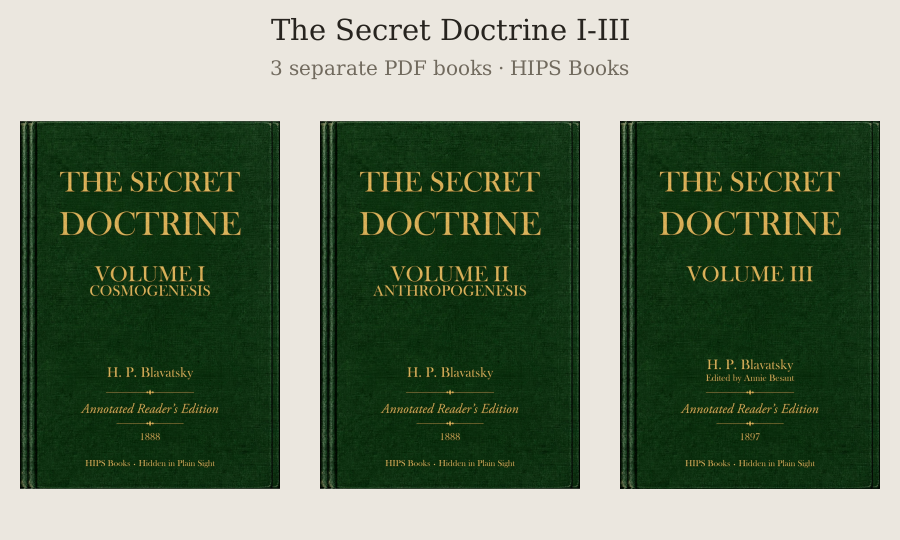
The three-volume HIPS collection keeps the volumes as separate PDFs. It should be approached as the two 1888 works plus the distinct 1897 publication, not as one uniform book with a single publication date.
A reading route that does not require mastering everything
Start with the Proem of Volume I and make a short note of its three propositions. Then read one stanza and its commentary. A small, complete unit is more useful than pages of terms that have not yet connected to anything. Ask what the stanza is describing and how the commentary tries to explain it.
Use a simple three-column notebook:
| Passage | What Blavatsky claims | What I need to check or understand |
|---|---|---|
| The Proem | Life shares a spiritual ground | What does “identity” mean here? |
| A cosmic stanza | A world emerges through stages | Which statements are images, and which are literal claims? |
| A comparison with another tradition | Two symbols express the same wisdom | Is the comparison justified by that tradition's own context? |
This method keeps your questions alive. You are not making a list of facts to absorb. You are following an argument and identifying its assumptions. When a passage quotes another writer, notice whether the quotation supplies evidence, offers an analogy or becomes material for a new interpretation.
If the account of mind and reincarnation remains unclear, pause for The Key to Theosophy and its dialogue. It explains concepts through objections and replies. Returning to The Secret Doctrine after that can make its human and ethical concerns easier to recognize.
Read Volume II with the racial and historical cautions already in mind. For Volume III, begin with Besant's preface rather than skipping it as routine publishing material. In this case, the editor's explanation changes what kind of book you know you are holding.
What a modern reader can take from the encounter
The lasting reading value lies in seeing an ambitious worldview take shape. Blavatsky asks how mind and matter belong together, why religions share certain images, and whether human life has a moral direction. Her answers preserve the intellectual and spiritual conflicts of her period, including its blind spots.
You do not have to accept her system to benefit from careful reading. You can learn to distinguish a first principle from a demonstrated conclusion, a symbol from a historical claim, and an editor's arrangement from an author's completed plan. Those distinctions are useful far beyond Theosophy.
The HIPS editions add vocabulary help and labelled reader guides while retaining the historical argument. They do not turn the books into contemporary scientific textbooks or remove their difficult claims. Our editorial method explains the distinction between the restored text and modern reading support.
For a first encounter with The Secret Doctrine, the most useful goal is modest: understand the three propositions, follow one stanza, and notice how the commentary builds its case. Depth comes from that sustained attention, not from rushing through every volume.
Sources and edition notes
- Primary texts: The Secret Doctrine, Volume I, Proem and stanza commentaries; Volume II, preliminary material and human-origin stanzas; Volume III, Annie Besant's preface and section contents. The volume pages identify the HIPS editions used here.
- Theosophical University Press biographical bibliography, for publication context; it represents the movement's own perspective.
- Theosophical Society in America: The Secret Doctrine and its Study, for an example of how the tradition introduces the work to students. This is a practitioner reading approach, not independent verification of its claims.