Ideas & reading guides
Hermetic, Gnostic, Theosophy, Occult: What’s the Difference?
Hermeticism, Gnosticism, Theosophy and the occult are four different things that often get blurred together. Hermeticism and Gnosticism are ancient traditions from Roman Egypt, the first built on texts attributed to Hermes Trismegistus, the second on teachings about salvation through inner knowledge. Theosophy is a modern movement founded in New York in 1875. The occult is an umbrella word that simply means "hidden".
The names give the first clue. Hermetic comes from a god, Hermes. Gnostic comes from the Greek gnosis, knowledge. Theosophy means "divine wisdom". Occult comes from the Latin occultus, hidden. Our film Hermeticism, Gnosticism & Theosophy: What's the Difference? covers the same ground.
 13:00
Watch · HIPS Books on YouTube
Hermeticism, Gnosticism & Theosophy: What’s the Difference?
The histories, central ideas and original books behind four words that are often confused, from Hermes Trismegistus to Helena Blavatsky.
Plays from YouTube when you press play.
What is the difference between Hermeticism, Gnosticism, Theosophy and the occult?
In one sentence each:
| Hermeticism | Gnosticism | Theosophy | The occult | |
|---|---|---|---|---|
| Core idea | The universe is mind, and you mirror it | You are a spark of light that forgot itself | Every religion holds a piece of one truth | What is hidden is real and can be known |
| When | c. 1st–3rd centuries CE | 2nd–3rd centuries CE | From 1875 | An umbrella term; "occultism" from the 19th century |
| Where | Roman Egypt | Alexandria, Rome and beyond | New York, then India and London | Europe and beyond |
| Key texts | Corpus Hermeticum, Asclepius | Nag Hammadi texts, e.g. Secret Book of John | Blavatsky's Isis Unveiled, The Secret Doctrine | Agrippa's Three Books of Occult Philosophy |
Hermeticism and Gnosticism are ancient siblings, literally buried in the same jar. Theosophy is a nineteenth-century attempt to gather them, and the religions of the East, into one wisdom. The occult is the umbrella over all of them.
What is Hermeticism?
Hermeticism is the tradition based on writings attributed to Hermes Trismegistus, "Thrice-Great Hermes", a legendary sage formed when Greeks in Egypt merged their god Hermes with the Egyptian god of writing, Thoth. The most important texts are the seventeen Greek treatises of the Corpus Hermeticum, written in Roman Egypt, most of them probably in the second or third century after Christ. They read like private lessons: Hermes teaching his son Tat or his pupil Asclepius.
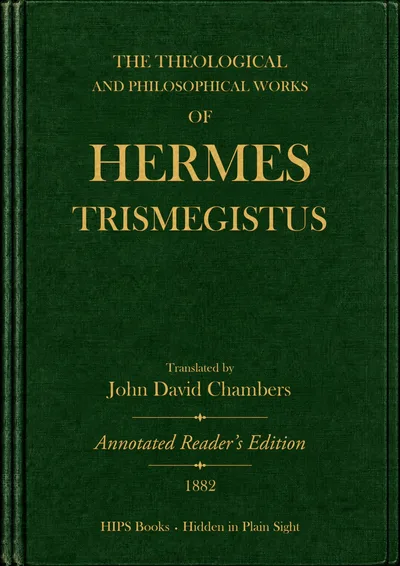
The most famous opens with a vision: a being called Poemandres, the Mind of the Supreme Power, shows Hermes how the cosmos poured out of divine light, how the soul fell into the body, and how it can climb back through the seven planetary spheres to God. In John David Chambers's 1882 translation, Poemandres introduces himself: "'I, indeed,' He says, 'am Poemandres, The Mind of The Supreme Power.'" The core message is that the human mind is a spark of the divine mind, and that to know yourself truly is to know God.
Beside these sits the Emerald Tablet, a short alchemical text first known in Arabic around the eighth or ninth century, whose famous line is usually paraphrased as "as above, so below." Renaissance Europe believed Hermes was older than Moses until Isaac Casaubon showed in 1614 that the Greek was far later. Our article Hermes Trismegistus: The Book That Fooled the Renaissance tells that story, and our guide to Hermeticism explains the main ideas.
Is The Kybalion Hermetic?
It claims to be, but it is a modern book. The Kybalion was published in Chicago in 1908 by "Three Initiates" and gave the world the famous seven Hermetic principles: Mentalism ("THE ALL IS MIND; The Universe is Mental"), Correspondence ("As above, so below"), Vibration, Polarity, Rhythm, Cause and Effect, and Gender. Most historians agree it was written by William Walker Atkinson, a leader of the American New Thought movement, who two years earlier had published Thought Vibration, or the Law of Attraction in the Thought World.
The Kybalion echoes real Hermetic ideas, especially the divine Mind, but none of the seven principles appears in the ancient texts. Our article Who Really Wrote The Kybalion? sets out the evidence.
What is Gnosticism?
Gnosticism is the modern name for a group of early Christian teachers and movements, flourishing in the second and third centuries, who taught that salvation comes through gnosis. This is not knowledge from a textbook but direct, inner, transforming knowledge, the kind you have of a person. Among them were Valentinus and his followers and the so-called Sethians, in cities such as Alexandria and Rome.
Many of their texts tell a version of the same extraordinary story:
- Beyond our world is a perfect, unknowable God, surrounded by a realm of light called the Pleroma, "the Fullness".
- One of its beings, Sophia (Wisdom), acts on her own, and from her mistake a lesser god is born: the Demiurge, "the craftsman", in some texts named Yaldabaoth.
- He believes he is the only god, and he makes the material world.
- But a spark of the true light ended up inside human beings. We have forgotten where we came from, and salvation is remembering.
If that sounds like The Matrix, you are not the first to notice.
For centuries these teachers were known mainly through their opponents, such as Bishop Irenaeus, who wrote a long attack on them around the year 180. Then, in December 1945, near the Egyptian town of Nag Hammadi, a farmer named Muhammad Ali al-Samman, digging for fertile soil, struck a sealed clay jar. Inside were thirteen leather-bound books containing fifty-two texts in Coptic, buried around the fourth century. Among them were the Gospel of Thomas, a collection of 114 sayings of Jesus, and the Secret Book of John, which tells the Demiurge story in full.
One caution: "Gnosticism" is a modern label. The people we call Gnostics did not share one church or one creed, and many scholars now prefer to speak of specific groups.
How are Hermeticism and Gnosticism connected?
They grew up in the same world and were read side by side. Tucked among the Gnostic books in the Nag Hammadi jar were several Hermetic texts, including one in which a teacher leads a student up to the eighth and ninth levels of heaven. Both traditions describe a divine spark in human beings and an ascent back to the divine through knowledge.
The key difference is how they see the world. Hermetic texts often treat the cosmos as beautiful, even a "second God", although some passages are harsh about the body. Classic Gnostic myths treat the material world as the work of an ignorant lesser god, a trap to escape. In short, Hermeticism says the universe reflects God, and Gnosticism says the universe hides God.
What is Theosophy?
Theosophia means "divine wisdom", a word Christian mystics used for centuries. Today it almost always means the Theosophical Society, founded in New York in 1875 by Helena Petrovna Blavatsky, Henry Steel Olcott and William Quan Judge. The Society set three aims: to form a nucleus of universal brotherhood "without distinction of race, creed, sex, caste or colour"; to study comparative religion, philosophy and science; and to investigate the unexplained laws of nature and the powers latent in human beings. Its motto is "There is no religion higher than truth."
In Isis Unveiled (1877) and The Secret Doctrine (1888), Blavatsky argued that every religion grew from one ancient wisdom, preserved by hidden Masters in the East. She taught karma, reincarnation, a human being made of seven principles, and a universe evolving towards spirit. She was controversial in her own lifetime: a report for the Society for Psychical Research called her a fraud in 1885, and that report has been argued over ever since.
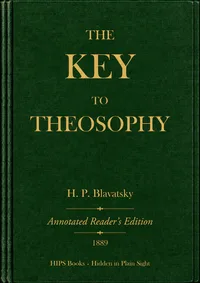
Her influence is hard to overstate. The Society moved its headquarters to India and helped bring Hindu and Buddhist ideas to Western readers. As a law student in London, Mohandas Gandhi read Blavatsky's Key to Theosophy, and in his Autobiography credits it with making him want to read books on Hinduism. Painters such as Kandinsky and Mondrian drew on Theosophy, and Rudolf Steiner began inside it before founding Anthroposophy. Much of today's spiritual vocabulary, such as the astral body, the Akashic records and ascended masters, reached a wide audience through Theosophy. See our guides to what Theosophy is and Helena Blavatsky's life and books.
What does "occult" actually mean?
It simply means hidden, from the Latin occultus. Doctors still test for "occult blood", blood you cannot see, and astronomers say the Moon "occults" a star when it passes in front of it. In the Renaissance, "occult" described the hidden powers of nature, such as the way a magnet pulls iron without touching it. In 1533 Cornelius Agrippa published Three Books of Occult Philosophy, a vast map of astrology, natural magic and Kabbalah.
The word "occultism" appeared only in the nineteenth century: the French magician Éliphas Lévi made occultisme famous, and Blavatsky helped bring it into English. In 1888 London's Hermetic Order of the Golden Dawn began teaching ritual magic, astrology and tarot; the poet W. B. Yeats was a member, and much of modern tarot comes out of that world. The occult, then, is not a religion and not automatically dark. It is an umbrella for traditions that claim there is more to reality than meets the eye.
Where should you start reading?
Start small, with the sources:
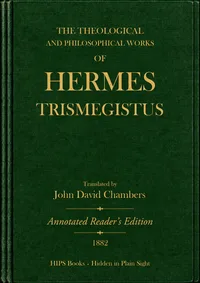
- Hermeticism: Poemandres, the first treatise of the Corpus Hermeticum, which can be read in one evening. Our annotated edition of the Hermes Trismegistus writings presents Chambers's 1882 translation with reader's guides.
- Gnosticism: the Gospel of Thomas, which can be read in an afternoon.
- The Kybalion: worth reading, as long as you know it is a book from 1908.
- Theosophy: Blavatsky's own beginner's introduction, The Key to Theosophy (1889), the book that sent Gandhi back to his own tradition. Our guide to its account of karma and reincarnation is a good companion.
Both HIPS editions are newly typeset, searchable PDFs, with vocabulary pages and reader guides kept separate from the historical text, and both are available from the HIPS Books Etsy shop.
Quick answers
What is the difference between Hermeticism and Gnosticism? Both are ancient traditions about a divine spark in humans. Hermeticism generally sees the cosmos as a reflection of God, while classic Gnostic myths see the material world as the work of a lesser, ignorant god.
Is Theosophy the same as Hermeticism? No. Theosophy is a modern movement founded in 1875 that drew on Hermetic, Gnostic, Hindu and Buddhist ideas, among others.
What does occult mean? Simply "hidden", from the Latin occultus. It is an umbrella term, not a religion.
Are the seven Hermetic principles ancient? No. They come from The Kybalion (1908), most likely written by William Walker Atkinson.
What was found at Nag Hammadi? In 1945, thirteen ancient books containing fifty-two Coptic texts, mostly Gnostic, including the Gospel of Thomas and several Hermetic writings.
Sources and further reading
- The Theological and Philosophical Works of Hermes Trismegistus, translated by John David Chambers (1882), Poemandres, in the HIPS annotated edition.
- H. P. Blavatsky, The Key to Theosophy (1889), in the HIPS edition; Isis Unveiled (1877); The Secret Doctrine (1888).
- The Kybalion, by "Three Initiates" (Chicago: Yogi Publication Society, 1908).
- M. K. Gandhi, An Autobiography, or The Story of My Experiments with Truth, Part I, on reading The Key to Theosophy.
- Cornelius Agrippa, De occulta philosophia libri tres (1533); Isaac Casaubon (1614), on the dating of the Hermetica.
- Film: HIPS Books, Hermeticism, Gnosticism & Theosophy: What's the Difference? (2026).