Ideas & reading guides
Can Metals Feel? Besant, Bose and Consciousness in 1904
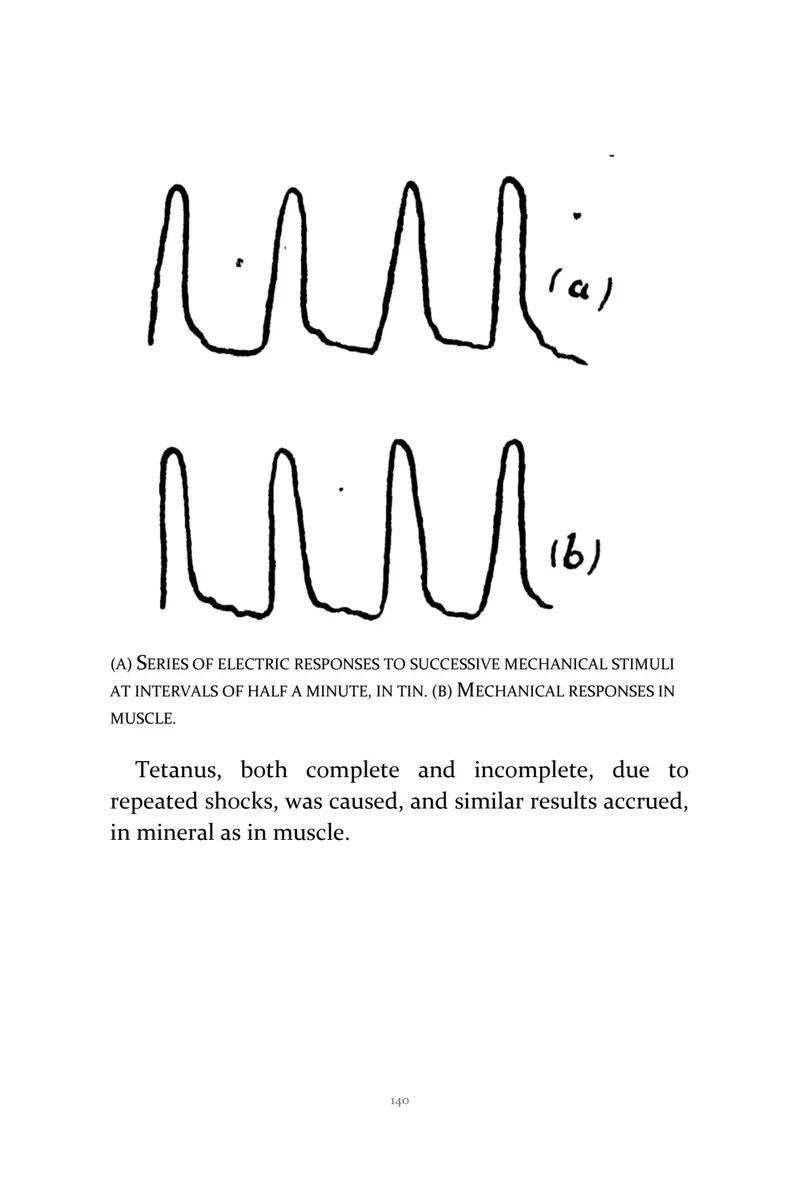
A metal responding to a stimulus is not, by itself, evidence that it has feelings. Annie Besant’s A Study in Consciousness makes a more complicated argument than the claim that a piece of tin feels pain like an animal. In the chapter discussing Jagadish Chandra Bose’s experiments, she explicitly distinguishes the animal’s feeling from the tin’s response.
Why, then, does a 1904 Theosophical book about consciousness reproduce curves comparing metals with muscle? Besant wanted to connect an account of universal life with physical observations. The interesting question is where the observations end and her interpretation begins.
Following that boundary reveals a genuine historical encounter between experimental work and religious philosophy. It also gives us a useful way to read any book that presents a scientific-looking diagram as support for a much larger claim.
What was A Study in Consciousness trying to explain?
A Study in Consciousness: A Contribution to the Science of Psychology asks how consciousness develops and expresses itself. Besant places the question within Theosophy, describing spiritual units, planes of existence and vehicles through which experience is supposed to become possible.
She does not begin from the position that consciousness is an accidental addition to an otherwise unconscious universe. A deeper unity of life is part of the framework she brings to the discussion. That starting point matters when she turns to physical experiments: she is looking for a connection with an existing philosophical commitment.
In Part I, Chapter VI, Unity of Consciousness, she discusses observations associated with Bose. In the current HIPS layout the main discussion runs through pages 135–149; the featured curve comparison appears on page 140. These are locations in this edition, not the pagination of the original printing.
The historical subtitle’s word science should not make us confuse the book with a current neuroscience textbook. Besant mixes religious premises, comparisons, reported experiments and her own interpretations. The task is to identify which kind of reasoning is operating at each point.
Readers unfamiliar with her terminology may find Man and His Bodies a more accessible introduction. The Besant biography explains why questions about suffering, mind and responsibility became so important in her work.
What did Jagadish Chandra Bose measure?
Bose’s Response in the Living and Non-Living, published in 1902, describes experiments on responses in living tissues and non-living materials. Its preface identifies earlier papers, including work presented at the Royal Institution and Royal Society. Chapters X–XII turn specifically to metals and the apparatus used to obtain consistent observations.
The measurements concern physical responses. Bose discusses stimuli, electrical changes, recording instruments and experimental conditions. These details are essential: a response curve is a record of something measured under particular conditions, not a picture of a private experience.
Besant uses comparisons between curves to support her claim of continuity across forms of nature. The illustration on her page 140 pairs electric responses in tin with mechanical responses in muscle. Notice the captions: the records being compared are not simply two readings of the same variable in identical systems.
A similarity in shape can be interesting. It may suggest a comparison worth investigating. But the curve’s shape does not tell us, by itself, that the systems share every property or that either one has the particular kind of consciousness a philosopher proposes.
That is a limit on the inference, not a dismissal of the experiment. We can take the recorded physical behaviour seriously while asking whether the next conclusion follows from it. Separating those questions is fairer to the scientist and to the philosophical writer than merging their projects into one.
Did Besant say that tin feels what an animal feels?
No. In the section on the meaning of physical consciousness, Besant distinguishes more than one use of that phrase. Ordinary waking awareness is one meaning. Consciousness receiving and responding to physical impacts is another, more restricted meaning in the argument she is making here.
On page 146 of the current HIPS edition she writes that the animal feels the stimulus while the tin does not. She explains the difference through activity in astral matter, which belongs to her Theosophical system. The distinction prevents a simplistic reading, but the explanation itself remains a metaphysical claim.
This is the central difficulty with a headline such as “Besant proved metals have feelings.” It misrepresents both the scope of the observations and a qualification Besant actually makes. Calling tin conscious in her restricted vocabulary is not equivalent to saying it has an animal’s sensations or a person’s reflective thought.
The opposite shortcut also fails. We should not silently replace her term with a modern definition, declare that she used it incorrectly and stop reading. First establish the definition she is using. Then ask whether the evidence supports that definition and what additional assumptions her explanation requires.
The guide to astral and etheric bodies explains some of the machinery she invokes. It makes the proposed explanation easier to follow; it does not independently confirm it.
Where does the interpretation go beyond the measurement?
The leap occurs when a physical response becomes evidence for an entire account of consciousness. Besant’s larger framework includes planes and processes that the response curve does not itself record. A reader needs to keep those additional commitments visible.
| What is being discussed? | What it can contribute | What it does not establish by itself |
|---|---|---|
| A material responds to a stimulus | A physical observation under specified conditions. | That the material has sensations or thoughts. |
| Two response curves resemble each other | A comparison that may suggest shared or comparable behaviour. | That the systems have every relevant property in common. |
| Besant calls the response physical consciousness | A definition within her account. | That her whole Theosophical explanation has been experimentally tested. |
An everyday comparison makes the logical problem easier to see. A thermometer changes when its surroundings warm up. A person also responds to warmth. The fact of response alone does not tell us that the thermometer experiences the room as the person does. This is a modern illustration of the inference problem, not a claim that it reproduces Bose’s experiment.
The more ambitious the conclusion, the more work is needed to connect it to the observation. A theory about subjective experience needs more than a label attached to a physical trace. It also needs an explanation of why that trace should distinguish the proposed experience from other possible accounts.
This is why the book is most revealing when read closely rather than quoted for a spectacular sentence. Its effort to connect kinds of evidence becomes visible, including the places where confidence carries more weight than the measurements can bear.
What do the N-rays tell us about the book’s evidence?
The same chapter appeals to reports of N-rays, a supposed radiation discussed during this period. Besant treats reported similarities involving animals, plants and metals as further confirmation of her account. For a modern reader, this part of the chapter needs explicit historical correction.
The N-ray claims did not survive scrutiny. The American Physical Society’s history of Robert Wood’s investigation describes his 1904 visit to René Blondlot’s laboratory. Wood removed a prism essential to one demonstration without the observers knowing, yet the claimed pattern continued to be reported. His critical report appeared in Nature in September 1904.
The lesson is not that every historical scientist was foolish. It is that expectation can help produce a convincing report when an effect is difficult to observe and controls are inadequate. The appeal of a result cannot replace a check on whether it remains when the conditions are changed.
It is equally important not to use the N-ray episode to dismiss Bose’s separate experiments as though they were the same programme. Besant brings different lines of supposed confirmation together. Each must be assessed on its own evidence, rather than accepted or rejected as one indivisible package.
This makes the chapter particularly valuable as a historical source. We can watch an author incorporating reports that seemed supportive at the time, including one that later became a classic example of failed confirmation. Preserving that passage is useful; silently modernizing it into a successful discovery would erase the lesson.
Does any of this settle whether consciousness is everywhere?
No. Besant’s chapter does not settle that philosophical question, and the failure of a particular supporting example does not automatically answer every possible version of it either. The useful conclusion is narrower: the physical responses described here do not, on their own, establish her larger theory.
The book is still worth reading if the question interests you. It shows an author trying to resist a sharp separation between living and non-living nature. It also reveals how definitions, observations and prior beliefs can become entangled when the subject is difficult to measure.
That distinction matters beyond this one work. A scientific term can move into a philosophical argument with its familiar authority attached, while its meaning changes. Words such as energy, vibration and consciousness need to be checked in context rather than treated as automatic bridges between different subjects.
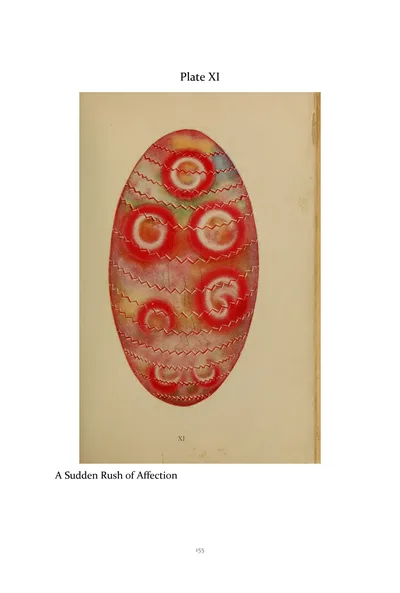
The same care helps with the vivid pictures in Thought-Forms. A visual representation can explain what an author proposes without proving that the proposal is correct. And in Atkinson’s Thought Vibration, physical analogies also carry conclusions about mental influence that need their own support.
How can you read the chapter critically without losing its interest?
Make three short notes as you read: the observation, the definition and the conclusion. Put a statement in more than one column if necessary, but do not let the columns disappear. Besant’s account becomes clearer when you can see which step connects the physical report with the proposed spiritual explanation.
Then check the qualifications. The line distinguishing the animal’s feeling from tin’s response is not a small detail; it changes the meaning of the entire discussion. The notes identifying Bose’s work also let a reader compare the sources instead of relying only on Besant’s retelling.
Finally, look for independent tests and alternative explanations. Asking those questions does not prevent sympathetic reading. It is how a reader takes an ambitious claim seriously enough to examine it rather than merely admire or ridicule it.
Our annotated edition of A Study in Consciousness includes the historical diagrams, linked notes, vocabulary and reader guides. The modern support is separate from Besant’s text. For an easier route through the wider writing, see where to start with her books.
The answer is more interesting than either “metals think” or “there is nothing to read here.” Besant used a particular definition of physical consciousness to connect response experiments with universal life. Seeing exactly where that connection depends on interpretation is the point of reading the chapter well.
Sources and edition notes
Primary reading: Besant’s A Study in Consciousness (1904), Part I, Chapter VI, including its definition of physical consciousness and notes on Bose; Bose’s Response in the Living and Non-Living (1902), especially the preface and chapters on metals. The N-ray correction follows the American Physical Society’s historical account and Wood’s 1904 Nature report, The n-Rays. The explanations of inference and the thermometer comparison are modern HIPS commentary. Nothing here presents historical response curves as a medical or psychological diagnostic method.