Ideas & reading guides
Hermes Trismegistus: The Book That Fooled the Renaissance
Hermes Trismegistus ("Thrice-Greatest Hermes") is the legendary Egyptian sage to whom the Corpus Hermeticum was attributed: a collection of Greek dialogues about God, the cosmos and the human soul. Renaissance Europe believed he was as old as Moses and had taught the wisdom that reached Plato. In 1614 the scholar Isaac Casaubon showed from the Greek that the texts were written in the first centuries after Christ.
The writings are real and still worth reading; what fell was their claim to extreme age. Our film The Book That Fooled the Renaissance tells the story, and this guide sets it out in writing.
 16:08
Watch · HIPS Books on YouTube
The Book That Fooled the Renaissance | Hermes Trismegistus
Why Renaissance Florence believed Hermes Trismegistus was as old as Moses, what the Corpus Hermeticum actually says, and how Isaac Casaubon dated it in 1614.
Plays from YouTube when you press play.
Who was Hermes Trismegistus?
He was not a historical person but a figure created when Greek and Egyptian religion merged. After Alexander the Great, Greeks living in Egypt identified the Egyptian god of writing and wisdom, Thoth, with their own Hermes, messenger of the gods. Over centuries the two blended into "Hermes the Thrice-Greatest": not quite a god and not quite a man, but a wise Egyptian who had written everything down.
Ancient writers credited him with an enormous library. The early Christian writer Clement of Alexandria counted forty-two books by him, on the stars, hieroglyphics, hymns and the discipline of priests. Christians admired him rather than condemning him. Lactantius, tutor to the son of the Emperor Constantine, wrote that "Trismegistus who, I know not how, investigated almost all truth", because Hermes seemed to have foreseen one God, a divine Word and a son of God, long before Christ.
Why did Cosimo de' Medici make Plato wait?
Because he believed Hermes was older and wiser than Plato. In Florence around 1463, Cosimo de' Medici, old and ill, had set the young scholar Marsilio Ficino to translate the complete works of Plato. Then a Greek manuscript of the Hermetic writings arrived, brought from Macedonia by Cosimo's agents, and Cosimo ordered Ficino to put Plato aside and translate Hermes first.
Ficino finished in a few months, and his Latin was printed in 1471. The legend grew quickly. In 1488 Hermes was set in inlaid marble at the entrance of Siena Cathedral, with an inscription calling him a contemporary of Moses. By 1591 the philosopher Francesco Patrizi could claim that "all the Greek philosophies" were "all taken from these his books."
What does the Corpus Hermeticum say?
It asks one question in many forms: what is a human being, really? The collection is a set of short dialogues, mostly Hermes teaching his son Tat or his pupil Asclepius. Read together, they answer in five steps. The quotations below are from John David Chambers's 1882 English translation.
1. Where we came from. The first treatise, Poemandres, opens with Hermes in deep meditation when a vast presence speaks: "'I, indeed,' He says, 'am Poemandres, The Mind of The Supreme Power.'" He shows Hermes the creation of the world from light and dark water, and the first human, made in God's image, who sees his reflection in nature and falls in love with it. Nature "smiled for love", and the human came down to live with her. That, the book says, is why we are double: "mortal indeed because of the body, immortal because of the essential Man."
2. What went wrong. The problem is not sin but ignorance: we have forgotten what we are. One discourse shouts at the reader: "Whither are ye carried, O men, intoxicated!" and calls the body "the living death, the sentient corpse, the tomb carried about with thee."
3. What we could be. This is the passage that thrilled the Renaissance:
"The Man upon earth is a mortal God, but the Heavenly God an immortal Man."
No god comes down from heaven, it says, "but the Man ascends unto the Heaven, and measures it." It even offers an exercise: "command the Soul of thine to proceed to India, and quicker than thy command it will be there."
4. How we change. In the best scene in the book, Tat is promised the secret of rebirth and loses patience. Hermes can only answer: "This kind, O Son! is not taught." Tat replies, in what may be the most relatable line in ancient philosophy, "I am really maddened, O Father!" Then Hermes drives out twelve inner "tormentors" with ten divine powers, and Tat cries: "I am in heaven, in earth, in water, in air."
5. What happens at death. "The dissolution is not death, but the dissolution of the mixture." The soul climbs through the seven planetary spheres, handing back a vice at each, until it reaches the eighth level: "This is the good ending of those attaining knowledge, to be made divine."
The book also contradicts itself. One passage calls the world "the plenitude of the evil", while another treats it as a living second god. Another insists the student must first "hate the body". Those contradictions turned out to be a clue.
How did the Hermetic writings influence the Renaissance?
They gave Renaissance thinkers an ancient-seeming authority for a high view of human beings. In 1486 the young Pico della Mirandola opened his famous oration on the dignity of man with a line from the Hermetic Asclepius: "a great miracle, Asclepius, is man." In 1543 Copernicus, placing the Sun at the centre of the universe, mentioned that Trismegistus called it a visible god (one line, which historians warn not to overstate). In 1600 the philosopher Giordano Bruno, an admirer of the "Egyptian" religion of Hermes, was burned for heresy in Rome; how much Hermes contributed to that remains debated.
For about a century and a half, very few people doubted that Hermes was ancient.
How did Isaac Casaubon prove the Hermetica were not ancient?
He read the Greek closely and showed it belonged to a much later age. Casaubon, perhaps the finest Greek scholar of his time, moved to London in 1610 under the patronage of King James I. He was not interested in occult books. He was refuting the Catholic historian Cardinal Baronius, who used Hermes as evidence that God had revealed Christian truths to the pagans.
Casaubon asked a simple question: what century does this Greek sound like? Its vocabulary and style were those of late antiquity, not the age of Moses, and its parallels with Plato and the Gospel of John came from those sources, not before them. He said so in print in 1614, the last year of his life. Chambers later put the same argument plainly in his preface:
"It is, moreover, quite impossible that an author who shows an intimate acquaintance with the phraseology of Plato … can have flourished at so early a period."
The legend was reversed: Plato did not learn from Hermes; the writers of Hermes had learned from Plato. Most scholars now date the Corpus Hermeticum to roughly the first to third centuries CE, written in Greek in Roman Egypt by several anonymous authors, which explains the contradictions. Chambers himself still thought it was one man, a Greek of Alexandria who "assumed the name of Hermes in order to give greater weight to his teaching."
Not everyone accepted the news at once. In 1645 John Milton could still publish a poem about a scholar sitting up at midnight "with thrice-great Hermes."
Was there anything Egyptian in the Hermetica at all?
Possibly more than Casaubon thought. In December 1945, near Nag Hammadi in Upper Egypt, farmers digging for fertile soil found a sealed jar of ancient books. Among them were Hermetic texts written in Coptic, including one in which a teacher leads a student up to the eighth and ninth levels, the same ascent described in the Corpus Hermeticum. Many scholars now see genuine Egyptian threads woven into these Greek writings. The date was wrong, but the Egypt may not have been entirely a costume.
Our guide to Hermeticism, Gnosticism, Theosophy and the occult explains how the Nag Hammadi find connects the Hermetic and Gnostic traditions.
Is "as above, so below" from the Corpus Hermeticum?
No. "As above, so below" is a loose modern paraphrase of a different text, the Emerald Tablet, first known in Arabic and later translated into English by Isaac Newton. It became the motto of alchemy, whose practitioners took Hermes as their patron, which is why something tightly closed is still called "hermetically sealed."
Nor are the famous "seven Hermetic principles" ancient. They come from The Kybalion, an American book of 1908. Our article Who Really Wrote The Kybalion? follows the evidence that it was written by William Walker Atkinson, and our introduction to Hermeticism and the seven principles compares the two traditions.
| Corpus Hermeticum | Emerald Tablet | The Kybalion | |
|---|---|---|---|
| Date | c. 1st–3rd centuries CE | known from Arabic, c. 8th–9th century | 1908 |
| Language | Greek | Arabic, then Latin | English |
| Form | Dialogues and revelations | A short alchemical text | Seven principles with commentary |
| Famous for | "A mortal God" | "As above, so below" | The seven Hermetic principles |
Why read the Hermetica today?
Because Casaubon took away their age, not their question. The Corpus Hermeticum is still one of the most vivid documents of ancient spirituality: a father and son on a mountain, a mind sent across the world in an instant, a soul climbing past the planets. It shaped Renaissance philosophy, alchemy, and centuries of esoteric thought, and it asks a question that has not gone away: is a human being "a sentient corpse" or "a mortal God"? The same book says both.
None of this makes its claims about the soul or the planets true. But it is the original Hermes, and far stranger and more alive than the modern summaries suggest.
Where can you read the Corpus Hermeticum in English?
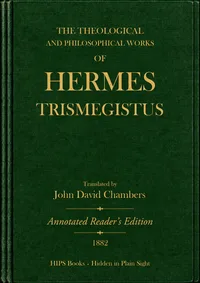
Start with Poemandres, then the dialogue on rebirth (Discourse XIII), the mountain scene above. Our annotated reader's edition of The Theological and Philosophical Works of Hermes Trismegistus presents John David Chambers's 1882 translation, the one quoted throughout this article. Chambers, an English lawyer and church scholar, complained that these writings "have been unaccountably neglected in England", and translated them as literally as he could.
The HIPS edition keeps his words and adds help around them: a short vocabulary before each discourse, and a summary, key ideas and reflection questions after it, all clearly marked as ours. It also includes the excerpts preserved by Stobaeus and what the early Church writers said about Hermes, and it notes where Chambers reads Hermes as more Christian than most scholars would today. It is a 261-page searchable PDF, available on Etsy as an instant download.
Quick answers
Was Hermes Trismegistus a real person? No. He was a legendary figure formed from the Greek god Hermes and the Egyptian god Thoth; the writings under his name were composed by several anonymous authors.
When was the Corpus Hermeticum written? Most scholars date it to roughly the first to third centuries CE, in Roman Egypt, not the age of Moses.
Who proved the Hermetica were not ancient? Isaac Casaubon, in 1614, by analysing their Greek language and style.
What is the main teaching of the Corpus Hermeticum? That the human being is a fallen but divine mind, "a mortal God", who can return to God through knowledge.
Is "as above, so below" in the Corpus Hermeticum? No. It paraphrases the Emerald Tablet, a different text first known in Arabic.
Sources and edition notes
- Primary text: The Theological and Philosophical Works of Hermes Trismegistus, translated by John David Chambers (1882): his preface, Poemandres and the later discourses, including the dialogue on regeneration, in the HIPS annotated edition, from which all quotations of the Hermetica in this article are taken.
- Isaac Casaubon, De rebus sacris et ecclesiasticis exercitationes XVI (London, 1614), on the dating of the Hermetic texts.
- Pico della Mirandola, Oration on the Dignity of Man (1486); Copernicus, De revolutionibus (1543); Milton, "Il Penseroso" (published 1645).
- Film: HIPS Books, The Book That Fooled the Renaissance | Hermes Trismegistus (2026).