About the book
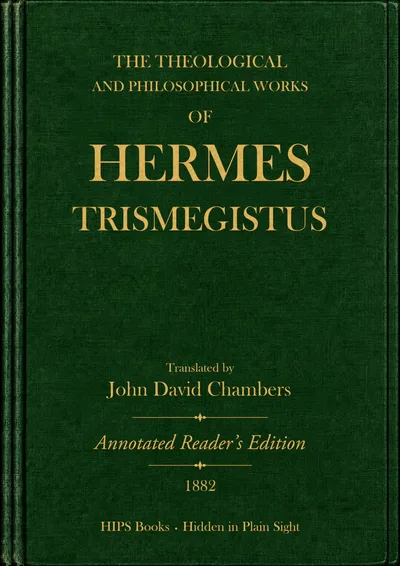
The Theological and Philosophical Works of Hermes Trismegistus presents John David Chambers’s 1882 English translation of fourteen Hermetic discourses, including Poemandres, dialogues with Tat and Asclepius, excerpts preserved by Stobaeus, notices in early Christian writers and the original index. The historical wording is retained in a newly typeset, searchable A4 reading edition.
Clearly labelled Editorial Reader’s Guides follow every continuous discourse and both later collections. They offer a summary, key terms, a critical-reading lens and questions for reflection, helping readers trace recurring ideas such as Mind, Word, cosmic order, fate, self-knowledge and regeneration.
This edition keeps the historical translation distinct from new editorial material. Chambers’s nineteenth-century Christian Neoplatonist framing and biblical comparisons are presented as part of that translation’s historical reception, not as settled modern scholarship on the date, authorship or religious identity of the Hermetic treatises.
What this edition includes
Includes the 1882 translator’s preface, fourteen continuous discourses, Stobaeus excerpts, notices of Hermes in the Fathers, the original index, an editorial glossary, clickable contents and PDF outline, plus sixteen Editorial Reader’s Guides. The original translator’s separate apparatus of Greek variants, biblical parallels and source citations has been omitted; the translated discourses themselves have not been abridged.
Inside the book: selected contents
A reading overview, not the complete text.
- Poemandres: a vision of creation becomes a discussion of human origins, divine Mind and spiritual ascent.
- To Asclepius: Catholic Discourse: movement, space and the incorporeal are considered through a philosophical dialogue. Here “catholic” means universal, not a modern church affiliation.
- The Crater, or Monas: Hermes addresses Tat about the gift of Mind and participation in divine understanding.
- That the Invisible God Is Most Manifest: the visible world is used to consider an unseen divine source.
- Secret Discourse about Regeneration: Tat asks about rebirth; the dialogue moves toward transformation, praise and silence.
- Collected excerpts and notices: material preserved by Stobaeus and references in Christian writers follow the discourses.
This is John David Chambers’s 1882 translation collection, not every surviving work in the wider Hermetica.
Key concepts for reading
HIPS editorial explanations of the historical text.
- Hermes Trismegistus: the legendary teacher to whom these writings are attributed, rather than a securely documented single author.
- Corpus Hermeticum: a collection of ancient philosophical and religious dialogues; not a synonym for every Hermetic text.
- Mind: a divine and knowing principle in these dialogues, not merely an individual’s passing thoughts.
- Poemandres: the revelatory divine Mind who instructs Hermes in the opening discourse.
- Regeneration: spiritual rebirth into a changed relationship with the divine, as presented by the text.
A sample from the reader’s guide
Modern HIPS editorial material — not the historical author’s words.
Hermes enters an altered contemplative state and encounters Poemandres, the divine Mind. The vision unfolds as a cosmogony: light, darkness, moist nature, the holy Word, the elements, and the seven cosmic Administrators appear in an ordered sequence. The archetypal Human, made in the image of the Father, beholds the created order and becomes joined to material nature.
The discourse then turns from origins to spiritual practice. Human beings are double—mortal in bodily composition yet immortal in their essential humanity—and their post-mortem ascent reverses the accretions of the seven spheres. Knowledge of one’s divine source, joined to ethical purification and thanksgiving, is presented as the route back to Life and Light.
Excerpt: HIPS Reader’s guide, I. Poemandres, page 21 of the supplied 116-page edition.
Before you buy
How is this different from an archive scan?
An archive scan preserves photographed pages. This is a prepared reading edition: reset text and modern reading support, with the historical author’s words kept distinct. The edition details and preview pages above show what is included in this particular book.
What will I receive, and where do I buy it?
This is a digital PDF edition, not a printed book. The Etsy listing is the place to check the current PDF price and delivery details, and to complete your purchase. Payment and digital delivery are handled by Etsy. A separate Kindle edition is available through the Amazon button. Amazon handles that purchase and delivery; its layout and pagination may differ.
Can I read or print the PDF?
You can read a PDF in a compatible viewer on a computer or tablet. Check the Etsy listing and the edition’s terms for printing permissions and paper size before buying. PDF support and navigation vary by device; this is not an EPUB or a physical copy.