Ideas & reading guides
Who Really Wrote The Kybalion? The Three Initiates Unmasked
The Kybalion was almost certainly written by William Walker Atkinson (1862–1932), a Chicago lawyer, magazine editor and prolific New Thought author. The book appeared in 1908 under the name "Three Initiates", from Atkinson's own Yogi Publication Society, and his 1912 entry in Who's Who in America lists "The Kybalion, 1908" among the books he published anonymously. It is not an ancient Egyptian text.
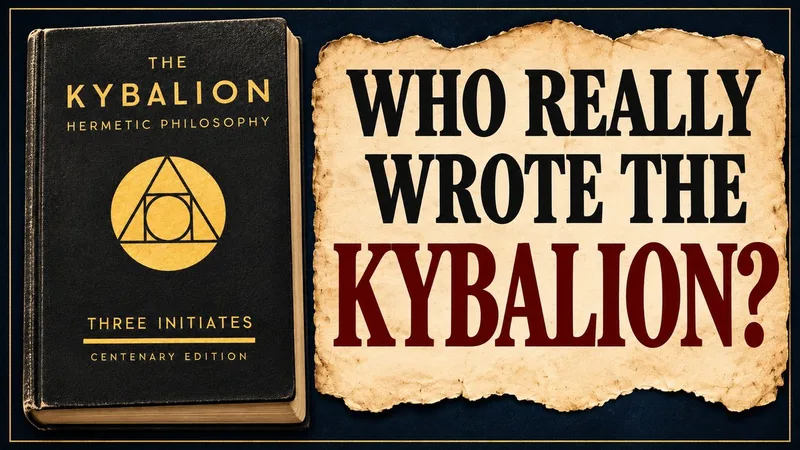
The evidence comes from the paper trail: the 1908 title page, the US copyright register, Chicago magazine mastheads, library copies with a pencilled name, Who's Who, and the book's own words. Our film Who Really Wrote The Kybalion? follows that trail on the original scans; this guide sets out the same evidence in writing.
 9:11
Watch · HIPS Books on YouTube
Who Really Wrote The Kybalion? The Three Initiates Mystery
The Kybalion (1908) claims "Three Initiates" and an ancient Egyptian source. The title page, copyright register, Who’s Who and the text itself point to William Walker Atkinson.
Plays from YouTube when you press play.
Who wrote The Kybalion?
William Walker Atkinson, on the strongest evidence available, possibly with help that no surviving document records. Six separate lines of evidence point the same way:
| Evidence | What it shows |
|---|---|
| 1908 title page | Published by "The Yogi Publication Society, Masonic Temple, Chicago" |
| 1908 copyright register | Copyright held by the Yogi Publication Society, with no author's name |
| Yogi Publication Society | The publisher of Atkinson's books as "Yogi Ramacharaka" from 1903 |
| Library copies | Librarians pencilled "William Walker Atkinson" into Yogi Ramacharaka books |
| Who's Who in America, 1912–13 | Atkinson's entry lists "The Kybalion, 1908" among his anonymous works |
| The text itself | Atkinson's favourite quotations, vocabulary and phrasing |
None of these alone is proof. Together they make Atkinson the only author any 1908-era document points to. The historian Philip Deslippe reached the same conclusion in the introduction to The Kybalion: The Definitive Edition (Tarcher/Penguin, 2011), which prints the book under Atkinson's name.
What does The Kybalion claim about itself?
That it preserves a secret teaching of Hermes Trismegistus, handed down orally since ancient Egypt. The book is dedicated "To Hermes Trismegistus, known by the ancient Egyptians as 'The Great Great' and 'Master of Masters'." Its first chapter places Hermes in Egypt "long before the days of Moses", adding that the best authorities regard him as "a contemporary of Abraham".
His teachings, the book says, survived in a collection of sayings called the Kybalion, whose precepts have "never been written down", passed instead from master to student, "from lip to ear". The book's most quoted line sets the tone of secrecy:
"The lips of wisdom are closed, except to the ears of Understanding."
Notice what that asks a reader to believe: that an unwritten Egyptian teaching survived for thousands of years and was then printed for the first time, in Chicago, in 1908.
Who were the Three Initiates?
The book never says. "Three Initiates" is the only name on the title page, and nothing inside identifies them. That anonymity was part of the appeal: a secret brotherhood of three suggests a lineage of hidden masters far better than a single author at a desk.
But the people who produced the book left records, and those records name one man.
What does the 1908 paper trail show?
It shows a Chicago publisher with an office address and no author's name. Start at the foot of the title page: "The Yogi Publication Society, Masonic Temple, Chicago." The name sounds like a secret lodge, but Chicago's Masonic Temple, completed in 1892, was a commercial skyscraper, with shops and a theatre at street level, offices above and lodge halls at the top. The Three Initiates had their mail delivered to an office building.
Next, the copyright. US publishers sent two copies of each copyrighted book to the Library of Congress. The government's Catalog of Copyright Entries for 1908 records the arrival on June 13, 1908:
"The Kybalion; a study of the hermetic philosophy of ancient Egypt and Greece, by three initiates … Copyright by Yogi publ. society, Chicago, Ill."
Not one human name appears, even on the official record. The question becomes: who was the Yogi Publication Society?
Who was William Walker Atkinson?
A Baltimore-born lawyer who became one of the most productive writers of the American New Thought movement. Atkinson was born in 1862, spent twelve years in business, and was admitted as a lawyer in Pennsylvania in 1894. Later accounts say overwork broke his health and that he recovered through the "mind-power" ideas then sweeping America.
That movement, New Thought, taught that thoughts shape health and circumstances: the self-help of its day. Chicago was one of its capitals, and Atkinson threw himself into it. He was associate editor of the Chicago magazine Suggestion by 1900, and by January 1905 the masthead of New Thought magazine read: "Editor: William Walker Atkinson." He wrote fast, on memory, willpower, success and the mind.
In 1903 he was admitted to the bar in Illinois, and the same year a new author appeared: "Yogi Ramacharaka", supposedly a teacher from India, published by the Yogi Publication Society. Library copies give him away. On the Library of Congress copy of Hatha Yoga (1904), someone pencilled "William Walker Atkinson … pseud." on the title page; on Cornell University's copy of Gnani Yoga, "Atkinson, William Walker, 1862–" is written under the copyright line.
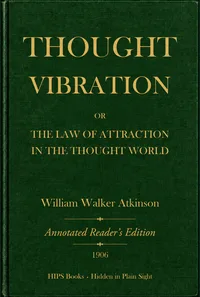
In 1906, under his own name, he published Thought Vibration, or the Law of Attraction in the Thought World. Two years later came The Kybalion, from the same Yogi Publication Society. He kept writing for another two decades under his own name and many others, and died in Los Angeles in 1932.
What does Who's Who in America say about The Kybalion?
It lists it as Atkinson's. The 1912–13 volume of Who's Who in America gives Atkinson more than thirty books under his own name, then adds that he also wrote as "Yogi Ramacharaka", and then:
"Also, anonymously: The Law of Financial Success, 1907; The Kybalion, 1908; Thoughts Are Things, 1909; 'The Arcane Series' …"
This is the single most important document. Who's Who entries were not written by outsiders guessing: the book's preface states that "the subject of each sketch has been given opportunity to scrutinize and revise the data pertaining to himself," and speaks of its "autobiographical character." Atkinson had every chance to correct that line. He let it stand, four years after The Kybalion appeared.
Does the text of The Kybalion point to Atkinson?
Yes. The book's language carries the fingerprints of an American New Thought writer, not an ancient sage.
- An American dictionary. In its chapter on cause and effect, this supposedly Egyptian teaching stops to say: "Webster defines the word 'Chance' as follows". Webster's is an American dictionary.
- A Victorian philosopher. It praises Herbert Spencer, the English philosopher who died in 1903, quotes his phrase "an Infinite and Eternal Energy, from which all things proceed", and even says Hermetists believe Spencer was a reincarnation of an ancient Egyptian philosopher who later returned as Heraclitus. Atkinson used the same Spencer phrase under his own name in Practical Mental Influence (1908) and The Mastery of Being (1911).
- Shared vocabulary. The anonymous "Arcane" books, also listed in Atkinson's Who's Who entry, speak the Kybalion's language: the Law of Rhythm, the principle of Polarity, Mental Transmutation.
For the film, we also compared the Kybalion's wording with thirteen of Atkinson's books and two control books by other mind-power writers of the same years, counting the six-word phrases each shares with the Kybalion per 10,000 words:
| Book or group | Shared six-word phrases per 10,000 words |
|---|---|
| Atkinson's books under his own name and as "Yogi Ramacharaka" | 3.8 to 12.1 |
| The anonymous Arcane Teaching (from a modern reprint of the 1909 series) | 20.2 |
| R. W. Trine, In Tune with the Infinite (1897) | 2.4 |
| T. J. Hudson, The Law of Psychic Phenomena (1893) | 1.9 |
Every Atkinson book shares more of the Kybalion's exact wording than either control. That is not proof on its own, because New Thought writers borrowed from one another, but it is what one writer's habits look like.
Did Paul Foster Case or someone else help write The Kybalion?
Possibly, but no evidence from 1908 says so. Some later writers have suggested co-authors, most often the American occultist Paul Foster Case, partly to explain the "Three" in "Three Initiates". Publishers still disagree: Penguin's 2011 Definitive Edition names Atkinson, while its 2018 Centenary Edition keeps the "Three Initiates" byline.
The documented record is narrower. No title page, copyright entry or contemporary reference names anyone except Atkinson. A simpler explanation for the "three" lies in his other pen names: Yogi Ramacharaka, Swami Panchadasi, Theron Q. Dumont and Magus Incognito are all believed to be his. An Indian yogi sells a book on yoga better than a Chicago lawyer does, and three secret initiates sell ancient wisdom better than one man.
Is The Kybalion an ancient Hermetic text?
No. No ancient text called the Kybalion has ever been found, and the word itself, though it looks Greek, has no known meaning in Greek, as scholars such as N. E. Chapel have pointed out. The book is an American work of 1908.
Real Hermetic writings do exist. They are Greek texts from Roman Egypt, collected as the Corpus Hermeticum and attributed to Hermes Trismegistus. In 1614 the scholar Isaac Casaubon showed from their language and ideas that they were written in the first centuries after Christ, not in the age of Moses. They open in a very different voice from the Kybalion. In the first treatise, Poemandres, a divine being appears to the narrator:
"'I, indeed,' He says, 'am Poemandres, The Mind of The Supreme Power.'"
The genuine Hermetica share some ideas with the Kybalion, above all a divine Mind behind the world. But they contain no list of seven principles and no mention of a Kybalion.
| The Kybalion | The Corpus Hermeticum | |
|---|---|---|
| Date | 1908, Chicago | c. 1st–3rd centuries CE, Roman Egypt |
| Author | "Three Initiates"; most likely W. W. Atkinson | Anonymous writers, attributed to Hermes Trismegistus |
| Language | English | Greek |
| Form | Seven principles with commentary | Dialogues and revelations |
| Influences | New Thought, Victorian science and philosophy | Greek philosophy, Egyptian religion |
Our guide to Hermeticism and the Corpus Hermeticum explains the real tradition in more depth.
What are the seven Hermetic principles in The Kybalion?
They are the book's core teaching, each summed up in a short maxim:
- Mentalism: "THE ALL IS MIND; The Universe is Mental."
- Correspondence: "As above, so below; as below, so above."
- Vibration: "Nothing rests; everything moves; everything vibrates."
- Polarity: "Everything is Dual; everything has poles; everything has its pair of opposites."
- Rhythm: "Everything flows, out and in; everything has its tides."
- Cause and Effect: "Every Cause has its Effect; every Effect has its Cause."
- Gender: "Gender is in everything; everything has its Masculine and Feminine Principles."
Seen in its real setting, the system makes sense: it is New Thought's belief in the creative power of mind, joined to old Hermetic vocabulary and to the science of the 1900s, with its vibrations and energies. Compare it with Atkinson's own Thought Vibration and our article on New Thought vs Theosophy to see the family resemblance.
Does it matter who wrote The Kybalion?
It matters for what the book claims to be, not for whether it is worth reading. Many readers keep The Kybalion close and say its principles changed how they live. Learning that it comes from 1908 Chicago does not make those principles useless. It means they should be judged on their own merits, by how well they hold up in a reader's life, rather than on a claim of ancient authority that the evidence does not support.
What the authorship does change is how to read the book: as one of the most successful works of American New Thought, written by a man who knew exactly how to package ideas for his audience, and not as a window into ancient Egypt.
Where can you read what Hermes Trismegistus really wrote?
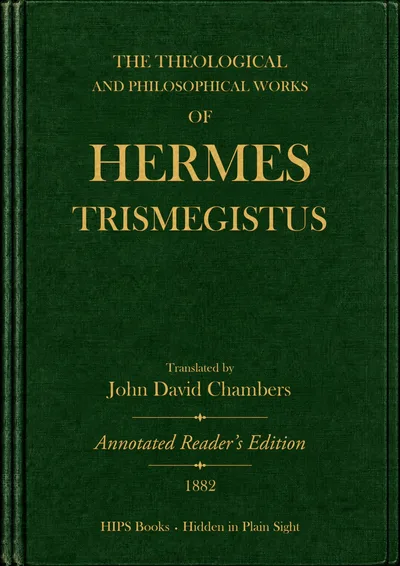
If the Kybalion made you curious about Hermes, go to the source. Our annotated reader's edition of The Theological and Philosophical Works of Hermes Trismegistus presents John David Chambers's 1882 English translation of fourteen Hermetic discourses: Poemandres, the dialogues with Tat and Asclepius, the Secret Discourse about Regeneration, and the fragments preserved by Stobaeus and early Christian writers.
It is newly typeset as a searchable 261-page PDF, with a reader's guide after every discourse, a glossary of key terms such as Mind, Word and regeneration, and reflection questions. It is the book to read after the Kybalion, because it shows what the real Hermetic tradition says. You can buy it on Etsy as an instant download.
To see the Kybalion's other parent, read Atkinson's Thought Vibration (1906), his law-of-attraction book written under his own name two years earlier.
Quick answers
Who wrote The Kybalion? William Walker Atkinson, on the strongest evidence. His 1912 Who's Who in America entry lists "The Kybalion, 1908" among his anonymous books.
Who were the Three Initiates? A pen name. No document from 1908 identifies three people, and the publisher, the Yogi Publication Society, was Atkinson's.
When was The Kybalion written? It was published in Chicago in 1908; the copyright copies reached the Library of Congress on June 13, 1908.
Is The Kybalion ancient? No. No ancient Kybalion has ever been found. The genuine Hermetic texts are Greek writings from the early centuries CE and contain no seven principles.
Did Paul Foster Case write The Kybalion? There is no 1908 evidence that he did. Some later writers suggest he contributed, but the documents name only Atkinson.
Sources and further reading
- The Kybalion: A Study of the Hermetic Philosophy of Ancient Egypt and Greece, by "Three Initiates" (Chicago: The Yogi Publication Society, Masonic Temple, 1908), first-edition scan at the Internet Archive: dedication; ch. I; ch. II (the seven principles); ch. VI (Herbert Spencer); ch. XII (Webster on "Chance").
- Catalog of Copyright Entries, 1908, Part 1, Books, Group I, no. 2 (July 9, 1908), p. 38.
- Who's Who in America, vol. VII (1912–13), A. N. Marquis & Co., pp. 62–63, "Atkinson, William Walker", and the preface.
- Yogi Ramacharaka, Hatha Yoga (Library of Congress copy) and Gnani Yoga (Cornell University Library copy), with Atkinson's name written in.
- Philip Deslippe, introduction to The Kybalion: The Definitive Edition (Tarcher/Penguin, 2011); Mitch Horowitz, "The Kybalion Without Tears"; N. E. Chapel, "The Kybalion's New Clothes," Journal of the Western Mystery Tradition 3, no. 24 (2013).
- John David Chambers, trans., The Theological and Philosophical Works of Hermes Trismegistus (1882), Poemandres, in the HIPS annotated edition.
- Film: HIPS Books, Who Really Wrote The Kybalion? (2026), with full chapter list and sources in its description.