Ideas & reading guides
What Is Hermeticism? The Corpus Hermeticum and Seven Hermetic Principles Explained
Hermeticism is a religious and philosophical tradition that explores the relationship between human beings, the universe, and the divine. It takes its name from Hermes Trismegistus, the legendary teacher to whom many Hermetic writings are attributed. Among its most important texts is the Corpus Hermeticum, a collection of ancient teachings about creation, the human mind, and spiritual understanding. Historical overview
At the heart of these writings is a question that remains easy to recognize: what are we, and how do we fit into the world around us? Their answers can be unfamiliar, but the questions are human ones. Why do we suffer? What deserves our attention? Can understanding ourselves change how we live?
You may have come across Hermeticism through the phrase “as above, so below,” or through the seven principles in The Kybalion. Those are useful starting points, but they belong to different parts of a long history. Understanding how they connect makes the subject much easier to follow.
Where did Hermeticism come from?
The ancient philosophical Hermetic writings developed in Egypt under Roman rule, where Greek and Egyptian traditions met. The texts in the Corpus Hermeticum are generally dated to the second and third centuries CE. They use Greek philosophical ideas to explore religious questions in a world also shaped by Egyptian beliefs. Origins and dating
Their teacher, Hermes Trismegistus, brings these influences together. His name means “Hermes the Thrice-Greatest,” and his figure connects the Greek god Hermes with the Egyptian god Thoth. Rather than a single known author whose life we can reconstruct, he is a legendary source of wisdom. Writing in his name gave the teachings the authority of an ancient, inspired teacher. Copenhaver’s introduction to Hermetica
This helps explain the way the books are written. Instead of presenting a modern textbook, they often show Hermes speaking with a pupil. The pupil asks a question, struggles with an answer, and gradually comes to see things differently. To understand Hermeticism, it helps to follow that learning process rather than begin with a list of rules.
What is the Corpus Hermeticum?
The Corpus Hermeticum is a collection of ancient Greek religious and philosophical writings attributed to Hermes Trismegistus. It is one of the main sources for studying Hermetic philosophy. Its subjects include God, the creation of the cosmos, the place of humanity within it, and the possibility of spiritual rebirth. The word corpus simply means a body or collection of writings. The collection and its contents
The opening treatise, usually called Poimandres or Poemandres, begins with someone deep in contemplation. A great presence appears and asks what he wants to understand. He wants to know the nature of things and to know God. What follows is a vision of the world's beginnings that gradually becomes an explanation of human nature. The question “Where did everything come from?” leads into another: “What does that mean for me?” Corpus Hermeticum I
The collection is important, but it does not contain every Hermetic writing. The broader body of literature, called the Hermetica, also includes the separate dialogue Asclepius, excerpts preserved by the ancient writer Stobaeus, and other surviving texts. Litwa’s introduction to Hermetica II
Other works attributed to Hermes concern astrology, alchemy, and magic. These also belong to the history of Hermeticism, although they differ from the philosophical dialogues discussed here. This is why two books described as “Hermetic” can seem quite different: they may be concerned with different subjects and come from different periods. Fowden’s The Egyptian Hermes
What does Hermetic philosophy teach?
A useful way into Hermetic thought is its relationship between the visible world and an invisible divine source. In the fifth treatise of the Corpus Hermeticum, Hermes asks his pupil Tat to consider the sun, the stars, and the formation of a human body. These familiar things become invitations to think about what makes their existence possible. The world is something through which a person may learn to recognize the divine. Corpus Hermeticum V
That raises a further question. If the world comes from a divine source, where do human beings belong? In Poimandres, humanity has a double nature: mortal through the body, yet connected to an immortal origin. Within this account, knowing yourself means more than recognizing your personality or preferences. It means understanding what you are beyond the body and its immediate needs. Corpus Hermeticum I
The texts connect this understanding with Mind, often translating the Greek word nous. Here, Mind has a spiritual meaning that goes beyond everyday thinking. In the fourth treatise, a great vessel filled with Mind is offered to humanity, and people are invited to immerse themselves in it. The image suggests that hearing about wisdom is only a beginning: the learner must participate in the understanding being offered. The same dialogue warns that attachment to bodily pleasures can keep a person from pursuing it. Corpus Hermeticum IV
This gives Hermetic self-knowledge an ethical purpose. In the thirteenth treatise, Tat asks Hermes about spiritual rebirth. As the teaching unfolds, ignorance, greed, and deceit give way to knowledge, generosity, and truth. Tat begins to describe himself and the world differently. Rebirth in this dialogue concerns a change in understanding and character, rather than simply describing another life after death. Corpus Hermeticum XIII
Read together, these passages show why Hermeticism combines philosophy and religion. It asks questions about reality, but also contains prayer, praise, and hopes of spiritual transformation. You do not have to accept its beliefs to find the questions worth studying. A careful reading begins by understanding what the texts claim and how they lead the pupil toward those claims.
How did these ancient ideas reach modern readers?
Hermetic writings travelled through several cultures and languages. One later text associated with Hermes, the Emerald Tablet, became important in alchemy. It circulated in Arabic before reaching Latin readers. The familiar saying “as above, so below” summarizes its statement about a relationship between what is above and what is below. It is not a quotation that sums up the entire Corpus Hermeticum. The Emerald Tablet and its transmission
Interest in the philosophical writings grew during the Renaissance, when Marsilio Ficino translated Greek Hermetic texts into Latin. Readers who believed Hermes lived around the time of Moses saw these works as wisdom older than Plato. Their supposed age helped give them enormous authority. Stanford Encyclopedia of Philosophy: Ficino
In 1614, Isaac Casaubon challenged that early dating. The texts came to be understood as products of a much later world, although their spiritual and philosophical appeal continued. Over time, new readers interpreted Hermetic ideas through their own interests and beliefs. Harvard’s introduction to Hermetic history
That continuing reinterpretation brings us to a book many people encounter before they ever hear of the ancient dialogues: The Kybalion.
What is The Kybalion?
The Kybalion is a modern book that presents its teachings through seven principles it calls Hermetic. First published in 1908 under the name “Three Initiates,” it places strong emphasis on the mind and a person's ability to direct their inner life. Research by Philip Deslippe identifies its author as William Walker Atkinson, a writer associated with the New Thought movement. Deslippe’s edition of The Kybalion
For a beginner, the important distinction is straightforward: the Corpus Hermeticum is an ancient collection; The Kybalion is a modern interpretation of Hermetic teaching. The seven-principle list comes from the latter. It should not be treated as a surviving seven-part creed from ancient Egypt.
That distinction does not prevent someone from finding The Kybalion useful. It simply lets us read each book on its own terms. The explanations below describe what The Kybalion teaches, with everyday examples to make its ideas easier to grasp. Its claims about universal laws are philosophical and spiritual teachings, not established scientific laws.
Corpus Hermeticum and The Kybalion: what is different?
The simplest distinction is this: the Corpus Hermeticum gives you ancient dialogues; The Kybalion gives you a modern system of seven principles. Both use the name of Hermes, but they are not the same book or the same historical layer.
| Question | Corpus Hermeticum | The Kybalion |
|---|---|---|
| When does it belong? | Ancient writings, generally dated to the early centuries CE. | First published in 1908. |
| How does it teach? | A teacher and pupil explore creation, divine Mind and rebirth through dialogue and revelation. | Seven named principles organise a system of reality and mental self-direction. |
| What should a beginner look for? | Follow the pupil’s question and how the answer changes their understanding. | Ask what each principle claims, then separate a useful analogy from a claim about the universe. |
For example, Poemandres moves from the creation of the world to the human being’s relation to divine Life and Light. The point is not simply “think positively.” Likewise, noticing that confidence and fear can change by degrees may illustrate The Kybalion’s polarity, but it does not prove every pair of opposites works that way. Keep the scale of the claim in view.
The seven principles explained below belong to The Kybalion. They are not a seven-point contents list extracted from the Corpus Hermeticum. For a modern edition with historical commentary, see the publisher’s description of The Kybalion: Centenary Edition, with an introduction by Richard Smoley.
The seven Hermetic principles, simply explained
1. Mentalism: mind is fundamental
Mentalism is the idea that the universe exists within an infinite, universal Mind, which the book calls “The All.” It makes a claim about the nature of reality, rather than merely saying that a positive attitude is helpful. The book uses an analogy: we can create an imagined world in thought; it proposes that the universe exists through Mind on an infinitely greater scale. This does not mean that an individual person's wishes automatically make things happen. The Kybalion, chapter V
2. Correspondence: patterns can help explain other patterns
Correspondence proposes connections between different levels of existence, expressed in the saying “as above, so below.” A simple analogy is noticing that a small group and a large organization can face similar problems. Understanding one may help us think about the other. The book extends this reasoning to material, mental, and spiritual existence. An analogy can suggest a connection; it does not, on its own, prove one. The Kybalion, chapter II
3. Vibration: nothing is completely at rest
Vibration teaches that everything moves and that differences between matter, mind, and spirit reflect different kinds or rates of vibration. For an everyday illustration of change, consider how a mood can shift from calm to agitation and back again. The book takes this idea much further, making vibration part of its explanation of reality. Its use of the word includes spiritual claims beyond the measurable vibrations studied in physics. The Kybalion, chapter IX
4. Polarity: some opposites are degrees of the same thing
Polarity presents opposites as ends of a shared scale. Hot and cold, for example, are different degrees of temperature. The book extends this idea to mental states, suggesting that a person can gradually move toward a different emotional position. A simple way to picture it is confidence growing as fear lessens, rather than expecting an instant switch. The Kybalion, chapter II
5. Rhythm: life has movements and swings
Rhythm describes a back-and-forth movement between states. The book points to tides and other cycles, then applies the idea to human experience. Enthusiasm, for example, may be followed by a period of lower energy. Its practical advice is to develop enough awareness that every passing mood does not take control of your decisions. In simple terms, notice the swing before you let it decide what you do. The Kybalion, chapter XI
6. Cause and effect: events have causes and actions have consequences
This principle proposes that events belong to chains of cause and effect, even when the causes are not obvious. Applied to daily life, it encourages attention to the choices that shape habits. Repeatedly practising a skill, for example, influences what you become able to do. The emphasis is on acting more deliberately instead of responding automatically to circumstances. The Kybalion, chapter II
7. Gender: creation involves complementary functions
The book uses “masculine” and “feminine” for complementary creative functions, including will, receptivity, and the development of ideas. It describes both as present within a person's mental life. An everyday analogy is a creative project: you decide to pursue an idea, then give it room to develop through imagination. This historical terminology can sound unfamiliar today. It should not be reduced to a rule that men must behave one way and women another. The Kybalion, chapter XIV
Together, the seven principles give The Kybalion a memorable framework for thinking about reality and self-direction. The ancient dialogues approach related questions differently, through accounts of divine revelation, conversations with pupils, and descriptions of rebirth. Reading both makes those differences easier to see.
Where should you start reading?
If you want to understand the ancient roots of Hermeticism, begin with the Corpus Hermeticum. Read Poimandres first for its account of creation and human origins. Then try the fifth treatise, where Hermes looks for the invisible divine source through the visible world, and the thirteenth, where Tat asks about rebirth. You do not need to understand every sentence on the first reading. Follow the pupil's questions and notice how the teacher responds.
If the seven principles brought you to the subject, read The Kybalion too, while keeping its modern date in mind. Comparing the books is more useful than assuming they say exactly the same thing. Ask what each means by Mind, what it thinks a person can change, and what kind of understanding it hopes to produce.
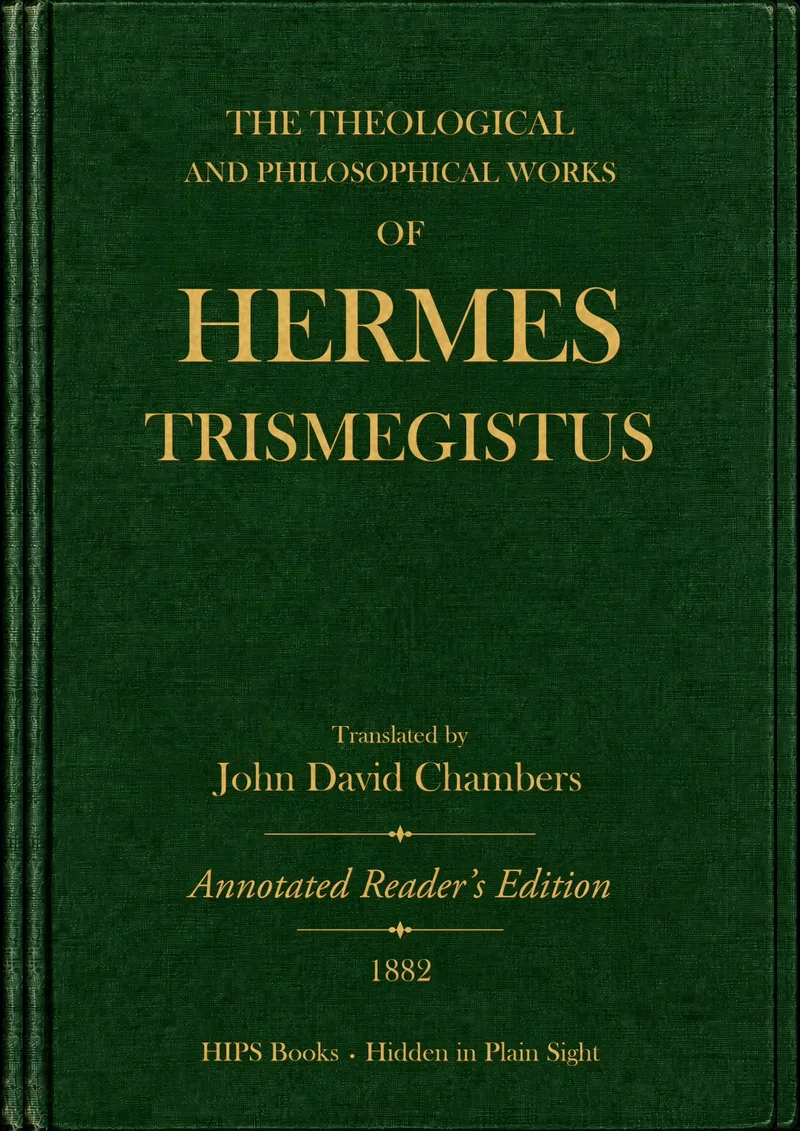
Translation also makes a difference. Older English editions can preserve unfamiliar words and religious interpretations belonging to their translators. HIPS Books offers an annotated reader’s edition of John David Chambers’s 1882 Works of Hermes Trismegistus, with historical wording retained and clearly labelled guides, summaries, and reflection questions. Chambers’s description of Hermes as a “Christian Neoplatonist” reflects his nineteenth-century interpretation; it should not be mistaken for settled modern scholarship. Our editorial method explains how we separate historical texts from new reading support.
The best introduction to Hermeticism is ultimately a patient encounter with its writings. The names and terminology become easier as you see what the conversations are trying to do: help a learner think about the world, examine their own nature, and consider whether understanding should change the way they live.