Ideas & reading guides
What Was the Philosophers’ Stone? A 1723 Book Explained
The philosophers’ stone was the substance or preparation that alchemists hoped could transform ordinary metals into gold or silver. Some also credited it with extraordinary medicinal powers. It was not simply a precious jewel, and the word stone does not tell us exactly what material an author had in mind.
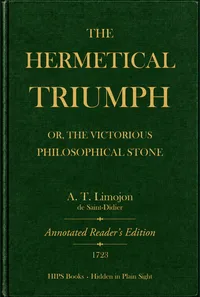
That definition is a beginning, but it leaves the interesting question unanswered: why did intelligent readers think such a thing might be possible? To get closer to their reasoning, it helps to open an actual alchemical book. In The Hermetical Triumph, published in English in 1723, Gold argues with an apparently worthless Stone. Gold has wealth and prestige on its side. The Stone claims something more important: the power to bring about a transformation.
Their dispute offers a way into the subject without assuming either that the promised stone existed or that every sentence is a disguised lesson in positive thinking.
What did alchemists expect the philosophers’ stone to do?
The central hope was transmutation: turning one metal into another, especially a less valuable metal into gold. The Royal Society of Chemistry’s introduction to alchemy connects that hope with ideas about the perfection of matter and the search for a life-prolonging medicine. These were ambitions within historical systems of nature, not verified properties of a substance we can identify today.
The distinction between a material’s present state and what it might become mattered enormously. Ordinary gold was valuable because it seemed durable and complete. But if a process could perfect other metals, the agent of that process would possess an ability ordinary gold did not. The supposedly inferior material might therefore be more useful to an alchemist than a finished treasure.
There was no single alchemical school agreeing on every ingredient, method or explanation. Historian Lawrence Principe’s account at the Science History Institute emphasizes that diversity. Alchemy included practical work on materials alongside philosophical, religious and commercial aims. Its failed ambitions should not erase that work, but practical achievements do not prove the larger promises either.
For a reader, this means asking a more precise question than “Was alchemy real?” The books and experiments were real historical activities. Whether a particular promised transformation happened is a separate question requiring its own evidence.
Why do Gold, Mercury and the Stone argue?
The opening Ancient War of the Knights in The Hermetical Triumph turns a dispute about materials into a conversation. Gold can point to its recognized worth. Mercury also enters the argument. The Stone must answer charges that it is contemptible, dangerous or useless.
Giving materials voices lets the writer put rival claims beside one another. Instead of listing ingredients, the dialogue asks what the materials can actually do. Gold’s social standing is not enough to establish its usefulness in the proposed work. The Stone’s poor appearance is not enough to settle its potential.
| Speaker or role | What to notice while reading |
|---|---|
| Gold | The difference between being a finished valuable metal and possessing a power of transformation. |
| Mercury | Whether the speaker means ordinary mercury or a specially qualified alchemical subject. |
| The Stone | How its alleged capabilities answer the objections made against it. |
This is not a modern chemical identification chart. The point is to follow the claims made by the speakers before deciding what the names mean. A word familiar from a school chemistry lesson can carry an unfamiliar meaning in this book.
An everyday comparison helps explain the logic, though it does not validate the chemistry. A polished wooden table may be worth more than a rough tool, yet the tool can make something the table cannot. The distinction between a valuable product and a transforming agent is intelligible even when the alchemical agent itself remains unproven.
Who wrote The Hermetical Triumph, and why are there two dialogues?
The collection is associated with the French writer A. T. Limojon de Saint-Didier. The English printing of 1723 has several layers, however: an earlier dialogue, French explanatory material, an English translator and a German-derived supplementary version. Calling every line the work of one author conceals part of its history.
The two English forms of the Ancient War should not be treated as an accidental repetition. One comes through French; the other through German. Their differences show how a translator’s choice can affect the reader’s interpretation. A phrase that looks like a technical clue may also be the result of a disputed translation.
The explanatory dialogue between Eudoxus and Pyrophilus develops the problem further. Pyrophilus asks the questions a puzzled reader might ask; Eudoxus distinguishes meanings, stages and qualifications. A later letter presents the Six Keys. Read in order, the sections form a conversation about how the earlier text is to be understood.
There is a useful historical connection here. Indiana University’s Chymistry of Isaac Newton project identifies references to the French Triomphe hermétique in Newton’s alchemical notes. The editors cannot determine which of two French editions he used for certain passages because their pagination agrees. That is evidence of Newton studying related material—not proof that he read this later English printing or succeeded in making the stone.
The connection makes the work less remote. It belonged to a reading culture in which someone might compare authors, annotate difficult passages and spend considerable effort deciding how a term was being used.
How should you read the symbols in the frontispiece?
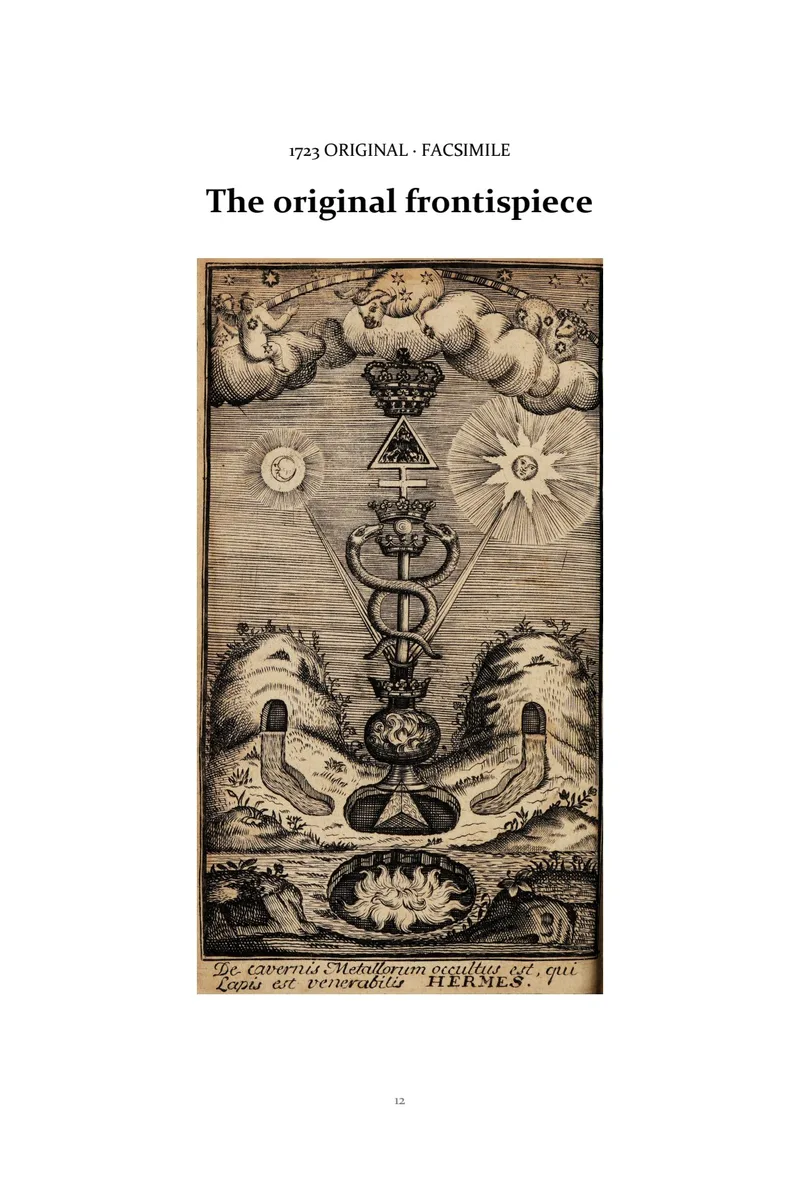
Start with the book’s own explanation. Its General Explication of the Embleme connects the picture with heaven and earth, the Sun and Moon, two streams, a triangular Stone and successive stages of perfection. The explanation turns a static engraving into an account of change.
It also refuses to disclose everything. That matters. The image is not accompanied by a plain key that solves the entire book. It belongs to a teaching style that promises understanding while insisting on conditions, preparation and limits to disclosure.
A reader can therefore make two opposite mistakes. One is to assume the engraving is mere ornament and skip it. The other is to impose a modern symbol dictionary on it, assigning every shape a fixed meaning without consulting the accompanying words. Both lose information the book actually provides.
For example, Sun and Moon can invite a broad interpretation about opposites. But the useful next question is more specific: what relationship does this particular explanation assign them, and at which stage of the work? If the answer changes from one passage to another, record the change rather than forcing a single meaning onto both.
The same care helps with words such as mercury, sulphur and fire. Their presence does not automatically identify a modern substance or a safe procedure. Nor does their symbolic use mean that every reference to a vessel or material operation can be ignored.
Was alchemy about chemistry or spiritual transformation?
For this book, that either-or question is too narrow. Material operations, religious language and images of perfection appear together. The speakers discuss transformation as something they consider possible in nature, while also placing the work within a larger philosophical and divine order.
Reading everything as modern psychology makes the promised material effects disappear. Reading everything as an ordinary recipe erases the indirection, argument and religious framework. A careful historical reading lets those different elements remain in view without pretending that we have solved their relationship once and for all.
Consider the claim that a substance must be brought to perfection. A present-day reader might hear an instruction about personal growth. The alchemical writer may also mean a change in the material’s properties and powers. Neither meaning should be selected merely because it feels more familiar or more appealing.
This is one reason the book rewards comparison with historical Hermetic writings, but should not be collapsed into them. The works attributed to Hermes Trismegistus ask different questions in a different literary setting. Sharing a vocabulary of hidden wisdom does not make the works interchangeable.
The reward is not necessarily finding a secret that still works. It can be understanding how a historical author connected matter, knowledge, authority and the possibility of change.
Why is the language so deliberately difficult?
The text presents concealment as a feature, not simply a failure to explain. Its speakers distinguish kinds of readers and warn that familiar words may be misunderstood. Knowledge appears as something to be earned through comparison and judgment, rather than obtained by lifting one sentence out of context.
That creates an important problem of authority. A difficult passage may contain a meaningful distinction. But an author can also use difficulty to protect a claim from criticism: a failed result can always be blamed on the reader having missed the secret. Recognizing that possibility is part of reading critically, not a reason to stop reading.
Notice when a speaker answers an objection with an explanation and when the answer becomes an appeal to secrecy or superior understanding. Those are different moves. The book becomes easier to follow when you can identify the move even if you cannot identify the material being described.
A useful reading notebook needs only a few columns: the term, the speaker, the immediate claim and a later passage that changes or qualifies it. This is a method for reading a text, not a method for performing the alchemical work. It helps prevent an attractive phrase from becoming a conclusion the surrounding argument does not support.
A sensible first reading—and what not to attempt
Begin with the first dialogue, then read Eudoxus and Pyrophilus as a commentary on its problems. Return to the emblem alongside its explanation. Only after that compare the alternate dialogue and the translator’s annotations. Their differences are much easier to notice when the main argument is already familiar.
Three questions are especially productive:
- Is this passage describing a material, a stage of a process or an ability the material is supposed to acquire?
- Is the apparent contradiction in the historical argument, or does it arise between translations?
- What evidence would be needed to establish the result the speaker promises?
Do not turn the text into a home experiment. Historical references to mercury, other metals, fumes, heating and sealed vessels are not safe working instructions. Its claims about medicine are not reasons to ingest a substance or replace treatment. A glossary can explain what an author meant without certifying that the procedure is safe or effective.
The annotated HIPS edition keeps the historical text distinct from vocabulary, reader guides and a parallel-passage index. Use those aids to follow the debate, then return to the passages themselves. You can also explore the alchemy and Hermetic literature collection for related reading.
The philosophers’ stone is interesting not just as an object people hoped to possess. It exposes a larger question running through the book: how do we recognize a power of transformation when ordinary appearances, inherited names and confident authorities may all mislead us?
Sources and edition notes
Primary reading: The Hermetical Triumph (English printing, 1723), especially the emblem explanation, both Ancient War versions, Eudoxus and Pyrophilus, and the Six Keys letter. Edition-specific discussion was checked against the current HIPS reading text. Wider historical context comes from the Royal Society of Chemistry and Lawrence Principe’s Science History Institute essay, linked above; the Newton connection comes from the university’s critical manuscript edition. Interpretations and reading suggestions here are modern HIPS commentary, not additional statements attributed to the historical authors.