About the book
Why does an alchemical book make gold, mercury and a stone argue with one another? The Hermetical Triumph; Or, the Victorious Philosophical Stone uses dialogue and commentary to make the reader work through competing claims about the alchemist’s material and method. Its language is deliberately indirect. What looks like a familiar substance may also carry a symbolic or technical meaning that the discussion has not yet explained.
This HIPS edition follows the 1723 English printing. The collection is associated with the French writer A. T. Limojon de Saint-Didier, but its layers matter: an earlier anonymous dialogue, French explanatory material and an unnamed English translator all contribute to the volume. Treating every sentence as the direct expression of one author would flatten the very history that makes the book interesting.
The central Ancient War of the Knights appears through two English renderings, one derived from French and one from German. Their differences are useful evidence of translation choices, not duplicate pages to be silently removed. The discussion between Eudoxus and Pyrophilus then returns to the philosophical stone and the interpretation of the dialogue, while the letter containing the Six Keys offers another carefully arranged account of the work.
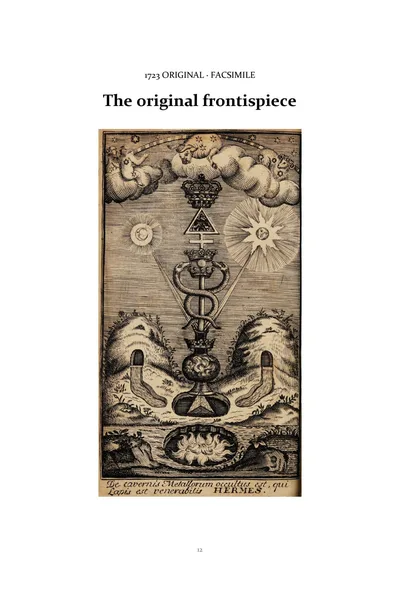
The historical frontispiece, explanation of its emblem, prefaces, translator’s annotations and errata belong to the reading experience. Together they show an author and translator attempting to guide interpretation while still withholding an uncomplicated recipe. A modern reader can follow those relationships without assuming that the promised transformation is either a proven chemical process or merely an empty metaphor.
The modern HIPS introduction, vocabulary and reader guides explain the structure and recurring terms without claiming to reveal a guaranteed secret. A parallel-passage index helps locate the corresponding discussions. The seven-sign planetary-metal key is a reading aid for historical symbols, not an instruction to handle those substances.
This is a historical alchemical text, not a safe practical manual. References to mercury, metals, fumes, heating or closed vessels must not be treated as procedures to try. Nor does preserving the book’s medical language endorse ingesting any substance or replacing treatment. Read the work as a document of alchemical thought, literary strategy and translation, with the author’s promises kept distinct from demonstrated results.
What this edition includes
218 pages; 145 × 215 mm fixed-page PDF. Includes the 1723 English text, engraved frontispiece and emblem explanation, both dialogue versions, Eudoxus and Pyrophilus, the Six Keys letter, original translation annotations and errata. Modern additions: introduction, eight vocabulary sections and eight reader guides, an 85-term glossary, seven-sign planetary-metal key and 40-entry linked parallel-passage index. The index points to the relevant annotations; it does not invent new historical notes. Digital PDF only.
Inside the book: selected contents
A reading overview, not the complete text.
- Prefaces and emblem: the translator’s opening, author’s preface and explanation of the frontispiece.
- The Ancient War of the Knights: the gold, mercury and stone dialogue through its French-derived and German-derived English forms.
- Eudoxus and Pyrophilus: a sustained commentary on how the dialogue should be understood.
- The Six Keys: the letter on the philosophical stone.
- Annotations and parallel passages: ways to trace translation differences and recurring arguments.
Key concepts for reading
HIPS editorial explanations of the historical text.
- Philosophical stone: the transforming substance or principle sought in the work; the text’s claims are not proof of its existence.
- Mercury: a term whose historical alchemical meaning cannot always be reduced to the modern element.
- Eudoxus and Pyrophilus: the speaking roles through which the explanatory discourse develops.
- Emblem: a picture organized to carry a condensed argument, requiring the accompanying explanation.
Before you buy
How is this different from an archive scan?
An archive scan preserves photographed pages. This is a prepared reading edition: reset text and modern reading support, with the historical author’s words kept distinct. The edition details and preview pages above show what is included in this particular book.
What will I receive, and where do I buy it?
This is a digital PDF edition, not a printed book. The Etsy listing is the place to check the current PDF price and delivery details, and to complete your purchase. Payment and digital delivery are handled by Etsy.
Can I read or print the PDF?
You can read a PDF in a compatible viewer on a computer or tablet. Check the Etsy listing and the edition’s terms for printing permissions and paper size before buying. PDF support and navigation vary by device; this is not an EPUB or a physical copy.
Read this edition
218 pages · PDF · 145 × 215 mm · download from Etsy once payment is confirmed.
Buy on Etsy