Ideas & reading guides
What Was a Fireless Cooker? Inside the 1917 Kitchen
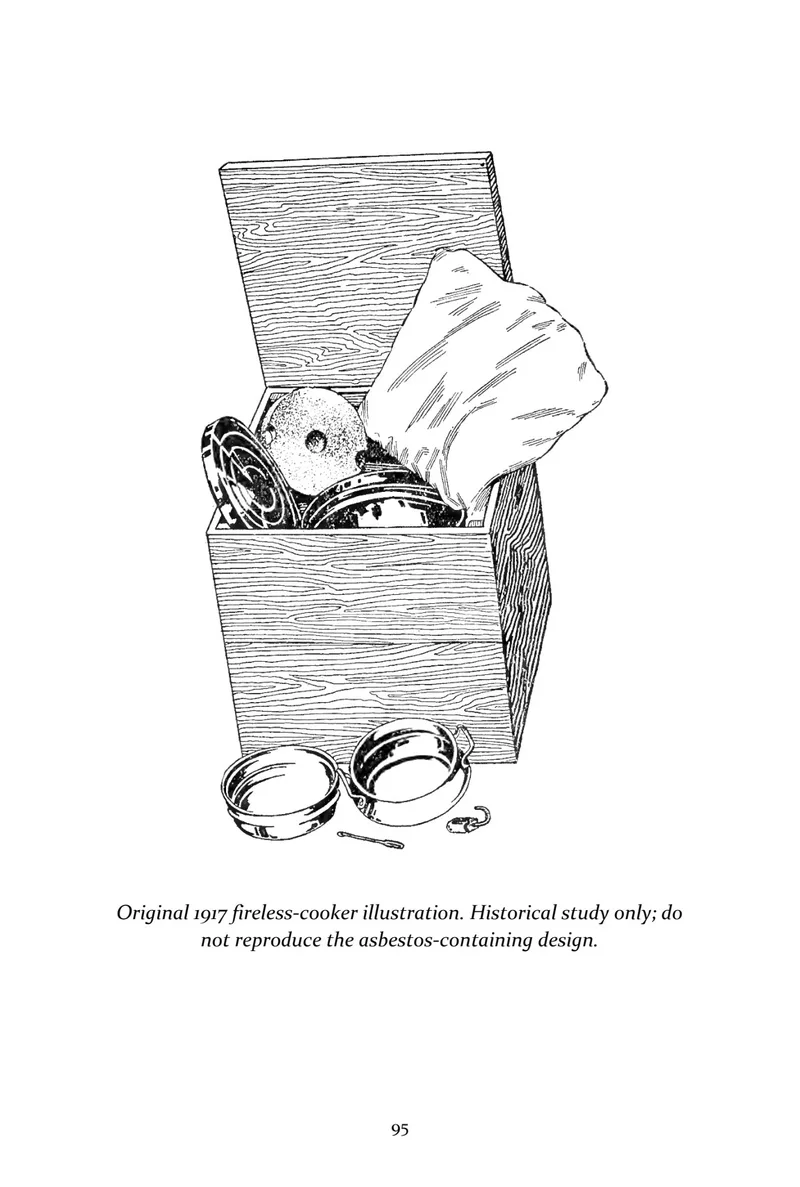
A fireless cooker was an insulated container that slowed the loss of heat from food already heated elsewhere. Some models also used preheated stones or other heat-storing parts. The name did not mean that a cold meal could cook without energy: the heat had to come from somewhere before the food went into the box.
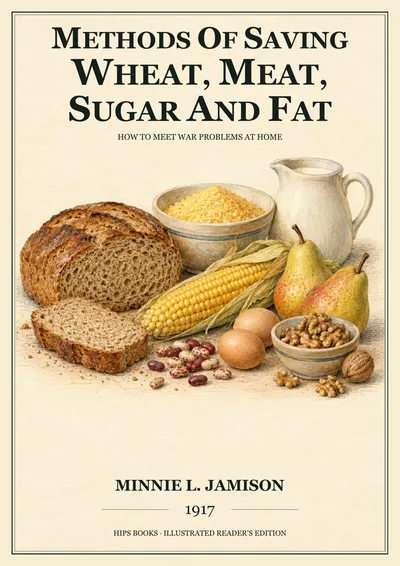
That simple distinction explains an appliance that can otherwise sound like a historical miracle. In Minnie L. Jamison’s 1917 Methods of Saving Wheat, Meat, Sugar and Fat, the cooker belongs to a wider effort to save household time, strength, fuel and food. It is a window into the work behind an ordinary meal.
This article explains that history, not how to build or use an old cooker. Jamison’s construction includes asbestos and other hazards, and her recipes are not modern safety-tested instructions. The engineering principle and the safety of a particular design are different questions.
How could a fireless cooker cook without a fire?
It retained heat supplied earlier. Insulation slows the movement of heat out of a hot vessel; it does not create a fresh supply. That is why a period cooker could reduce the time a pot spent over a stove while still depending on a stove or another heat source at the beginning.
The USDA National Agricultural Library’s history of the fireless cooker places it within a longer history of retained-heat methods, including insulated cooking boxes. The appliance did not invent the underlying principle. Its promoters offered particular household designs and ways of organizing meals around that principle.
The comparison with an insulated flask is useful, provided we do not take it too far. Both aim to slow heat loss. But keeping a drink warm and safely cooking a meal are not equivalent tasks. The temperature reached inside food, and how it changes over time, matter in ways that the word insulation cannot answer.
A box that remains warm to the touch does not tell us that every part of its contents was properly cooked. Nor does it tell us that food has stayed safely hot. Those are reasons to separate an explanation of the device from practical advice about using one.
The historical question is therefore not “How did people escape the need for heat?” It is “How did they try to make better use of heat they had already paid for or worked to produce?”
Why did Jamison discuss it in a food-saving booklet?
Jamison’s 1917 booklet is best understood as a home-front document. Its title names four scarce or strategically important foods, but its final section broadens the idea of economy. Food did not arrive at the table merely because the ingredients were available. Someone had to prepare it, supply fuel, manage the stove and clean up afterwards.
Section E is headed Saving Time, Strength, Fuel and Food Values. That list is revealing. Strength appears beside fuel because physical effort was itself a household resource. A method that reduced attention at the stove could matter even when its attraction was not expressed as a monetary saving.
Jamison discusses arranging foods together and using the cooking process efficiently. The cooker is part of that planning. Instead of treating each dish as a completely separate demand on the stove, the household is asked to think about the meal as a coordinated job.
The same planning appears elsewhere in the booklet’s efforts to stretch ingredients and avoid waste. Our article on Jamison’s wartime cooking covers those broader food substitutions. The present article follows one appliance to show how the saving campaign reached the timing, equipment and labour of cooking.
It is important not to turn the author’s enthusiasm into a measured result. The booklet advocates economies, but a recommendation is not a controlled comparison proving that every household saved a particular percentage of fuel or work. We should not invent numbers the source does not establish.
What did a household have to do differently?
The attraction was less continuous tending, not the disappearance of preparation. A meal still had to be chosen and started, equipment arranged and the timing considered. In effect, some work shifted from watching the stove to planning what would happen before and after the insulated stage.
Jamison’s examples also bring several foods into the same cooking arrangement. Read as household history, that suggests an interest in coordinating a whole meal and reducing repeated work. The details are evidence of a period method, not a recipe we are validating for use now.
Think of the difference between an appliance that permits interruption and one that tolerates no planning error. A cook might gain time away from the stove yet become more dependent on starting the right dish at the right moment. Convenience can change the shape of work rather than remove it entirely.
That observation is a modern reading of the source, not a claim that every household experienced the cooker the same way. A small kitchen, an established routine, the number of people being fed and the foods available could all affect whether a device felt useful. The book does not give us a representative survey of those experiences.
It does give us the author’s priorities. Fuel, bodily effort, food quality and the organization of a meal belong in the same discussion. The appliance makes more sense when we keep all four in view instead of imagining a novelty box unrelated to the work around it.
Were people convinced by fireless cookers at the time?
Not uniformly. Period discussions collected by the National Agricultural Library include enthusiastic claims alongside criticism of exaggerated promises and disappointment. The name itself invited expectations that the mechanism could not fulfil.
That disagreement is useful evidence. We do not have to choose between a story in which the appliance transformed every kitchen and one in which it was an obvious failure. Contemporaries argued about whether the convenience justified the planning, expense or trouble. Their judgments depended in part on what they expected it to do.
The federal government also issued material on the subject. The University of North Texas preserves the catalogue record for the USDA’s 1917 Homemade Fireless Cookers and Their Use. Its existence shows that the topic was part of organized household education, not merely a passing claim in one author’s book. The historical pamphlet is not present-day safety guidance.
Jamison’s drawing makes that wider discussion tangible. You can see an attempt to turn the principle of heat retention into affordable household equipment. In the HIPS edition, the original engraving is kept with an explicit safety warning. It is distinct from the edition’s five newly made illustrative plates.
That distinction matters when viewing old-book images online. A convincing modern illustration is not evidence that an object looked exactly that way in 1917. Here the historical engraving and the modern editorial artwork are identified separately, so readers can tell which kind of evidence they are looking at.
Is a fireless cooker an early slow cooker?
They can serve a similar household wish—less continuous attention at the stove—but they should not be described as the same mechanism. An electric slow cooker supplies heat during cooking. A retained-heat box mainly conserves heat put into its contents before or when they are enclosed.
| Device or method | Where the continuing warmth comes from | What the comparison helps explain |
|---|---|---|
| Historical retained-heat cooker | Previously supplied heat, sometimes supplemented by preheated heat-storing parts. | Why insulation and the starting conditions were central. |
| Electric slow cooker | An electrical heat source operating during use. | Why instructions for this appliance cannot simply be transferred to an old insulated box. |
| Insulated flask | Heat already present in the contents. | The general principle of slowing heat loss, not a guarantee of safe meal preparation. |
The USDA’s guidance on slow cookers and food safety discusses the combination of heat, time and steam in an electrical appliance. That is not a blanket endorsement of every device described as slow, insulated or fireless. The official FSIS publication is also available through the government archive.
Likewise, the survival of retained-heat cooking in later designs does not validate Jamison’s construction. A general physical principle can remain useful while a specific old design, material or procedure is unsuitable. That distinction lets us take the history seriously without turning it into a practical recommendation.
What should a modern reader avoid copying?
Most importantly, do not reproduce Jamison’s asbestos-containing design or use its instructions as a modern cooking method. Asbestos is not a harmless historical substitute for insulation. CDC/ATSDR guidance explains that disturbing asbestos-containing materials can release fibres that harm health when inhaled. Do not experiment with or handle suspect old materials on the strength of a cookbook description.
The food-safety problem is separate. An enclosure or hot stone does not prove a meal reached an appropriate internal temperature or remained at safe holding conditions. The historical flour-colour test is not a substitute for food-temperature guidance. We are not reproducing construction dimensions, heating tests or cooking times here.
For actual cooking, use current tested instructions appropriate to a modern appliance and follow the manufacturer’s directions and authoritative food-safety advice. Do not assume that a procedure is safe because the wording has been faithfully transcribed or a drawing is detailed.
This boundary applies to the rest of the historical library as well. The food-preservation history article explains why a period account of preserving and a validated method for shelf-stable food are different things. A reader’s edition preserves the document; it does not retrospectively test the equipment or recipes.
Why is this old appliance still worth reading about?
Because it changes what we notice in a cookbook. A recipe is not only a list of ingredients. It assumes equipment, available fuel, someone’s time and enough physical effort to bring the meal together. Jamison makes some of those assumptions unusually visible by naming time and strength as things to conserve.
The fireless cooker also gives a useful perspective on claims about labour-saving technology. A device can reduce one task while demanding more preparation or a different routine. Asking who gains time, when the work happens and what the promise leaves out is a good historical question—not merely a complaint about an obsolete machine.
Read the appliance alongside the growing side of the home front in our victory-garden history. The kitchen and garden were connected parts of the household food effort, not separate curiosities. The Self-Reliance Library collection brings several of these period texts together for historical reading.
The next time an old book mentions a fireless cooker, the name need not stop the reading. Think retained heat, prior energy and a household trying to organize work differently. Then keep the historical evidence separate from the question of what is safe to do in a kitchen today.
Sources and edition notes
Primary reading: Minnie L. Jamison, Methods of Saving Wheat, Meat, Sugar and Fat (November 1917), Section E and the original cooker engraving, consulted in the current HIPS illustrated edition. Historical context comes from the National Agricultural Library’s collection story and the USDA 1917 pamphlet record at UNT. Modern safety distinctions draw on USDA FSIS guidance and CDC/ATSDR, linked above. The historical drawing is retained as evidence, not as a construction plan; the comparisons and discussion of household work are modern HIPS interpretations.