Ideas & reading guides
Victory Gardens History: The First World War Origins
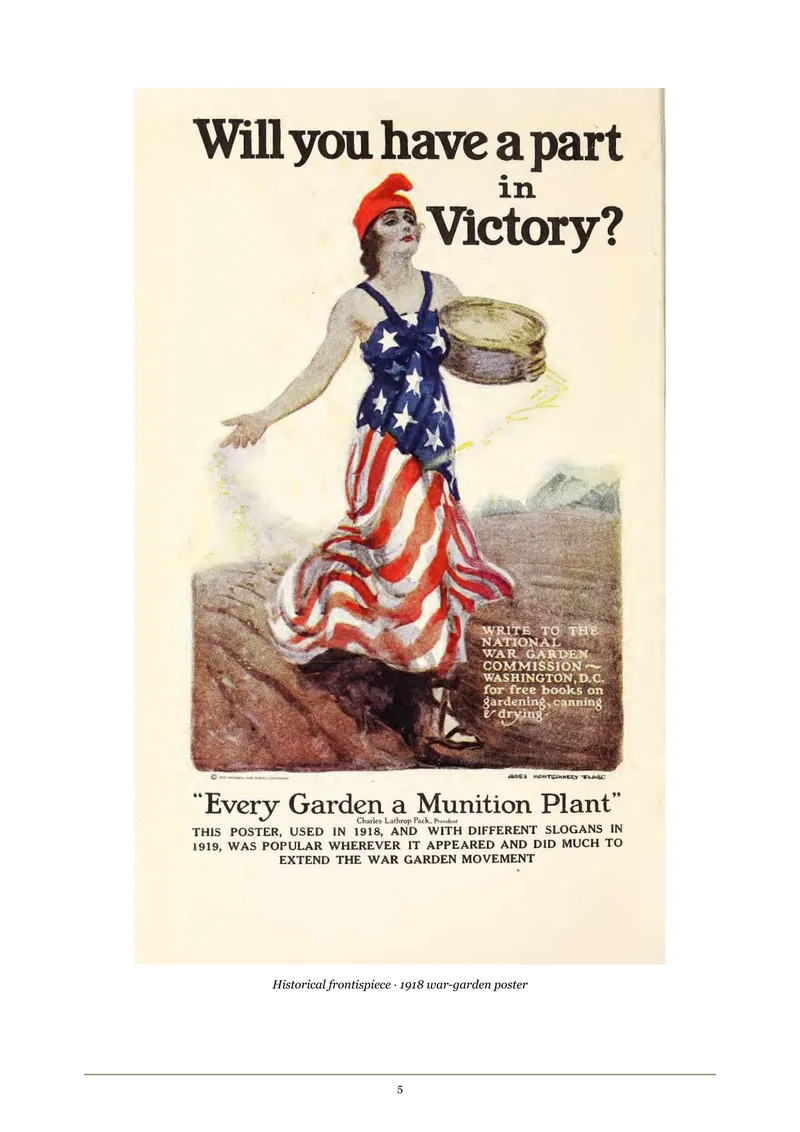
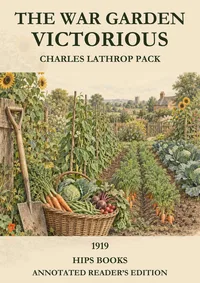
Victory gardens history begins before the Second World War. During the First World War, American war-garden campaigns encouraged households and organizations to grow food and conserve the harvest. Charles Lathrop Pack's The War Garden Victorious, published in 1919, records that movement through gardens, schools, workplaces, transport networks and public appeals.
The book is especially useful because it shows more than people planting vegetables. It describes a campaign that needed land, teaching, publicity and ways to preserve food. Gardening became a way for civilians to imagine their daily work as part of a national effort.
This article reads that campaign through Pack's book, with help from Smithsonian historical context. Pack was an advocate and an organizer, not a detached observer. His enthusiasm is part of the evidence. We can learn from the book without accepting every promotional claim as an independently measured result.
War gardens came before the familiar WWII image
The Smithsonian's gardening exhibition traces the term “victory garden” to the First World War period and explains its reuse during the Second World War. That helps correct a common assumption: the later campaign did not invent the whole idea.
The distinction matters when reading Pack. His book appeared in 1919 and looks back at a movement associated with the war of 1914–1918. Its world is not the American home front of the 1940s. The people, organizations and immediate pressures in the text belong to an earlier campaign.
Pack describes wartime disruption to food production and distribution, along with the need to support populations and forces overseas. Gardening is offered as one civilian response. Within his argument, more food grown near home means greater capacity to meet a larger need.
That was also a persuasive story. Posters and speeches translated an enormous supply problem into an activity a family or school could recognize. The individual plot became a visible sign of participation. You did not have to run a railway or a food agency to feel that you had a task in the campaign.
For the earlier small-plot conversation, see Bolton Hall's Three Acres and Liberty. Hall links land and livelihood; Pack links food production and wartime duty. Both look beyond the garden fence, but they are trying to persuade readers toward different aims.
Who was Charles Lathrop Pack, and what kind of book did he write?
The Smithsonian catalogue record identifies Pack as the author and records the book's 1919 publication and contents. The opening chapters explain the National War Garden Commission and the movement it promoted. Pack's relationship to that effort gives the narrative access and energy, but also a particular viewpoint.
The main text is chiefly a history and an argument for gardening, not a modern step-by-step horticultural manual. Its chapter titles move from the origin of the commission to types of gardens, businesses, railroads, schools and community organization. Later chapters turn to conservation and the future of the movement.
Two practical pamphlets were bound into the original volume: War Gardening and Home Storage of Vegetables and Home Canning and Drying of Vegetables and Fruits, both in 1919 Victory Editions. The HIPS edition includes them alongside the main narrative. Their presence explains why the book can move from campaigning to detailed period instructions.
Those instructions must remain historical. Obsolete preservation and pesticide directions are not made safe by appearing in a successful campaign book. Their value here is evidence of what readers were told, not a recommendation to use the same directions today.
Why schools, railroads and businesses appear in a gardening book
Pack's chapters show that a mass gardening campaign requires more than enthusiasm at the household level. Different organizations can contribute different resources. A school can connect growing with instruction; a workplace can make land or organization available; a transport network can help ideas and supplies move.
The chapter on school gardeners is a concrete example. Children appear not only as helpers but as learners and participants in a collective effort. The garden becomes a place where care, observation and routine can be taught. In the book's presentation, education and production reinforce each other.
The railroad chapter provides another angle. Railways belong to the infrastructure through which land, workers and communication can be organized. Their appearance reminds the reader that food growing is not isolated from the systems that surround it. A garden campaign can spread through institutions that were not created primarily for gardening.
The chapters on business and community organization make the same point from other directions. Pack's story connects the plot to people able to allocate space, offer help or give a project public attention. It is not simply a tale of separate households discovering the same idea at once.
| Setting in Pack's account | What it adds to the campaign | A question for the historical reader |
|---|---|---|
| School garden | Instruction and organized participation | What did the pupils learn, beyond producing a crop? |
| Workplace or business | Access to resources and an existing organization | Who supplied the land and who did the work? |
| Community garden | Shared coordination | How were tasks and benefits distributed? |
| Household plot | A direct connection to meals and storage | What happened when more food ripened than could be eaten? |
These questions also keep the public story from becoming too simple. A photograph of a flourishing plot does not tell us every participant's experience. Nor does a list of successful projects reveal the time, support or difficulties involved. The book supplies starting points for inquiry, not every answer.
The posters made growing food feel like public service
The reproduced posters and pictures are part of the campaign's argument. They connect ordinary food and gardening work with national purpose. A harvest is made to stand for contribution, preparedness and victory, rather than merely a household's private success.
That is why the visual material should be read alongside the prose. A poster compresses the message into a form that can be noticed quickly. The chapters explain the institutions and activities that the brief appeal cannot show. Together they reveal how a campaign translated a distant emergency into familiar work.
The Smithsonian's “Gardening for the Common Good” exhibition places wartime imagery within a broader tradition of civic gardening. It also shows how seed catalogues took up patriotic themes. Gardening was communicated through a commercial and public visual world, not only through government documents.
We should distinguish the historical posters reproduced in the book from a modern edition's cover and new reading material. The former are evidence of period campaigning. The latter help today's reader navigate the restored work. Calling both “old illustrations” would blur the source of the evidence.
A useful exercise is to choose one poster and one chapter. Ask what the poster wants you to do, what feeling it uses, and which chapter explains how that action became possible. The comparison makes the campaign's persuasive method visible without requiring you to share its rhetoric.
Growing the crop was only half the wartime task
Pack devotes substantial attention to conserving the surplus. Food that ripens together cannot all be eaten together, and a garden campaign needs an answer to that seasonal problem. Drying, canning, storage and community conservation therefore become part of the same story as planting.
The chapters on dehydration are particularly revealing. The author treats a change in the form of food as a way to change how it can be kept, transported and used. The discussion is not just culinary; it is concerned with the relation between household effort and a larger food supply.
The separate 1917 winter-storage manual makes a related argument through cellars, outdoor storage and preserved vegetables. It begins with the urgency of saving a harvest already produced. That shift in emphasis is useful: more growing does not automatically mean more food available months later.
These old instructions are not current preservation guidance. The National Center for Home Food Preservation explains that safe canning depends on the food and an appropriate tested process. In particular, low-acid foods require suitable pressure-canning methods. A historical water-bath instruction cannot substitute for that requirement.
Our article on food preservation before widespread domestic refrigeration compares several older manuals as historical documents. It explains why their ingenuity and their safety limits should be studied together. The point is to understand how households handled the seasonal problem, not to revive an untested recipe.
Reading victory gardens history beyond the success story
Pack wants the movement's energy to continue after the immediate wartime need. Chapters on city assets and the future of gardening ask whether a temporary campaign can leave a lasting civic benefit. That is one reason the book remains interesting after the war it describes has receded into history.
Read its optimistic claims with attention to their source. When an organizer reports an achievement, the statement tells us what the campaign wanted to emphasize. If you want to compare exact totals, you need to investigate how they were gathered and what they counted. This guide does not turn Pack's promotional figures into independent statistics.
There are quieter questions worth asking too. Who had access to a suitable plot? Who could spare the time? What support turned a beginner into a productive gardener? Those questions come into view when the institutional chapters are read closely, even if the book's public language stresses unity and success.
For a first reading, follow this route:
- Read how the commission came into being and what problem the campaign claimed to answer.
- Compare the school, business and community chapters.
- Study a historical poster beside the prose.
- Follow the harvest into storage and conservation.
- Read the postwar hopes as proposals, not as proof that the hopes were fulfilled.
The Charles Lathrop Pack author page leads to the edition, while the gardening-history collection provides related reading. The value of The War Garden Victorious is its picture of a garden becoming part of a public system: growing, teaching, organizing and saving food are linked tasks.
Sources and further reading
- Primary text: Charles Lathrop Pack, The War Garden Victorious (1919), especially the commission, school, railroad, community, conservation and future-gardening chapters, plus its two bound-in pamphlets.
- Smithsonian catalogue record for the 1919 book, for bibliographic and contents confirmation.
- Smithsonian Libraries: Gardening for the Common Good, for the WWI origin of “victory garden” and its later reuse.
- National Center for Home Food Preservation: Ensuring Safe Canned Foods, for the modern safety boundary, not validation of period recipes.