Ideas & reading guides
Cooking with Less in 1917: Jamison’s WWI Home-Front Cookbook
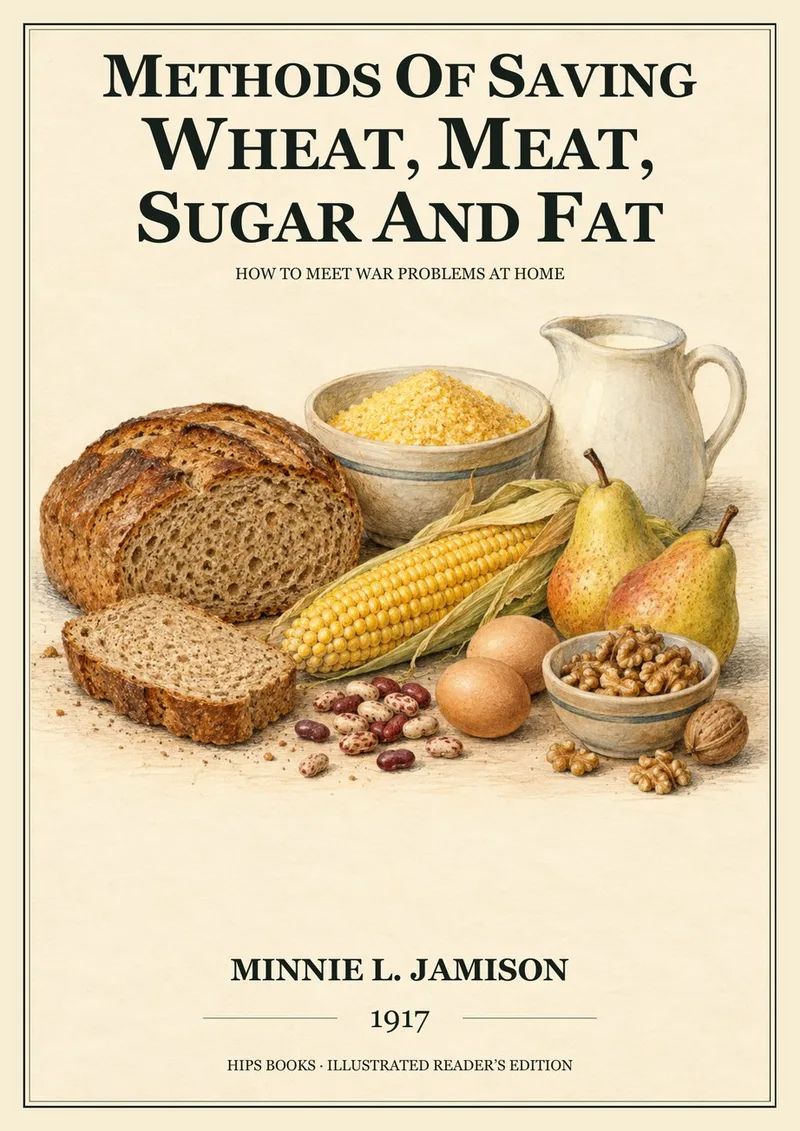
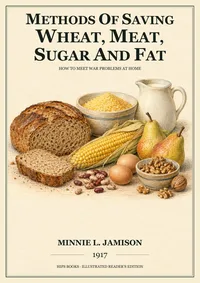
In November 1917 an American kitchen was part of the war effort. Wheat, meat that could be shipped, sugar and fat were needed for soldiers and allies, and households were asked to use less of all four. Methods of Saving Wheat, Meat, Sugar and Fat: How to Meet War Problems at Home, by Minnie L. Jamison, turned that national request into everyday cooking advice. This article looks at what the booklet asked people to do and why.
It is a guide to a historical cookbook, not a set of tested modern recipes. Some of the booklet's methods and equipment are unsafe by present standards, as explained below.
Who wrote it, and for whom?
Jamison worked in the Extension Department of the State Normal and Industrial College in Greensboro, North Carolina, and the booklet was issued as one of the college's bulletins. Extension work took practical teaching out of the classroom and into homes, often through demonstrations for rural women. That explains the tone. This is not a book of elegant dishes but of ordinary meals built from what a Southern household was likely to have: corn meal, potatoes, cow peas, beans, cottage cheese, nuts and leftovers.
Saving wheat: corn bread every day
The first section opens with four ways to save wheat. Jamison claims percentages for the first two:
- Grind white flour while keeping some of the "shorts" (the bran-rich part of the grain) for people to eat, which she says saves 10–15%.
- Grind in Graham (whole-wheat) flour, which she says saves 15%.
- Combine wheat flour with other foods.
- Eat corn bread once a day.
The recipes follow from this: light bread made with cooked potatoes, brown bread made with Graham flour and soy bean meal or corn meal, muffins, griddle cakes and corn pone. Jamison also argues that changes should be gradual, so some white flour stays in use. Her health claims for whole grains are historical opinions, not modern nutrition advice.
Saving meat: beans, eggs and cheese
The second section treats protein-rich foods as "tissue builders", her phrase, and looks for ways to stretch or replace meat: beans and peas, eggs, cheese, fish, game and leftovers. Cottage cheese appears often, as does the cheese dish called rarebit. Meat is used to flavour a meal rather than make up most of it, a pattern that will feel familiar to anyone who cooks economically today.
Saving sugar and fat
The sugar section suggests honey and syrups of all kinds, including syrups made from left-over fruit juices, and simpler fruit desserts in place of elaborate sweets. The fat section is a list of household thrift:
- save all drippings
- use bacon fat in sauces for coarse meats and vegetables, and keep butter for the table
- gather nuts
- leave out pie crusts and top fruit with sugared stale bread instead
- use cottonseed and peanut oils
- fry less
Saving fuel, time and strength: the fireless cooker
The final section is about energy as well as food: making one fire do several jobs, and using a fireless cooker. This was an insulated box in which a pot, brought to the boil, kept cooking slowly on its own retained heat. The booklet includes an engraving of one. It was a real economy in its time. It is also one of the booklet's clearest examples of advice that should not be copied today: retained-heat cooking can leave food in the temperature range where bacteria grow, and the historical construction used materials now known to be hazardous.
What should not be copied
The HIPS edition keeps Jamison's quantities and wording, and separates its own safety notes from her text. Among the historical instructions that are not safe models today:
- Retained-heat cooking and home-built cookers. Use current tested guidance for slow cooking and food temperatures.
- Asbestos mats and sheets, mentioned as household equipment of the period.
- Syrup made from fruit seeds or pits. Stone-fruit kernels contain cyanide-producing compounds.
- Short, unverified canning steps and "seal" instructions. Shelf-stable preserving needs a current tested recipe and method.
Read as history, the booklet is a vivid record of how a war reached the kitchen table. For actual cooking and preserving, use current, research-tested sources.
Why it is worth reading now
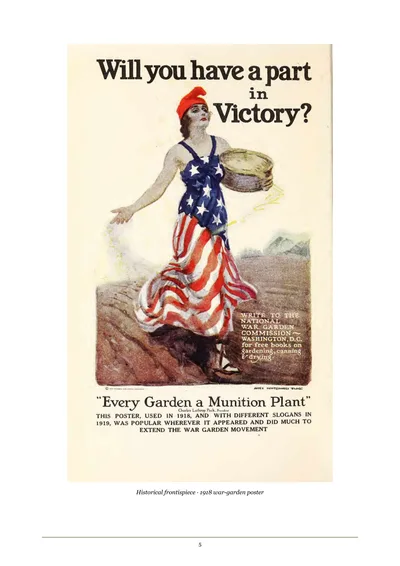
Jamison's booklet sits alongside the better-known story of the First World War food campaigns: posters, pledge cards and war gardens. Our article on victory gardens in the First World War covers the growing side; this booklet shows the cooking side. It is a short, concrete source on how national policy became household habit, and on what ordinary people in 1917 actually ate.
The illustrated HIPS edition adds vocabulary for older kitchen terms such as yeast cake, shorts and sweet milk. It is also part of the Self-Reliance Library collection.
Sources and edition notes
- Primary text: Minnie L. Jamison, Methods of Saving Wheat, Meat, Sugar and Fat: How to Meet War Problems at Home (Bulletin of the North Carolina State Normal and Industrial College, November 1917), Sections A–E, as prepared in the HIPS illustrated edition. The source scan is the Library of Congress copy.
- Modern food safety: follow current guidance from the USDA and the National Center for Home Food Preservation rather than historical instructions.