Ideas & reading guides
Food Preservation Before Refrigeration: Three Old Books
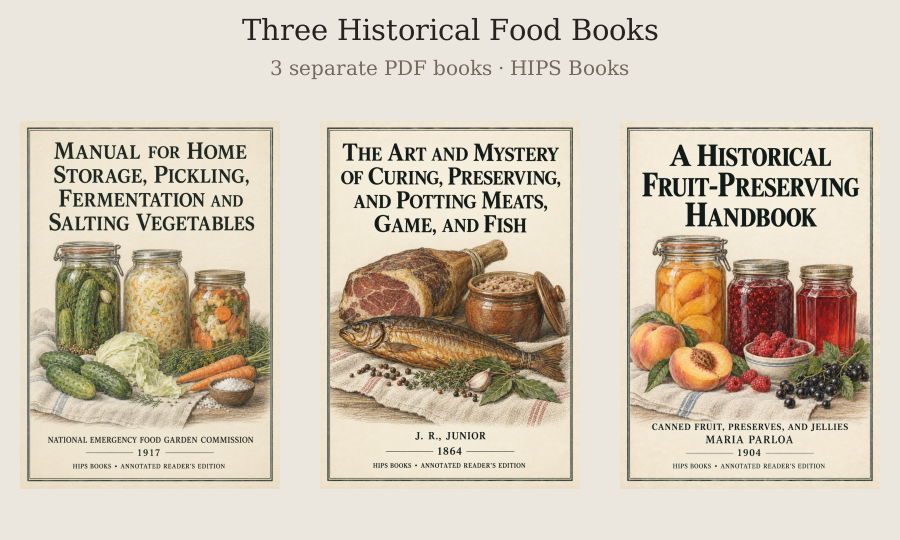
Food preservation before refrigeration was not one technique or one way of life. Three manuals from 1864 to 1917 show households and traders using different approaches to the same problem: how to make food available after its freshest moment had passed. Meat might be cured or potted, fruit turned into preserves, and vegetables stored for winter or fermented.
These books also reveal different priorities. The Victorian manual addresses dealers as well as housekeepers. Maria Parloa connects fruit preserving with household economy and a market for well-made goods. The wartime manual turns saving a harvest into a matter of national responsibility.
This article compares their accounts as history. It is not a recipe collection or a safety guide for making preserved food. Older methods can be interesting without being safe to reproduce. Refrigeration also existed in different forms before these books appeared; “before refrigeration” here concerns a world before widespread domestic electric refrigerators, not a claim that nobody ever used ice or cold storage.
What problem were these old preservation books solving?
A harvest or a supply of fresh food does not arrive in neat daily portions. There can be more than a household needs now and less than it needs later. The three books ask how that uneven supply can be carried across time, whether for family meals, commercial sale or a wartime winter.
The texts do not treat preserving as separate from the economy around it. Ingredients cost money. Containers need to be obtained and maintained. Work takes time. A product intended for sale also has to be attractive and reach someone willing to buy it. Those details make the books richer than lists of old recipes.
| Historical work | Original setting | Main concern in this comparison |
|---|---|---|
| The Art and Mystery of Curing, Preserving, and Potting Meats, Game, and Fish | London, 1864; preface signed J. R., Junior | A wide repertoire for dealers and housekeepers |
| Maria Parloa's Canned Fruit, Preserves, and Jellies | USDA Farmers' Bulletin 203, first issued 1904 | Principles, tools, fruit quality and household markets |
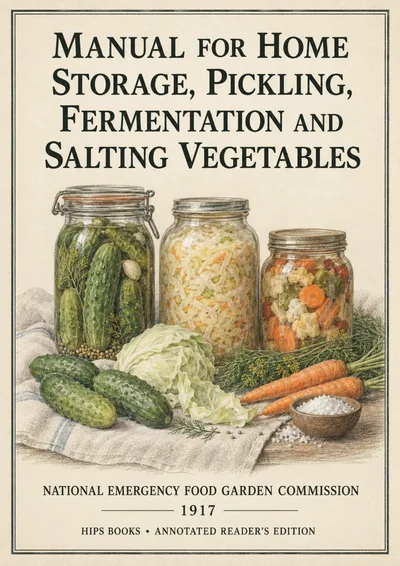
| Manual for Home Storage, Pickling, Fermentation and Salting Vegetables | National Emergency Food Garden Commission, 1917 | Saving the garden surplus for winter in wartime |
The dates identify specific documents. They do not mean every household in the 1800s followed the first book or every family in 1917 followed the last. A manual tells us what its writer recommended and expected readers to understand. Actual practice could differ by income, region, facilities and experience.
All three works are included in the HIPS historical food-preservation collection. Reading them together makes changes in purpose and language easier to see. It also prevents “old-fashioned preservation” from becoming a vague phrase that hides distinct methods and periods.
The 1864 manual: curing, smoking and the meaning of potting
The Victorian book's long title makes its range clear. It covers meats, game and fish, then extends into pickling and preserving fruit and vegetables. It explicitly addresses wholesale dealers as well as housekeepers. This is not a record of one isolated farm family's habits.
Its contents move through named meat preparations, smoked and dried fish, potted foods, sauces, fruit and pickles. The variety shows how preservation could concern flavor and the identity of a finished product as well as keeping qualities. Names associated with places and styles suggest that these foods belonged to a commercial and culinary world.
Two examples make the range concrete. The book includes regional preparations such as Westphalia hams and Shropshire beef. It also has sections on potted shellfish and game. Those subjects require different handling, yet they sit within one practical repertoire. A modern reader should not turn that shared placement into an assumption that the same safety principle applies to everything.
“Potting” needs explanation because it is less familiar than pickling. In the historical text, it concerns preparing food for keeping in a pot, often with a covering of fat. That is a description of the period practice, not a guarantee of shelf stability. Fat over food is not a substitute for a tested preservation process.
The writer signs the preface “J. R., Junior.” Without reliable identification, we should leave the credit there rather than inventing a full name or occupation. This small restraint matters: the book can be studied carefully even when the author's biography is incomplete.
Read the contents first, then compare two preparations as historical documents. Ask which foods the author expects to be available, which tools are assumed, and whether the intended user is a trader or a household. The aim is to reconstruct the setting, not to extract a formula for use in your kitchen.
Maria Parloa: preserving as knowledge, equipment and quality
Parloa's bulletin takes a more explanatory route. Before the named fruit preparations, it discusses principles of canning and preserving, bacteria and yeasts, molds, sterilization, utensils and the selection of fruit. The arrangement tells readers that successful work involves understanding as well as repetition.
Her wider context was teaching and writing about cookery. Michigan State University's Feeding America collection describes Parloa as a recognized culinary author and cooking teacher. That is useful background for a bulletin which turns household work into something that can be taught in an ordered way.
One concrete example is the attention to equipment. A container is not just a decorative jar: the bulletin discusses the tools and vessels used in preparation. The reader is being asked to see the kitchen as a place where materials, measurement and routine affect the result.
Another is Parloa's discussion of selling homemade fruit products. She does not assume the word “homemade” excuses poor quality. She describes a market in which household products compete with professionally prepared goods. Appearance, flavor, packing and the relationship with a retailer all belong to that historical business problem.
These passages connect naturally with Bolton Hall's small-farming argument. In both works, producing something is not the whole livelihood. Using it, preserving it or reaching a buyer matters too. The domestic and commercial parts of the story overlap.
Parloa's work was first issued as Farmers' Bulletin 203 in 1904. The HIPS reading text follows a 1917 USDA printing, compared with the corrected 1905 printing. A file label containing “1905” should not lead us to change the original publication date or pretend all printings are identical.
Its explanatory language is historically important, but it does not make every direction acceptable today. The bulletin includes methods that modern authorities do not recommend. It is an example of household knowledge developing in its period, not the final state of food-preservation science.
The 1917 manual: saving a garden meant saving a winter supply
The wartime manual begins with storage rather than the assumption that all surplus must be canned. It argues that some vegetables can be kept in a comparatively natural condition. Its discussion moves through cellars, outdoor storage, potatoes, cabbage, fermentation, pickling and other uses of garden produce.
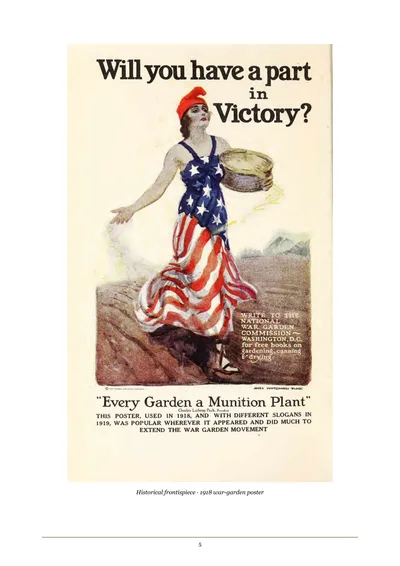
The reason is larger than one household's comfort. The opening links domestic food conservation to the need for supplies overseas. A local harvest is framed as part of a national food problem. The reader's cellar and crock become places where wartime participation can happen.
A revealing example is the separate treatment of potatoes, onions and squashes. The manual does not imagine one storage environment equally suitable for everything. It describes different needs for moisture, dryness and protection. The historical insight is the attention to variation, not an invitation to copy every old condition or construction detail.
Another example is the potato-starch section. It looks for a use for a portion of the crop that might otherwise be wasted and connects that use to pressure on other staple foods. This shows how “conservation” could mean changing the form of food, not merely leaving it in storage.
Our article on root cellars and winter storage in the 1917 manual examines that document more closely. The War Garden Victorious supplies the larger campaign setting in which producing and saving food were presented as linked civic tasks.
What modern safety knowledge changes
An old method's long history does not establish that it is safe. The National Center for Home Food Preservation's guidance on safe canned foods distinguishes acid and low-acid foods and explains the importance of an appropriate tested process. Low-acid foods, including meats and many vegetables, require suitable pressure-canning methods for safe home canning.
The Centre also identifies equipment and methods it does not recommend, including conventional oven processing and open-kettle canning. Its guidance on preventing spoilage explains why wax seals are no longer recommended for sweet spreads. A sealed-looking jar alone does not establish safety.
Fermentation has its own requirements. Current NCHFP fermenting guidance stresses tested ingredient proportions and the role of salt in fermented pickles and sauerkraut. An attractive old description of a crock does not establish that an improvised process will be safe.
These boundaries are not an objection to studying old books. They are the condition for studying them honestly. We can recognize ingenuity while also recognizing gaps in knowledge and unsafe recommendations. A history article should not slide from “people were told to do this” into “you can safely do this.”
For that reason, this guide does not reproduce old curing mixtures, processing times or jar-sealing directions. Anyone preserving food now should use current research-tested instructions suitable for the exact food, equipment and location. The historical work can explain the past; it cannot validate a modern batch.
How to read food preservation before refrigeration as history
Start with the introductions, contents and sections on principles. They show what the writer thinks the problem is. Then choose one recurring subject, such as fruit, and notice how its role changes between a broad Victorian repertoire, a teaching bulletin and a wartime campaign.
Keep a short set of questions beside the book:
- Who is the intended reader: household cook, dealer, gardener or campaign participant?
- What facilities, money and labor does the text assume?
- Is the aim flavor, sale, seasonal supply, waste reduction or several of these?
- Which statements describe observation, and which simply repeat a recommendation?
- Which methods now need a different safety standard?
The questions bring the everyday world into view. They also make the hidden work visible: acquiring jars, preparing ingredients, managing fuel, protecting a harvest and finding buyers. The books are about time and attention as much as about salt, sugar or cold.
The HIPS collection retains the historical wording and keeps reader guides and new interpretive artwork separate from original text and figures. Consult the edition details to see what each PDF contains. The food-preservation-history collection groups the available reading without presenting it as current professional advice.
These three books are valuable because they make older household systems easier to see. Their strongest lesson is not that the past had one perfect method we should recover. It is that feeding people through a year required planning, knowledge and work—and that our understanding of safe practice must remain open to better evidence.
Sources and further reading
- Primary texts: the 1864 Art and Mystery manual; Maria Parloa's Canned Fruit, Preserves, and Jellies, first issued 1904; and the National Emergency Food Garden Commission's 1917 manual. All are identified in the three-book collection.
- MSU Libraries, Feeding America: Parloa context, for the author's work as a culinary writer and teacher.
- NCHFP: Ensuring Safe Canned Foods, Methods Not Recommended, and General Information on Fermenting, for the modern safety boundaries stated here.