Ideas & reading guides
Three Acres and Liberty: Bolton Hall's Small-Farm Idea
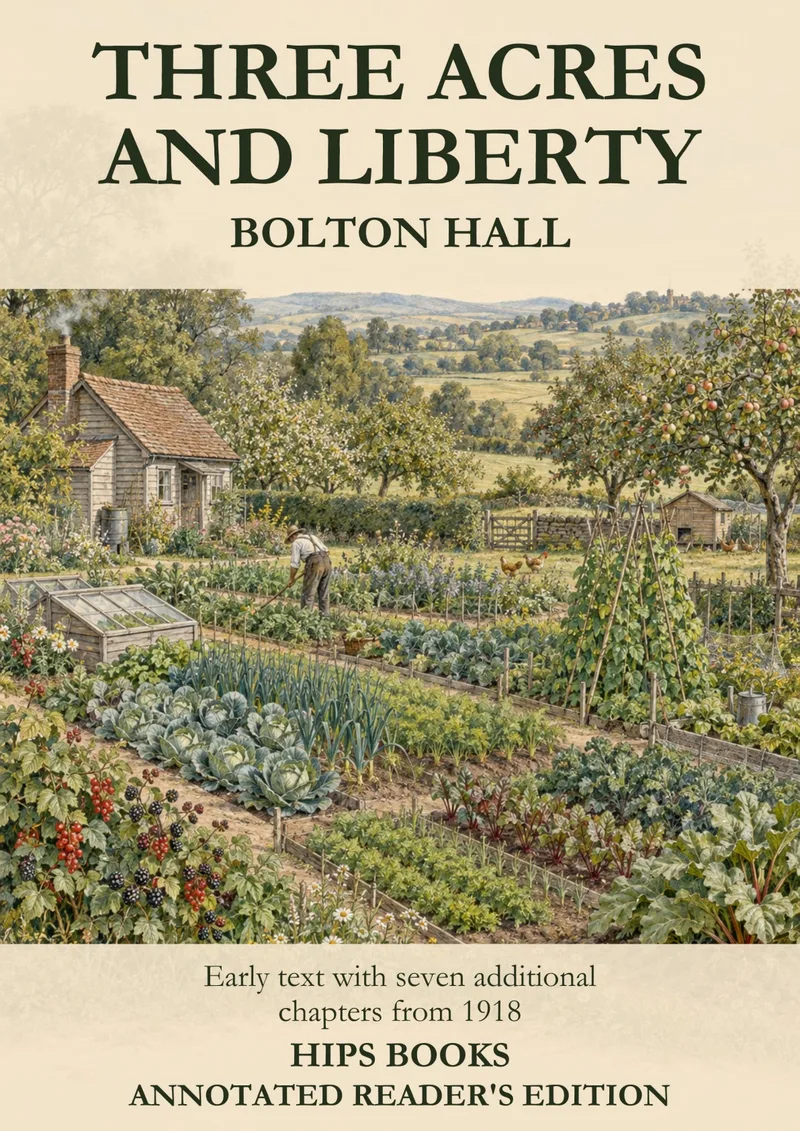
Three Acres and Liberty is Bolton Hall's early-twentieth-century argument that a small piece of land, used intelligently, could offer a route toward a more independent life. First published in 1907, it combines gardening, small farming and social reform. Its real subject is not simply how much can grow on three acres, but what stands between ordinary people and a useful livelihood.
The title can sound like a modern promise of effortless self-sufficiency. The book is more revealing when read as a historical answer to urban crowding, insecure work and the desire for a home. It mixes optimism with practical discussions of soil, markets, equipment and the limits of the beginner.
This article follows the ideas in the early text and the separately identified 1918 supplement included in the HIPS edition. It is a reading guide to an old book, not a current income forecast or a recommendation to follow its obsolete practical directions.
Who was Bolton Hall, and why did land matter to him?
Bolton Hall lived from 1854 to 1938. The New York Public Library's finding aid for his papers describes him as a lawyer, author and social reformer. He supported Henry George's ideas, including the single tax, and took an interest in housing and access to land. That background helps explain why this gardening book repeatedly becomes a discussion of opportunity.
The foreword makes the aim plain. Hall wants readers to question whether they are as trapped in their existing work as they believe. But he also says the book is not a complete agricultural textbook. It points toward other knowledge and tries to awaken thought about what a small holding might make possible.
Its introduction, by George T. Powell, connects the question to the movement of people into cities and the strains of crowded urban life. Hall's own opening chapter is not simply anti-city. It recognizes that people are social and that towns offer work and learning. His proposal often concerns land within reach of a town or market, not withdrawal into a remote wilderness.
That makes a difference to how we read the title. “Liberty” does not mean doing everything alone, without customers, transport or other people. It means reducing dependence on conditions the author considers unnecessarily restrictive. The garden is a proposed opening in a social system, not an escape from society altogether.
Intensive gardening: a small area, closely understood
Hall's central contrast is between possessing a large acreage and using a manageable area well. The book repeatedly argues that more land is not automatically a better opportunity. A beginner can be defeated by scale, poor location or a crop whose return does not justify the work.
“Intensive” in this context means concentrating skill and attention on a limited space. It does not mean that crops grow by magic or that labor disappears. Soil condition, timing, equipment and the suitability of the crop all matter in the book's examples. The optimism depends on capable management, not acreage alone.
A useful example is the distinction between a kitchen garden and produce grown for sale. The first supplies a household; the second must also meet a buyer's needs and survive the journey to market. A vegetable that is valuable at the kitchen door may not be the best commercial choice once packing, transport and selling are considered.
The chapters on tools, specialized crops, hot-beds and greenhouses extend the same point. Equipment can change what is possible, but equipment also requires money and knowledge. Hall does not give one universal plan that fits every reader. He assembles examples to encourage investigation of a specific situation.
For a modern reader, the transferable lesson is a question rather than an old yield figure: what does this particular piece of land allow, and what would it cost to use it well? The historical prices and production claims belong to Hall's period. They cannot be lifted into a present-day budget as though conditions have remained unchanged.
Why the market is part of the garden
The book treats location as an economic matter as well as a growing condition. Land can be inexpensive because it is badly placed, difficult to work or disconnected from buyers. A low purchase price does not settle whether a holding can support the life the buyer wants.
For example, a perishable crop grown far from the people who want it presents a different problem from the same crop grown near them. The author connects production with distribution. Growing something successfully is only one part of the story if it cannot be sold or used at the right time.
This is why the chapters on buying a farm and choosing where to go deserve attention before the attractive lists of what an acre may produce. They ask about the setting in which a figure becomes possible. Without that setting, the figure turns into an advertisement rather than useful reading.
| Question in Hall's book | What lies behind it | What a modern reader should not do |
|---|---|---|
| How much land is needed? | Capacity to manage it with available labor and capital | Assume three acres guarantees a living |
| Where should the holding be? | Soil, access, transport and demand | Treat low price as proof of value |
| Which crop should be grown? | Household need or a particular market | Copy a period profit claim into a current plan |
| What equipment helps? | A change in capability, with costs attached | Assume every investment will pay for itself |
The word truck also needs a little historical help. “Truck farming” here means growing produce for market; it does not mean farming with a motor truck. Vocabulary like this can make an old practical book seem more remote than it really is. Once the term is clear, the argument becomes easier to follow.
Vacant city lots and the social side of self-help
The vacant-lot chapter shows that the book's small-land idea is not limited to privately owned farms. It discusses organized cultivation of unused urban ground. The historical title page credits R. F. Powell, associated with vacant-lot cultivation in Philadelphia, as assisting Hall. The examples therefore include a social setting in which access, supervision and supplies matter.
In the chapter's account, offering a plot is not the whole intervention. Seeds, fertilizer, preparation and advice can help people use the opportunity. This complicates a simple story in which determination alone produces success. Even Hall's argument for self-help depends on resources and organization.
The Smithsonian's exhibition on gardening for the common good places food gardening within a wider civic history. That context is useful because an individual plot can also be part of a neighborhood response to hardship. The social value and the harvest are not necessarily separate aims.
There is still reason to read the claims critically. The book often presents successful cases to persuade the reader that an opportunity exists. A success story does not reveal every unsuccessful attempt, and a program's hopeful account is not a complete assessment of its effects. Notice who is speaking and what the example is intended to demonstrate.
The chapter becomes more interesting when you ask what made the opportunity real: permission to use land, tools, someone able to advise, and a manageable task. Those conditions are concrete. They help turn “self-help” from a slogan into a historical arrangement that can be examined.
What changes in the 1918 supplement?
The HIPS edition includes seven separately identified supplement chapters from 1918 alongside the earlier work. They should not be confused with a claim that the entire text is a complete 1918 revision. The distinction is stated on the edition page.
The supplement brings in subjects including woodlots, experimental foods, dried produce, cooperation in retailing and summer colonies. These additions widen the question from growing a crop to making better use of resources and finding ways to organize distribution. They also show how the discussion changed during the wartime period.
The material on dried produce is a revealing example. A harvest that cannot be used or sold fresh becomes a question about preservation and a different market. The book connects the garden's output to what happens after harvest. Our history of food preservation through three old manuals follows that second part of the story.
The experimental-food passages are another example of the period's optimism. The supplement discusses imported or less familiar crops as possible answers to food costs and limited choice. These are historical proposals, not a modern guarantee that a named plant will thrive safely in any climate or serve as a suitable substitute in any diet.
Some of the practical directions in the book, including land clearing, pesticide use and preservation, are obsolete or hazardous. Reading about them is not the same as recommending them. Keep the historical text as evidence of what was proposed, and consult current qualified guidance for any actual work.
How to read the book without turning it into a promise
Begin with the foreword and introduction, then the chapters on buying land, vacant lots and choosing a location. This puts Hall's social and economic argument in view before you meet its most attractive production examples. Next, choose a practical subject that interests you, such as the kitchen garden or specialized crops.
As you read, separate three kinds of value:
- Historical evidence: the priorities, language and proposed opportunities of the early 1900s.
- Questions worth carrying forward: scale, access, skill, timing and the link between growing and using a harvest.
- Directions that need current replacement: period prices, safety assumptions, chemical treatments and technical recipes.
That distinction preserves the book's interest without asking it to do a job it cannot do. An old manual can sharpen a modern question even when its numerical answer is no longer usable. Hall is especially good at making the reader ask whether a large or impressive project is actually a manageable one.
For the wartime development of food gardening, continue with the history of victory gardens through Charles Lathrop Pack. For the seasonal problem after harvest, read winter food storage in a 1917 manual. These books belong to related but distinct historical conversations.
The Bolton Hall author page and small farming and land collection provide the route back to the catalogue. Three Acres and Liberty is worth reading as a practical-minded social argument: land alone does not make a person free, but access to land, knowledge and opportunity can change what a life seems able to become.
Sources and edition notes
- Primary text: Bolton Hall, Three Acres and Liberty, especially the foreword, introduction, chapters on buying land, vacant lots, kitchen gardens and location, and the separately labelled 1918 supplement. The HIPS early text follows a 1908 reprint of the work first published in 1907.
- New York Public Library: Bolton Hall papers, for the author's dates, profession and social-reform interests.
- Smithsonian Libraries: Gardening for the Common Good, for wider civic gardening context.