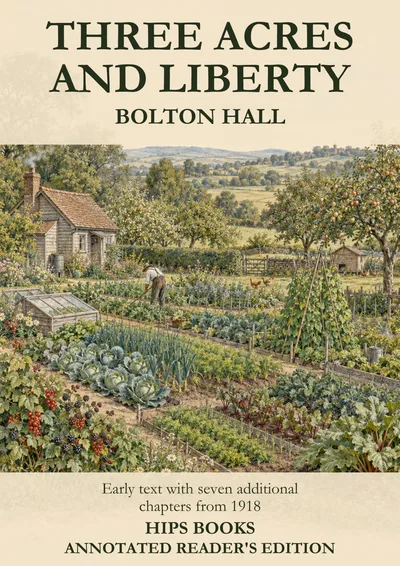
About the book
Could a small piece of land offer a different way to make a living? In Three Acres and Liberty, Bolton Hall treats that question as both a practical problem and a question about opportunity. First published in 1907, the book joins work in the garden to the cost of land, access to markets, available capital and the possibilities of cooperation.
Hall begins with where and how a person might earn a living, then considers buying a farm and cultivating vacant city lots. His examples of what an acre may produce lead into soil, methods, the kitchen garden and the tools required for different crops. Hotbeds and greenhouses, fruit and flower growing, unusual livestock and the choice of location broaden the discussion beyond a single model of farming.
The appeal is not just in the instructions. Hall is trying to persuade readers that small-scale growing can change their relationship to work and land. His reported yields, costs and successes give the book its period character, but they are not present-day financial forecasts. Read them as evidence of what the author proposed and hoped for, rather than guarantees that three acres will support a household now.
This HIPS Books edition keeps the complete twenty-one-chapter early text and its appendices. A separately headed supplement then adds seven chapters from the expanded 1918 edition. Those chapters cover the wood lot, practical experiments, experimental foods, dried produce, home cold-pack canning, retail cooperation and summer colonies for city people. The later material is clearly identified; it is not silently mixed into the early book.
Original photographs, charts and historical appendices help show the kinds of work Hall describes. New vocabulary notes explain unfamiliar gardening and economic terms, while short reader guides after the chapters help you reconsider his argument. These additions are separate from Hall’s wording. They make the book easier to follow without updating his figures or rewriting him into a modern homesteading adviser.
The book contains period assumptions about race, gender, labour and migration, as well as practical directions that may be unsafe today. It is not a current farming, construction, medical or food-preservation manual. In particular, the historical canning and plant-use passages should not be followed without current qualified guidance. Its value is as a readable record of early twentieth-century small-farm thinking: what people thought possible, how they argued for it, and where their expectations need careful scrutiny.
What this edition includes
One illustrated English-language A4 PDF, 171 pages. Includes the complete early book, its historical appendices and index, followed by seven separately identified 1918 chapters. Some complex tables and appendices remain labelled historical facsimiles.
Original illustrations, charts, vocabulary, reader guides, clickable contents, illustration links and PDF bookmarks support study and personal printing. Safety notes identify relevant historical hazards. This is a fixed-page digital edition, not a current how-to manual or a physical book. AI-assisted tools supported parts of the cover and production workflow under human direction.
Inside the book: selected contents
A reading overview, not the complete text.
- Making a Living; Present Conditions; Buying a Farm: Hall begins with land access and the economic problem facing the would-be small grower.
- Vacant City Lot Cultivation: unused urban land becomes an alternative to acquiring a distant farm.
- Kitchen gardens, tools, hotbeds and greenhouses: the middle chapters consider crops, equipment and extending production.
- Fruit, flowers, drug plants and other uses of land: a small holding is discussed as more than a vegetable patch.
- 1918 supplement: later material addresses wood lots, experiments, dried produce, canning and retail cooperation.
The period costs, yields and preservation methods belong to the historical record, not a present-day business forecast or food-safety manual.
Key concepts for reading
HIPS editorial explanations of the historical text.
- Intensive cultivation: making concentrated use of a small area through work, inputs and attention.
- Vacant-lot cultivation: growing on otherwise unused city land.
- Hotbed: a historically heated growing bed used to start or protect plants.
- Truck gardening: producing vegetables for market; “truck” here refers to market produce, not a vehicle.
- Cooperation: shared purchasing, marketing or organisation intended to reduce obstacles for individual growers.
Before you buy
How is this different from an archive scan?
An archive scan preserves photographed pages. This is a prepared reading edition: reset text and modern reading support, with the historical author’s words kept distinct. The edition details and preview pages above show what is included in this particular book.
What will I receive, and where do I buy it?
This is a digital PDF edition, not a printed book. The Etsy listing is the place to check the current PDF price and delivery details, and to complete your purchase. Payment and digital delivery are handled by Etsy. A separate Kindle edition is available through the Amazon button. Amazon handles that purchase and delivery; its layout and pagination may differ.
Can I read or print the PDF?
You can read a PDF in a compatible viewer on a computer or tablet. Check the Etsy listing and the edition’s terms for printing permissions and paper size before buying. PDF support and navigation vary by device; this is not an EPUB or a physical copy.