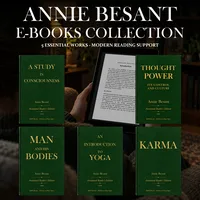
About the book
What did Annie Besant mean by yoga before it became familiar to many readers as a sequence of physical postures? An Introduction to Yoga gathers four lectures delivered at Benares on 27–30 December 1907 and first published in 1908. Their subject is the nature of consciousness and the discipline of the mind, approached through Besant’s Theosophical interpretation of Indian philosophy.
The lectures form a progression. The Nature of Yoga introduces the self and the instruments through which it acts. Schools of Thought compares philosophical explanations that must be understood before their terms can be used consistently. Yoga as Science sets out the systematic claims Besant makes for the discipline. Yoga as Practice turns towards the conditions and difficulties of attempting it.
That sequence makes the book useful to readers who meet words such as Purusha, Prakriti or samadhi in older spiritual writing and want to understand the argument around them. Besant draws on Samkhya, Vedanta and Patanjali, but her account should not be mistaken for the only Indian understanding of yoga. It is a particular historical interpretation, shaped by her work in the Theosophical movement.
This is not an illustrated exercise book, a beginner’s sequence of poses or a medical guide. The lectures include historical claims about trance, bodily control, illness, diet and unseen beings. The title Yoga as Science records Besant’s own claim to systematic knowledge; it is not a statement that every claim in the lecture has been experimentally verified.
The HIPS reading edition follows the 1908 first printing and preserves the complete Foreword and four lectures. Its newly typeset text is accompanied by vocabulary before each lecture and a guide afterwards. These additions explain difficult words, trace the argument and ask questions without rewriting Besant as a present-day wellness teacher. The original notes remain linked, and the title and contents facsimiles are labelled.
The editorial material also identifies colonial-era racial hierarchies and the defence of caste in the historical text. Preserving those passages makes them available for scrutiny; it does not validate them. Read the book for the history of ideas and its account of attention, not as permission to undertake dangerous bodily practices, abandon treatment or interpret distress as spiritual failure.
What this edition includes
172 pages; 145 × 215 mm fixed-page PDF. Complete 1908 Foreword and four lectures, modern introduction, vocabulary before each lecture, four reader guides with reflection questions, glossary and textual notes. Seven original notes have links and return links. Includes labelled original title-page and contents facsimiles and the original Lecture IV comparison table. Historical wording is retained; modern HIPS support is clearly marked. Digital PDF only, not EPUB, a printed book or an exercise programme.
Inside the book: selected contents
A reading overview, not the complete text.
- The Nature of Yoga: consciousness, the self and its vehicles.
- Schools of Thought: Besant’s comparison of Samkhya, Vedanta and the philosophical language of yoga.
- Yoga as Science: her account of method, mental states and the claims made for the discipline.
- Yoga as Practice: attention, preparation and the difficulties she associates with practice.
Key concepts for reading
HIPS editorial explanations of the historical text.
- Purusha: the conscious principle in the philosophical vocabulary Besant discusses.
- Prakriti: nature or the material principle, whose meaning depends on the school under discussion.
- Samadhi: a technical term for a state of absorption; not simply a synonym for relaxation.
- Yoga: in these lectures, a discipline of consciousness, not merely physical postures.
Before you buy
How is this different from an archive scan?
An archive scan preserves photographed pages. This is a prepared reading edition: reset text and modern reading support, with the historical author’s words kept distinct. The edition details and preview pages above show what is included in this particular book.
What will I receive, and where do I buy it?
This is a digital PDF edition, not a printed book. The Etsy listing is the place to check the current PDF price and delivery details, and to complete your purchase. Payment and digital delivery are handled by Etsy.
Can I read or print the PDF?
You can read a PDF in a compatible viewer on a computer or tablet. Check the Etsy listing and the edition’s terms for printing permissions and paper size before buying. PDF support and navigation vary by device; this is not an EPUB or a physical copy.
Read this edition
172 pages · PDF · 145 × 215 mm · download from Etsy once payment is confirmed.
Buy on Etsy