About the book
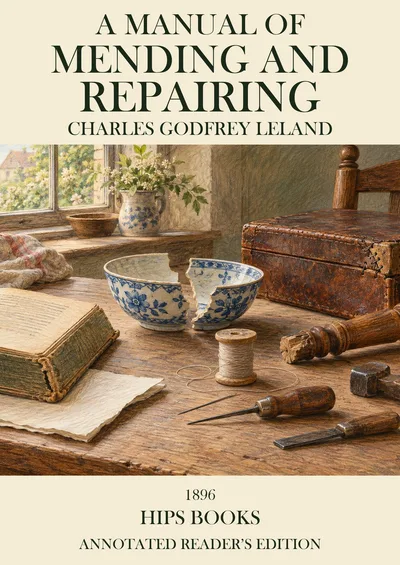
Before replacing a broken object, nineteenth-century households often tried to mend it. Charles Godfrey Leland’s A Manual of Mending and Repairing (1896) brings together the era’s ideas for repairing china and earthenware, glass, furniture, books and paper, leather and shoes, felt and clothing, and the chemistry behind its glues, pastes and cements.
Its eighteen subject chapters range from bookbinding and papier-mâché to ivory, amber, metal-work and invisible mending, with the original diagrams beside the passages they illustrate. It is a document of the older make-do-and-mend mindset, not a modern safety-tested DIY manual: historical chemical treatments are retained for study, not recommended.
This HIPS Books edition resets the 1896 text in readable, searchable type, with chapter vocabulary, reader guides and a glossary of period terms. Editorial additions and declared corrections are labelled and never presented as Leland’s words.
What this edition includes
151 A4 pages. Leland’s original introduction and all 18 subject chapters; 17 retained historical illustrations; chapter vocabulary, reader guides and a glossary of period terms; clickable contents, 65 PDF bookmarks and the original linked index; all five historical notes; modern cautions, source notes and a declared-corrections page.
Inside the book: selected contents
A reading overview, not the complete text.
- Materials and adhesives: the glues, pastes and cements behind every chapter.
- China, earthenware and glass: period methods for broken household ware.
- Wood, furniture and papier-mâché: illustrated woodwork repairs.
- Books and paper: bookbinding and paper repair, with diagrams.
- Leather, felt and invisible mending: shoes, textiles and clothing.
Key concepts for reading
HIPS editorial explanations of the historical text.
- Cement: in Leland’s usage, any strong adhesive, not only building cement.
- Invisible mending: reweaving cloth so the repair is hard to see.
- Historical recipes: chemical mixtures are reproduced for study and carry modern cautions.
Before you buy
How is this different from an archive scan?
An archive scan preserves photographed pages. This is a prepared reading edition: reset text and modern reading support, with the historical author’s words kept distinct. The edition details and preview pages above show what is included in this particular book.
What will I receive, and where do I buy it?
This is a digital PDF edition, not a printed book. The Etsy listing is the place to check the current PDF price and delivery details, and to complete your purchase. Payment and digital delivery are handled by Etsy.
Can I read or print the PDF?
You can read a PDF in a compatible viewer on a computer or tablet. Check the Etsy listing and the edition’s terms for printing permissions and paper size before buying. PDF support and navigation vary by device; this is not an EPUB or a physical copy.
Read this edition
151 A4 pages · A4 digital PDF · download from Etsy once payment is confirmed.
Buy on Etsy