Ideas & reading guides
Make Do and Mend in 1896: Leland’s Manual of Repairing
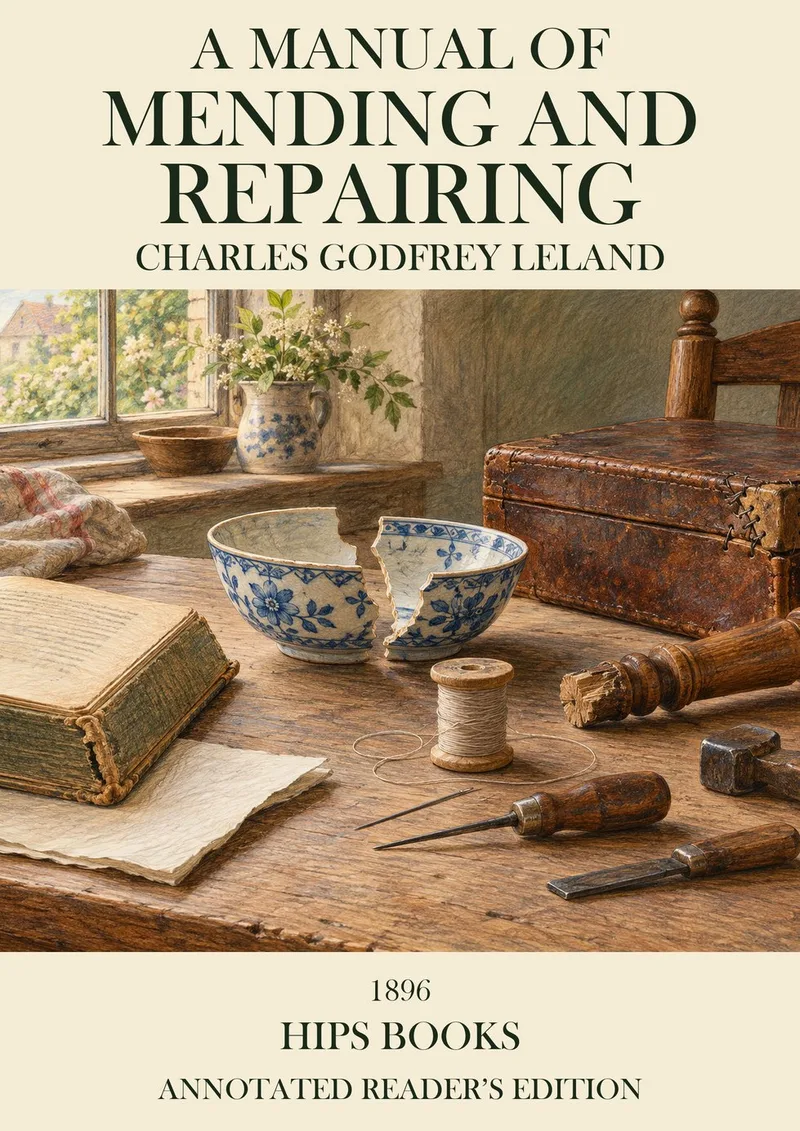
Long before "make do and mend" became a Second World War slogan, households kept things in use because replacing them was expensive. In 1896 Charles Godfrey Leland published A Manual of Mending and Repairing; With Diagrams to argue that repair deserved to be treated as a skill in its own right. This article looks at what his book covers, what makes it unusual, and how to read its recipes today.
It is a guide to a historical handbook, not a modern repair manual. Many of Leland's glues, cements and treatments use substances that are hazardous or obsolete, as explained below.
Who was Charles Godfrey Leland?
Charles Godfrey Leland (1824–1903) was an American writer, humorist and folklorist, best known for the comic Hans Breitmann ballads and for books on folklore. He was also an energetic promoter of the decorative and industrial arts, and of teaching practical handwork. A Manual of Mending and Repairing comes out of that second interest. Late in his life he wrote it partly from experience. He mentions walking in Florence and seeing worn old pottery that, with a little skill, could be restored.
Repair as an art with its own laws
Leland's introduction makes a bold claim. Mending, he says, has been treated as "a mere adjunct to other arts", but it is really an art in itself, even a science, because it rests on chemical principles that can be learned and combined. Earlier books, in his view, offered only scattered tricks for particular cases. He wanted to show the general rules.
He also had a practical and social point. Every household breaks things, and few people know how to mend anything except with common glue that soon fails. He suggests that repair could be taught cheaply, as an introduction to technical education. He even argues that a person with a little ingenuity could make a living by repairing things, as the street umbrella-menders and chair-caners did.
What the book covers
The eighteen subject chapters move across almost every material a nineteenth-century home contained:
- Materials used in mending: the glues, pastes and cements behind the rest of the book.
- China, earthenware and glass: broken household ware, among the most common repairs.
- Wood-shavings and woodwork: split wood, frames and furniture, with diagrams.
- Books, manuscripts and papers: bookbinding and paper repair, including folding patterns.
- Papier-mâché, stone-work, ivory and amber.
- Indiarubber, gutta-percha and metal-work.
- Leather, felt hats and blankets, and invisible mending of cloth.
- Mother-of-pearl and coral, pictures, and a closing chapter of general recipes.
Seventeen original diagrams show techniques such as supporting a book during binding, repairing a split board and overlapping leather edges.
Reading the recipes safely
Leland was confident in his chemistry, and he says his recipes are tested rather than copied from old housekeeping manuals. That confidence is part of the book's historical interest. It does not make the recipes safe or suitable today. The manual predates modern product labelling, exposure limits and conservation practice. Some of its mixtures involve toxic, flammable or corrosive substances, and some treatments would now be considered damaging to valuable objects.
Read the book for:
- the logic of repair: what failed, what will bond to it, and how to support the join while it sets
- material history: what substances were available and trusted in the 1890s
- attitudes: the value placed on keeping objects in use
For real repairs, use modern products according to their instructions. Valuable or antique objects should go to a professional conservator.
Why it still matters
Interest in repair is growing again, from repair cafés to visible mending. Leland's manual is an early, articulate statement of the same idea: that a broken object is often a problem to be solved rather than rubbish. It also shows how much practical knowledge ordinary households once held, and how much of it depended on materials we now handle very differently.
The HIPS edition keeps all eighteen chapters and the seventeen diagrams. It adds vocabulary for period material names and labelled modern cautions. The book is also part of the Self-Reliance Library, alongside The Amateur Carpenter (1915).
Sources and edition notes
- Primary text: Charles Godfrey Leland, A Manual of Mending and Repairing; With Diagrams (New York: Dodd, Mead and Company, 1896), especially the original Introduction and the chapter list, as prepared in the HIPS annotated edition.
- Quotations are from Leland's introduction. Biographical dates and his best-known works are standard reference facts about the author.