Ideas & reading guides
Marie Countess of Caithness: The Mystery of the Ages
Marie, Countess of Caithness, was a nineteenth-century writer who tried to read the religions of the world as different languages for one spiritual wisdom. Her 1887 book, The Mystery of the Ages, brings together Christianity, Hermeticism, Kabbalah, Hindu and Buddhist material, Greek philosophy and the ideas circulating in early Theosophy. It can be a difficult book. Her life makes its purpose much easier to see.
Caithness was not simply collecting curious old beliefs from a distance. She was active in the spiritual and Theosophical circles of her time. A historical study describes her as Marie Mariategui (1830-1895), an important early Theosophical participant and a close friend of Helena Blavatsky and Henry Steel Olcott. She was also a committed Roman Catholic and a reader of Allan Kardec, whose Spiritist writings defended reincarnation. In 1883, she became the first president of the Societe Theosophique d'Orient et d'Occident in Paris. Theosophical History's introduction to Joscelyn Godwin's study.
That combination matters. Marie did not set out to abandon Christianity for a new religion. She wanted to uncover what she believed was the inner meaning of Christianity and to place it beside other religious and esoteric traditions. Historian Joscelyn Godwin calls her a "rebuilder": someone who read the Bible and Christian sacraments as symbols rather than only at their most literal level. Godwin's publication note.
This is the best starting point for reading The Mystery of the Ages. It is a passionate nineteenth-century argument, not a neutral textbook on world religion. Marie believed that resemblances between traditions revealed a shared divine wisdom. Modern historians usually need much stronger evidence before treating similar stories as proof of a common origin. Both things can be true at once: the book is historically of its time, and it still offers an interesting way to ask what religious symbols mean to a reader.
The book in one simple idea
The full title, The Mystery of the Ages: Contained in the Secret Doctrine of All Religions, tells you Marie's goal. Published in London in 1887, the book proposes that religious traditions differ outwardly but preserve related insights about human transformation. Bibliographic record.
Her recurring question is simple: what if stories about fall and return, death and rebirth, darkness and light, or salvation and liberation are not only stories about events outside a person? What if they can also describe changes within a person?
Marie answers that question through an old Hermetic pattern: the microcosm and the macrocosm. The word microcosm means a small world; macrocosm means the larger world or universe. In her reading, a human being is a small-scale reflection of the whole. To understand the universe is therefore also, in some sense, to understand the self.
This is why the book moves so quickly among Egyptian myths, Christian imagery, Kabbalah, Greek philosophy and Asian traditions. Marie thinks they are different symbolic maps of a similar journey: a person becomes caught in ignorance and self-centred desire, then gradually turns toward wisdom, love and a deeper sense of the divine.
You do not need to agree with that historical claim to understand the book. It is enough to see the method. When Marie compares two traditions, she is usually asking, "Could these images be speaking about the same inner change?" That is an interpretive question, not proof that the traditions came from one secret school.
A writer at the meeting point of several movements
Marie belonged to a period when European writers were intensely re-reading religion, psychology, science and ancient texts. Spiritualism, the study of communication with spirits; Theosophy, a modern movement that looked for wisdom across religions; and esoteric Christianity, an inward reading of Christian symbols, often met in the same rooms and books.
Her earlier book, Old Truths in a New Light (1876), already shows the shape of her project. Its title is almost a summary of her approach: she did not think she was inventing a new religion. She believed that old spiritual truths had become hard to recognize and needed a new interpretation. The University of Pennsylvania's online catalogue lists both that 1876 work and The Mystery of the Ages among her publications. Online Books Page.
Her engagement with Theosophy was real, but it should not flatten her into a copy of Blavatsky. She had her own combination of Catholic symbolism, Kardec's belief in reincarnation, spiritualism and comparative religion. The first article in this series on Theosophy explains the wider movement and why people such as Blavatsky, Anna Kingsford and Caithness were connected without teaching exactly the same thing.
The point is not to label Marie with as many movements as possible. It is to see why she could put Christianity, Hermeticism and reincarnation in the same book without feeling that they cancelled one another out. For her, they were possible paths toward what she called divine wisdom.
What is the sevenfold diagram?
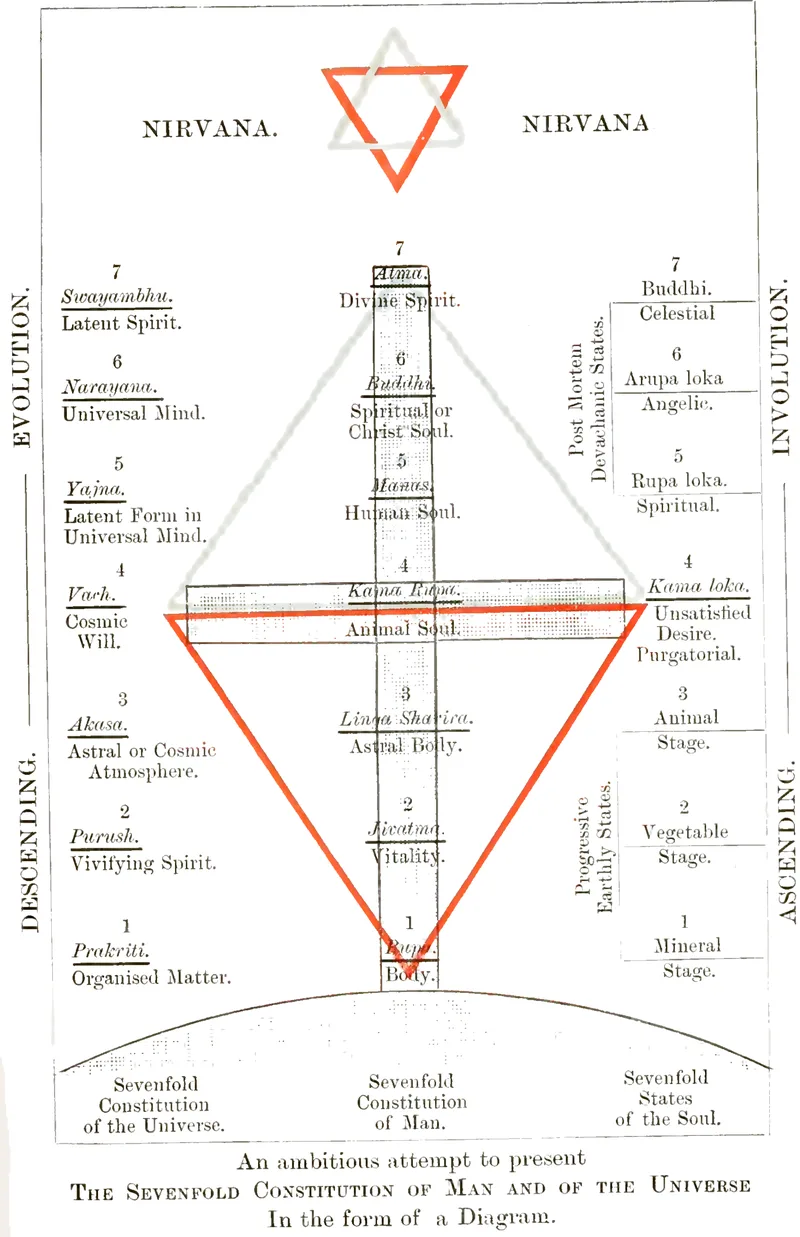
The sevenfold diagram is one of the clearest windows into Marie's way of thinking. It is also easy to misread. It is not a scientific chart of the body, the brain or the universe. It is a nineteenth-century Theosophical map, designed to show correspondences between the universe, a human being and the soul's supposed spiritual states.
Marie is unusually open about where part of it came from. Before presenting the diagram, she says that the sevenfold "Constitution of Man" is drawn from A. P. Sinnett's Esoteric Buddhism. She adds her own parallel material: a sevenfold constitution of the universe and a set of spiritual states of the soul. Caithness, The Mystery of the Ages, "Esoteric Buddhism". Sinnett's book had presented a closely related seven-part account of the person a few years earlier. Sinnett, Esoteric Buddhism.
In other words, the plate is best understood as Marie's synthesis. She uses it to make a visual argument: the human being is a microcosm, and the same ordered pattern appears at different scales.
The central column concerns the person. Here it is in plain English, with the historical Sanskrit labels retained only where they help readers recognize the original diagram:
| Level in the diagram | Marie's label | Plain-English reading |
|---|---|---|
| 1 | Rupa, the body | The visible physical body. |
| 2 | Jivatma, life-principle or vitality | The life force that she believed animated the body. |
| 3 | Linga Sharira, astral body | A subtle or invisible form, in the system's own terms. |
| 4 | Kama Rupa, animal soul or will | Desire, impulse and self-will: the turning point of the diagram. |
| 5 | Manas, human soul or mind | Reflective thought, understanding and self-awareness. |
| 6 | Buddhi, spiritual soul | Spiritual insight, conscience and a less self-centred love, in Marie's interpretation. |
| 7 | Atma, divine spirit | The highest, divine principle in the system. |
The table is not asking us to imagine seven little objects stacked inside the body. It is a hierarchy of functions and possibilities, from material life to what Marie calls divine spirit. Her own text numbers the levels from the outside inward: the body is the outermost layer, while the highest principle is the hidden centre.
Why level four matters so much
The most helpful way to approach the diagram is not to memorize all seven names. Start with level four: Kama Rupa, which Marie calls the animal soul or will.
It sits in the middle. Three levels are placed below it, and three above it. Marie calls it the axis around which character turns. In everyday language, her point is that a life can be directed by appetite, fear and self-interest, or it can be educated by understanding and shaped by care for something beyond the self.
That is the human drama the picture is trying to express. The lower levels stand for embodiment, vitality and desire. The higher levels stand for thought, wisdom and spirit. The middle is where direction becomes a question. What do you love? What do you choose? In Marie's model, those questions matter more than collecting unusual information about hidden worlds.
The diagram makes this visual through a cross and two triangles. Marie interprets the upward movement as a lower or earthly nature rising, and the downward movement as heavenly wisdom coming toward it. When the two meet, she sees a union of spirit and matter, human effort and divine help. This is her religious symbolism, not a factual map of how consciousness works.
The words can sound remote, but the basic reading is familiar. A person may be pulled by immediate wants and still be capable of reflection, compassion and moral change. Marie turns that familiar experience into a grand cosmic picture.
What the diagram does — and does not — explain
The diagram tries to join together several big questions:
- What is a human being?
- How does a person change?
- How does the small world of a person relate to the large world of nature and spirit?
- What might happen to the soul after death?
It does this through correspondences. The plate aligns a sevenfold human being with a sevenfold universe and with a sequence of soul states. It also places Nirvana above the seven levels, as the completion of the journey in Marie's reading. Her terms for post-mortem states, cosmic evolution and invisible bodies belong to the Theosophical worldview she was using; they are not conclusions of modern medicine, neuroscience or the academic study of religion.
That boundary is important because the book sometimes moves rapidly from poetic symbolism to confident claims about ancient history or physical processes. A good modern reading does not need to choose between uncritical belief and dismissal. You can ask what a symbol is doing while also asking what evidence would be needed for a historical or scientific claim.
For example, the lower-to-higher movement can be read as an ethical picture of human development: instinct becomes self-awareness; self-awareness can become wisdom; wisdom becomes less possessive and more compassionate. That is an interpretation a reader can consider without having to accept a literal astral body or a seven-layer universe.
How to read The Mystery of the Ages today
Marie, Countess of Caithness is most interesting when we let her be specific. She was neither merely a collector of strange ideas nor a modern historian of religion. She was a nineteenth-century Christian mystic and esoteric writer who thought many traditions carried signs of one divine wisdom. Her book turns that conviction into a method of reading: look for the inward journey beneath the surface story.
That method has limits. Similar motifs do not, by themselves, prove a shared origin. Her translations and historical sources belong to her time, and some of her comparisons will look too quick to a modern specialist. But the central question remains alive: can religious stories also be read as stories of attention, desire, conscience and transformation?
If you approach The Mystery of the Ages with that question in mind, the sevenfold diagram stops being a puzzling page of names. It becomes the book in miniature. Matter, life, desire, mind, wisdom and spirit are arranged as one possible map of a human life moving toward a more generous and conscious centre.
For the historical text alongside modern reading guides and reflection questions, see our annotated edition of The Mystery of the Ages. You may also want to read our introductions to Hermeticism and Theosophy before returning to the book's longer comparisons.