About the book
The Mystery of the Ages is Marie, Countess of Caithness’s ambitious 1887 work of comparative esotericism. It reads Hindu, Buddhist, Egyptian, Greek, Jewish, Islamic and Christian sources as different symbolic expressions of a shared interior wisdom. Theosophy, Kabbalah, Sufism, Gnosticism, Hermeticism, regeneration and the relation between soul and cosmos form its recurring themes.
The historical argument is a product of the nineteenth-century Theosophic and Hermetic revival, not a neutral history of religions. Caithness uses myths, sacred texts, planets, numbers and religious figures as a symbolic grammar for consciousness and spiritual transformation. This reader’s edition helps readers follow that method while keeping historical claims, symbolic interpretations and modern editorial material distinct.
Twelve Editorial Reader’s Guides introduce the original chapters with orientation, key ideas, vocabulary notes, critical questions and prompts for reflection. A thematic map, annotated glossary and five reading paths make this long comparative work easier to navigate without rewriting the author’s own argument.
What this edition includes
Includes a new editorial introduction, thematic map, twelve chapter guides, definitions, critical-reading notes, reflection questions, an annotated glossary, five reading paths, linked navigation and restored historical diagrams.
Inside the book: selected contents
A reading overview, not the complete text.
- Chapters I–II: the opening establishes Caithness’s search for divine wisdom and inward spiritual change.
- Chapters III–IV: Hermetic myth and Egyptian-Gnostic interpretation supply symbolic connections.
- Chapters V–VI: Asian and Druidic materials lead into Buddhist cosmology and sevenfold accounts of human nature.
- Chapters VII–IX: Greek and Roman religion, Kabbalah, Islam and Sufism become further stages of her comparison.
- Chapters X–XII: Christianity, biblical allegory and the conclusion return to the soul, regeneration and Nirvana.
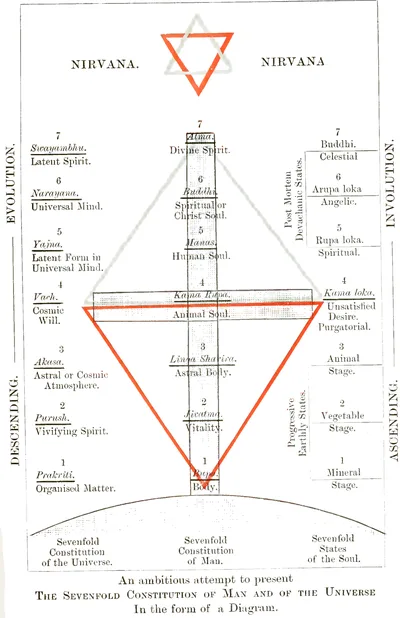
The book’s sevenfold diagram should be read as a map of Caithness’s proposed correspondences, not as proof that all traditions teach an identical system.
Key concepts for reading
HIPS editorial explanations of the historical text.
- Theosophy: divine wisdom in Caithness’s broad religious usage; it does not always mean membership in the modern society.
- Regeneration: the inward transformation she presents as the purpose of spiritual reading.
- Sevenfold constitution: a model of human nature divided into seven principles or levels.
- Allegory: a reading that treats a story’s persons and events as signs of an inward process.
- Correspondence: her proposed links between numbers, planets, symbols and faculties of the soul.
A sample from the reader’s guide
Modern HIPS editorial material — not the historical author’s words.
The book’s many traditions are held together by a single claim. Divine Wisdom is universal, but it appears under changing names, images, and institutions. The author uses the word Theosophy in its broad older sense of divine wisdom or knowledge of God, not merely as the name of one modern organization. For her, a true theosophist is a person who seeks direct spiritual knowledge and moral transformation.
Excerpt: HIPS Editorial Introduction, “The Central Thesis,” page 4 of the supplied 307-page edition.
Before you buy
How is this different from an archive scan?
An archive scan preserves photographed pages. This is a prepared reading edition: reset text and modern reading support, with the historical author’s words kept distinct. The edition details and preview pages above show what is included in this particular book.
What will I receive, and where do I buy it?
This is a digital PDF edition, not a printed book. The Etsy listing is the place to check the current PDF price and delivery details, and to complete your purchase. Payment and digital delivery are handled by Etsy. A separate Kindle edition is available through the Amazon button. Amazon handles that purchase and delivery; its layout and pagination may differ.
Can I read or print the PDF?
You can read a PDF in a compatible viewer on a computer or tablet. Check the Etsy listing and the edition’s terms for printing permissions and paper size before buying. PDF support and navigation vary by device; this is not an EPUB or a physical copy.