Ideas & reading guides
The Hidden Way Across the Threshold: J. C. Street Explained
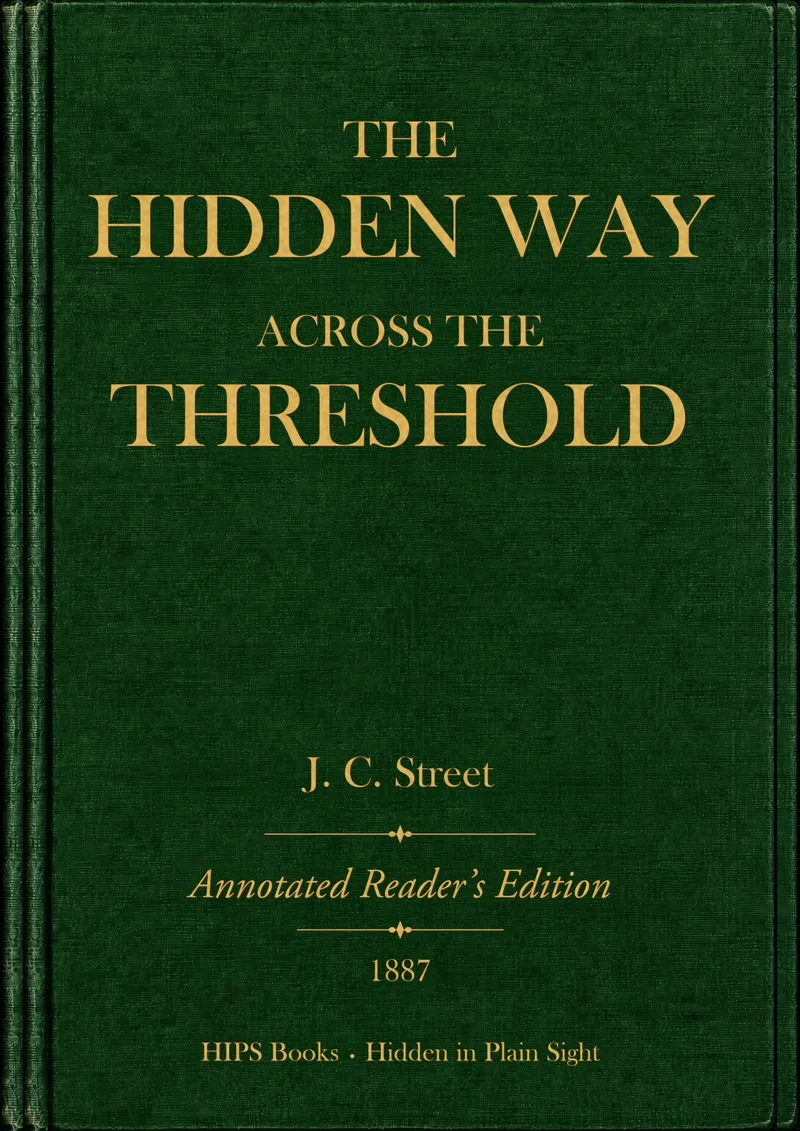
What would it mean to discover a spiritual life within the life you already lead? That question runs through The Hidden Way Across the Threshold. First published in 1887, J. C. Street’s book explores the soul, spiritual development and the unseen world. Publication reference: The Sabian Manual.
The title suggests a doorway into something mysterious. Street certainly writes about hidden powers, spirit communication and life after death. Yet he continually brings the reader back to ordinary conduct: the thoughts we encourage, the desires we follow and the care we show other people.
This gives us a useful way into a sometimes difficult book. As its ideas grow more elaborate, one question helps hold them together: what kind of person does this spiritual knowledge help someone become?
Who was J. C. Street?
J. C. Street is easier to approach through his writing than through a detailed biography. A later history published by Fraternitas Rosæ Crucis identifies him as John C. Street, a physician associated with Boston and Brooklyn. This is an account from within a Rosicrucian organisation, however, and it provides little independently checkable detail about his life. It should be read as that organisation’s account, rather than a complete scholarly biography. Fraternitas Rosæ Crucis: John C. Street.
Street’s own introduction presents him as a student of occult teachings and a medium. He describes encounters with spiritual teachers and attributes his understanding to years of study and experience. These statements tell us how he understood his work; they do not, by themselves, verify his claims about hidden masters or spiritual abilities.
He is also unusually frank about how he assembled the book. In the introduction to the third edition, he describes a compilation drawn from many minds and acknowledges that some borrowed passages had lost their credits or quotation marks.
That matters when reading him. The book moves between teachings, quotations, personal reflections and moral advice. Its changes of voice become less puzzling once we understand how it grew. Street gathered material that expressed his spiritual outlook; he did not arrange it into one tightly organised argument.
What is The Hidden Way Across the Threshold about?
The book explores a distinction between outward life and inward awareness. Outwardly, people are occupied with possessions, ambitions, bodily sensations and social approval. Street believes that beneath these concerns lies a spiritual nature that can be gradually recognised and developed.
His “hidden way” is the process of turning towards that deeper life. The threshold also carries the meaning of death and passage into another state of existence. These meanings belong together in his thinking: how we live now prepares us for what he believes comes afterwards.
The chapter called “The Temple Within” gives this idea one of its clearest expressions. Street places spiritual life within the person, connecting it with conscience, self-knowledge and the cultivation of character. Religious language becomes a way of describing an inward change that should affect everyday behaviour.
The book’s eighteen chapters develop this outlook through discussions of the soul, the astral body, sacred symbols, prayer, mediumship and immortality. Some passages are reflective and devotional; others make sweeping claims about the structure of the universe. Reading slowly helps distinguish these different kinds of writing.
Why character matters more than unusual experiences
The opening chapter, “From Night to Light,” gives love a central place in spiritual life. As the book unfolds, Street returns to patience, generosity, restraint and freedom from selfish motives.
His concern is that an interest in hidden knowledge can become another form of vanity. A person may want powers, impressive experiences or the feeling of being more advanced than everyone else. Street repeatedly questions whether that desire leads to genuine growth.
He makes a related distinction when discussing mediumship. He accepts spirit communication, but warns against remaining absorbed in phenomena without progressing beyond them. In his view, an extraordinary experience has limited value if it leaves someone’s character unchanged.
A present-day example can make his concern easier to recognise. Someone might spend hours studying spiritual systems while remaining impatient or unkind at home. Street’s emphasis asks that reader to bring the study back into daily life: how does it affect the next disagreement, disappointment or opportunity to help?
This is an interpretation of the book’s ethical thread, not a claim that Street was writing modern psychology. His moral teaching belongs to a spiritual worldview that he takes seriously.
The astral body and the unseen world
That worldview becomes more unfamiliar in the chapter on the astral body.
Street describes a subtle vehicle connecting the soul with bodily life. He uses it to explain experiences and possibilities that he believes the physical body alone cannot account for, including dreams, psychic impressions and survival beyond death.
In simple terms, the astral body is part of his answer to a question: if a person is more than a physical organism, how do the spiritual and bodily parts relate?
This is a historical occult explanation, not an established anatomical description. Street’s broader discussions of spiritual forces and mental healing likewise should not be treated as scientific demonstrations or medical advice.
Keeping that distinction clear makes the book easier to explore thoughtfully. We can ask what an idea means within Street’s system, what experience it is trying to explain and what evidence would be needed to accept it literally. We do not have to settle all three questions in the same way.
What do the sacred symbols mean?
Street uses symbols to give visible form to these relationships between spirit and matter. In “Sacred Symbols,” crosses, triangles and circles become pictures through which he interprets spiritual life.
One example is the pair of interlaced triangles. He connects them with the descent of spirit into matter and its return towards spiritual life. The design holds these movements together in one image.
A serpent forming a circle around the figure suggests continuity and eternity. Street also gives importance to an unseen centre within the six-pointed design, treating it as a spiritual principle behind the visible form.
These explanations help us read his illustrations, but they remain his interpretations. A similar shape appearing in different traditions does not automatically prove that those traditions share an identical teaching or origin.
The symbols also return us to the book’s practical concern. Street wants the reader to contemplate the relationship between inner and outer life: how spiritual aspirations might find expression in a person’s actions.
Christian mysticism, Theosophy and Street’s search for common ground
Christian language is woven throughout the book. Street writes about divine love, rebirth, the soul and the temple within. He reads these ideas as descriptions of spiritual transformation and connects them with teachings he draws from other traditions.
This makes esoteric Christianity a useful term for approaching his work: Christianity interpreted through inward experience and hidden or symbolic meanings. It does not mean his interpretations represent Christianity as a whole.
Readers familiar with Theosophy and the Theosophical Society will recognise related interests in spiritual evolution, subtle aspects of human nature and connections between religions. That overlap is useful context, but it should not be turned into an unsupported claim about Street’s membership or position in the Society.
There is also a helpful comparison with Marie, Countess of Caithness and The Mystery of the Ages. Both books invite readers to look beneath outward religious forms for a deeper spiritual meaning. Street’s repeated emphasis on character and inward training gives his own compilation a distinctive focus.
How to read the book today
For a first encounter, it helps to follow the ethical thread before trying to understand every occult term. These chapters offer useful starting points:
| Start with | What to look for |
|---|---|
| I. From Night to Light | Why love, motive and discernment matter to Street |
| XIII. The Great Mystery; or, The Hidden Way | The relationship between love, intuition and will |
| XVI. The Temple Within | How spiritual life connects with conscience and character |
| VI. The Astral Body | The less familiar model of human nature behind his teaching |
It is also worth knowing that the book attracted criticism from within the occult world. An August 1887 review in The Path accused it of extensive unacknowledged borrowing. Street’s own admission about missing credits makes this a real issue to keep in mind, rather than a criticism to dismiss. The Path, August 1887, pp. 159–160.
Later readers could value it differently. Marc Edmund Jones included the book in The Sabian Manual as a work suited to meditative reading. He also recognised its mixture of material and its interest in spirit communication. The Sabian Manual, “The Occult Literature”.
Together, these responses suggest a balanced approach: read it as a historical compilation to reflect on and question. Notice when Street is offering ethical guidance, interpreting a symbol or making a claim about an unseen reality. Each calls for a different kind of attention.
The HIPS Books annotated reader’s edition of The Hidden Way Across the Threshold pairs the historical text with clearly labelled editorial guidance and reflection questions to support that reading.
Its most accessible question can stay with us even when the cosmology becomes difficult: what does our search for spiritual understanding change about the way we live?