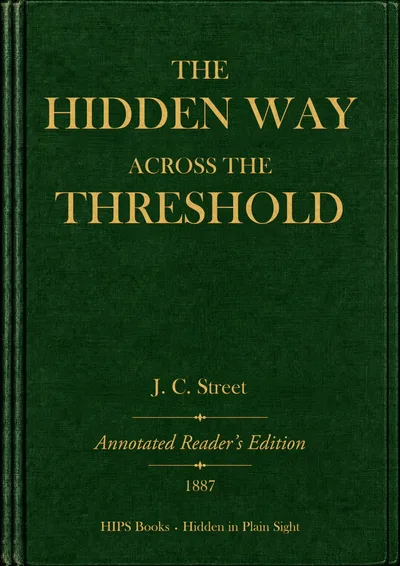
About the book
The Hidden Way Across the Threshold is J. C. Street’s 1887 compilation of late-nineteenth-century spiritualist and occult thought. Across eighteen chapters, it considers divine love, sacred symbols, the soul, astral body, mediumship, spiritual gifts, evolution and involution, the temple within, death and the threshold. It draws on Pythagorean, Hermetic, Christian, Theosophical and spiritualist traditions.
Street’s writing is an historical document of its era, full of spiritual claims, symbolic correspondences and speculative science. The reader’s edition preserves that voice while making its structure easier to follow. It does not present the book’s historical, medical, scientific or religious assertions as current professional advice or settled scholarship.
Every chapter is followed by a clearly marked Editorial Reader’s Guide with a summary, key ideas, historical vocabulary, a critical-reading lens and reflection questions. These new additions help readers assess unusual claims with care while following the book’s continuing concerns with love, moral discipline, discernment and inner transformation.
What this edition includes
Includes the historical front matter and all nine listed illustrations, linked contents and illustration list, eighteen chapter-level Editorial Reader’s Guides, a glossary and clearly separated modern editorial material.
Inside the book: selected contents
A reading overview, not the complete text.
- From Night to Light: Street opens with spiritual love, moral growth and a proposed middle path between denial and uncritical belief.
- Sacred Symbols: crosses, triangles and other inherited images become ways of discussing inner life.
- Soul and Spirit Soul; The Astral Body: read Street’s distinction between bodily existence and the spiritual dimensions he believes surround it.
- A World’s Religion; Adept, Seer, and Mediumship: comparative religious ideas meet the vocabulary of nineteenth-century spiritualism.
- Evolution and Involution; The Temple Within; Across the Threshold: later chapters return to spiritual development, inward discipline and the meaning Street gives to death.
The historical text has eighteen chapters. These are selected landmarks, not a modern account of psychology or science.
Key concepts for reading
HIPS editorial explanations of the historical text.
- Correspondence: Street reads visible images as signs of invisible spiritual relationships. A resemblance is not proof of a shared historical origin.
- Astral body: his proposed subtle counterpart to the physical body; a historical occult belief, not an established anatomical structure.
- Mediumship: the claimed communication of messages from spirits through a person.
- Illumination: spiritual insight that Street connects with charity, patience and self-command.
- Involution: an inward or descending movement paired with evolution in his spiritual account of life.
A sample from the reader’s guide
Modern HIPS editorial material — not the historical author’s words.
Street opens with Love as the governing principle of spiritual life. He criticizes religious exclusiveness and materialism alike, then treats the natural world, ancient temples, moral character, and inward illumination as evidence that life has a spiritual direction.
The chapter repeatedly asks the reader to take a middle path: neither cold denial of spiritual experience nor reckless fascination with it. For Street, the test of insight is whether it enlarges charity, patience, self-command, and practical love.
Excerpt: HIPS Editorial Reader’s Guide — Chapter I, page 29 of the supplied 489-page edition.
Before you buy
How is this different from an archive scan?
An archive scan preserves photographed pages. This is a prepared reading edition: reset text and modern reading support, with the historical author’s words kept distinct. The edition details and preview pages above show what is included in this particular book.
What will I receive, and where do I buy it?
This is a digital PDF edition, not a printed book. The Etsy listing is the place to check the current PDF price and delivery details, and to complete your purchase. Payment and digital delivery are handled by Etsy. A separate Kindle edition is available through the Amazon button. Amazon handles that purchase and delivery; its layout and pagination may differ.
Can I read or print the PDF?
You can read a PDF in a compatible viewer on a computer or tablet. Check the Etsy listing and the edition’s terms for printing permissions and paper size before buying. PDF support and navigation vary by device; this is not an EPUB or a physical copy.